Kochi in a Day - Laundry, Murals and Kathakali
After flying to Kochi yesterday, today was set aside for a tour around the city before we board the riverboat tomorrow. Kochi turned out to be far larger and more developed than I expected, a busy, spread-out place where modern India sits alongside layers of Portuguese, Dutch and British history.
If today’s account feels a little like a tick-box exercise, that’s probably because it was. We moved quickly from place to place, guided efficiently from one stop to the next, although we did manage to find a little time to wander on our own later in the afternoon.
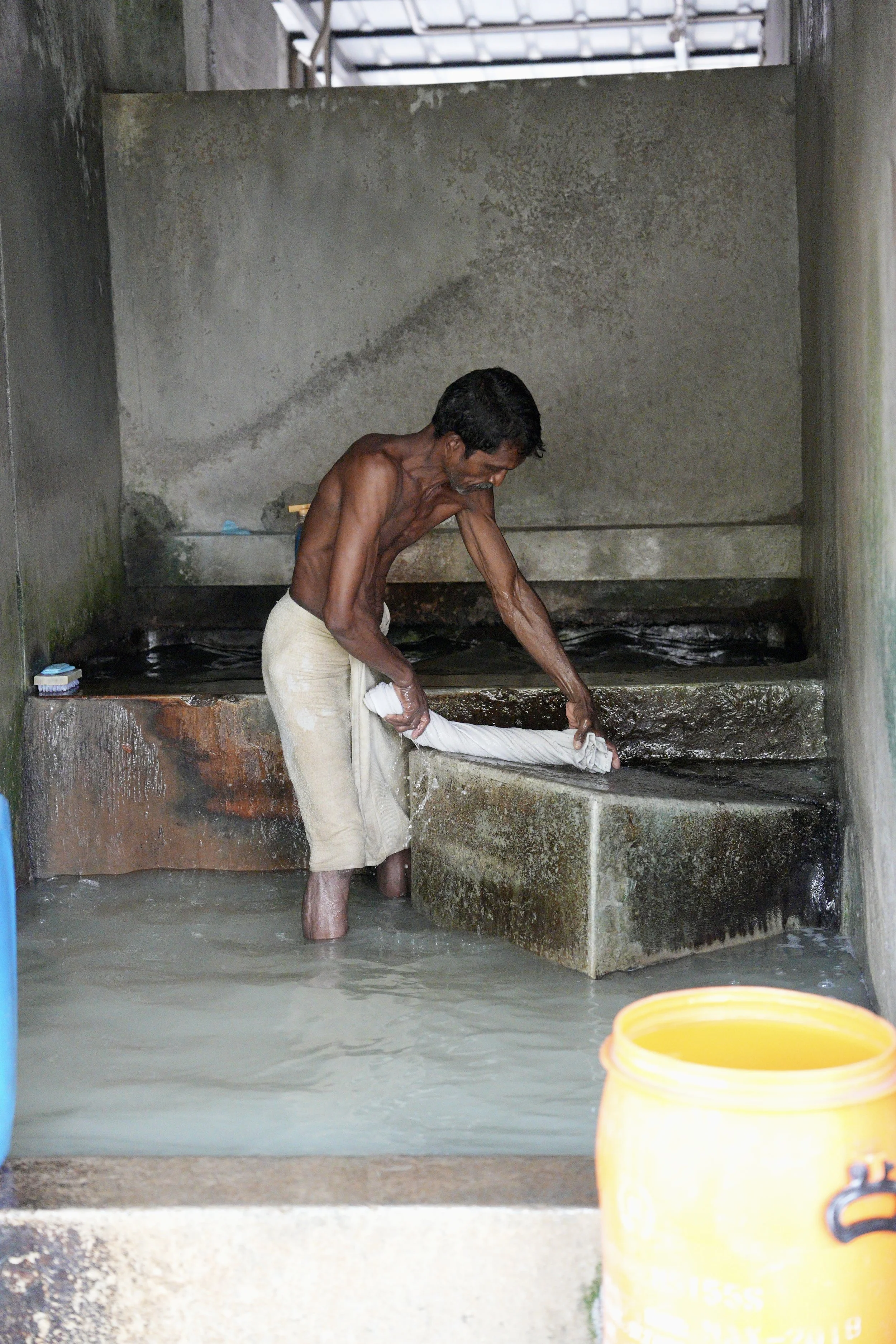
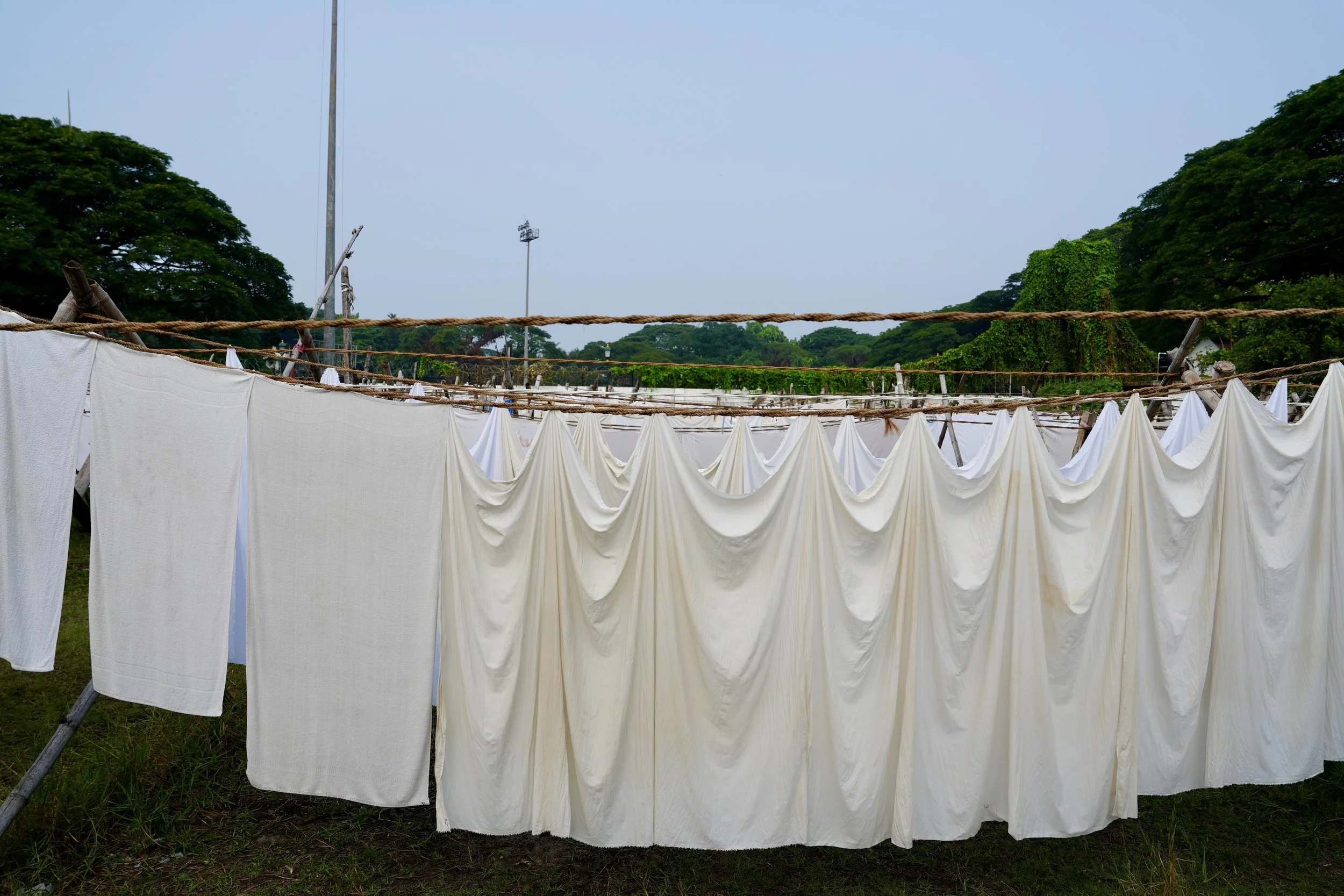
Our first visit was to the Dhobi Khana, a smaller version of the vast open-air laundry we saw in Mumbai, but with a much more local, almost village-like feel. Inside the long, low buildings men worked methodically at stone washing blocks, beating and rinsing clothes in cloudy water tanks before wringing them out by hand. Others stood at wooden tables folding perfectly pressed white shirts into neat stacks. Outside, lines of washing stretched across the grass in every direction, trousers, shirts and sheets hanging in careful rows supported by bamboo frames.
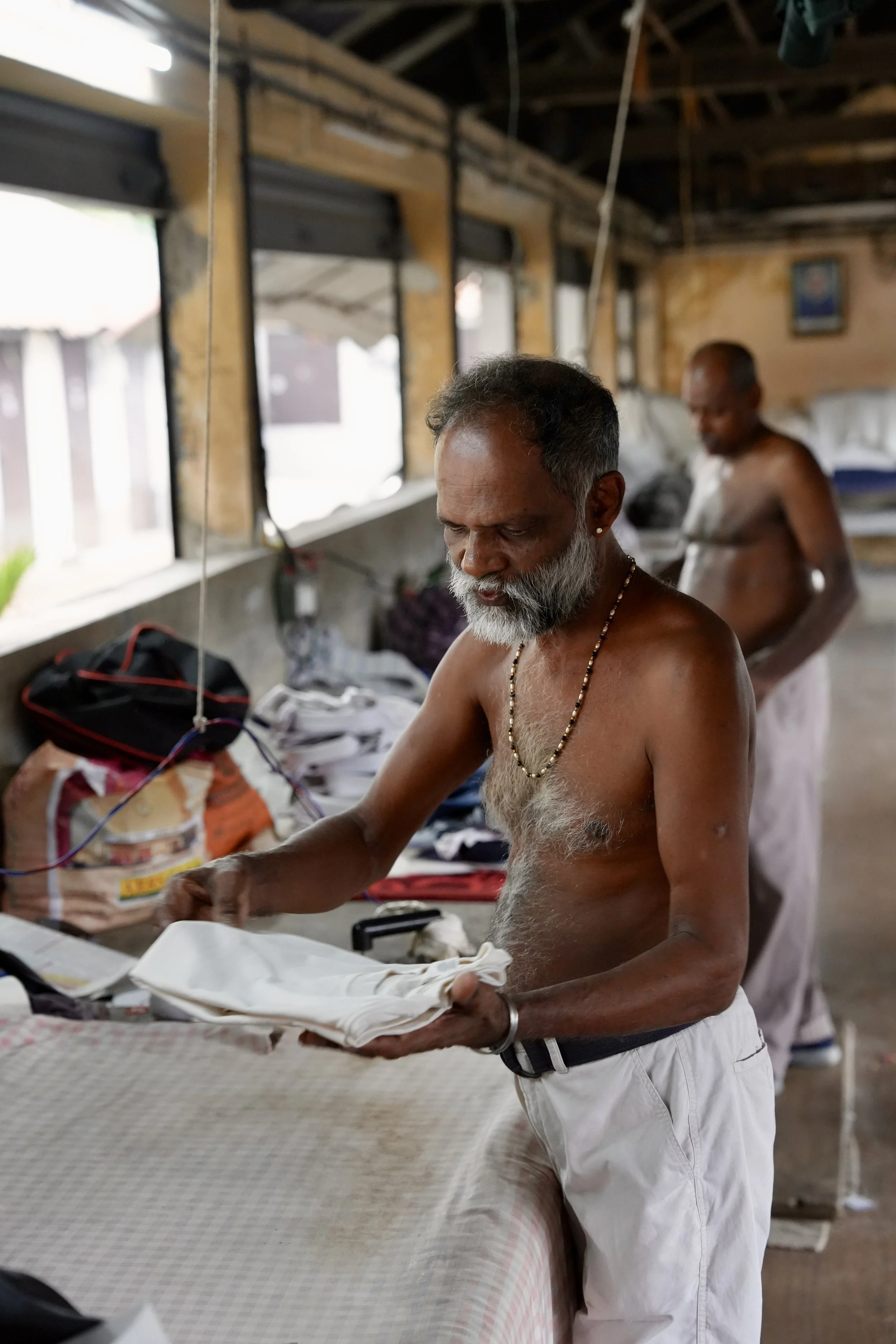
Worker at the Dhobi Khana, Kochifort
Unlike Mumbai, this one felt more aware of visitors. Some of the workers smiled and paused slightly as cameras appeared, as if they had long ago accepted that their daily routine had become part service, part demonstration. It still felt authentic, just a little less chaotic, a little more contained.
From there we moved on to David Hall, which despite the name is not a person but an old Dutch bungalow now used as an art space. The building itself was as interesting as the exhibition, thick whitewashed walls, deep verandas and wooden shutters opening onto a shaded courtyard. Inside, contemporary artwork from the Kochi arts festival filled the rooms, an unexpected contrast to the colonial architecture. It was only a short stop, but one that hinted at how much culture sits quietly beneath the surface of this city.
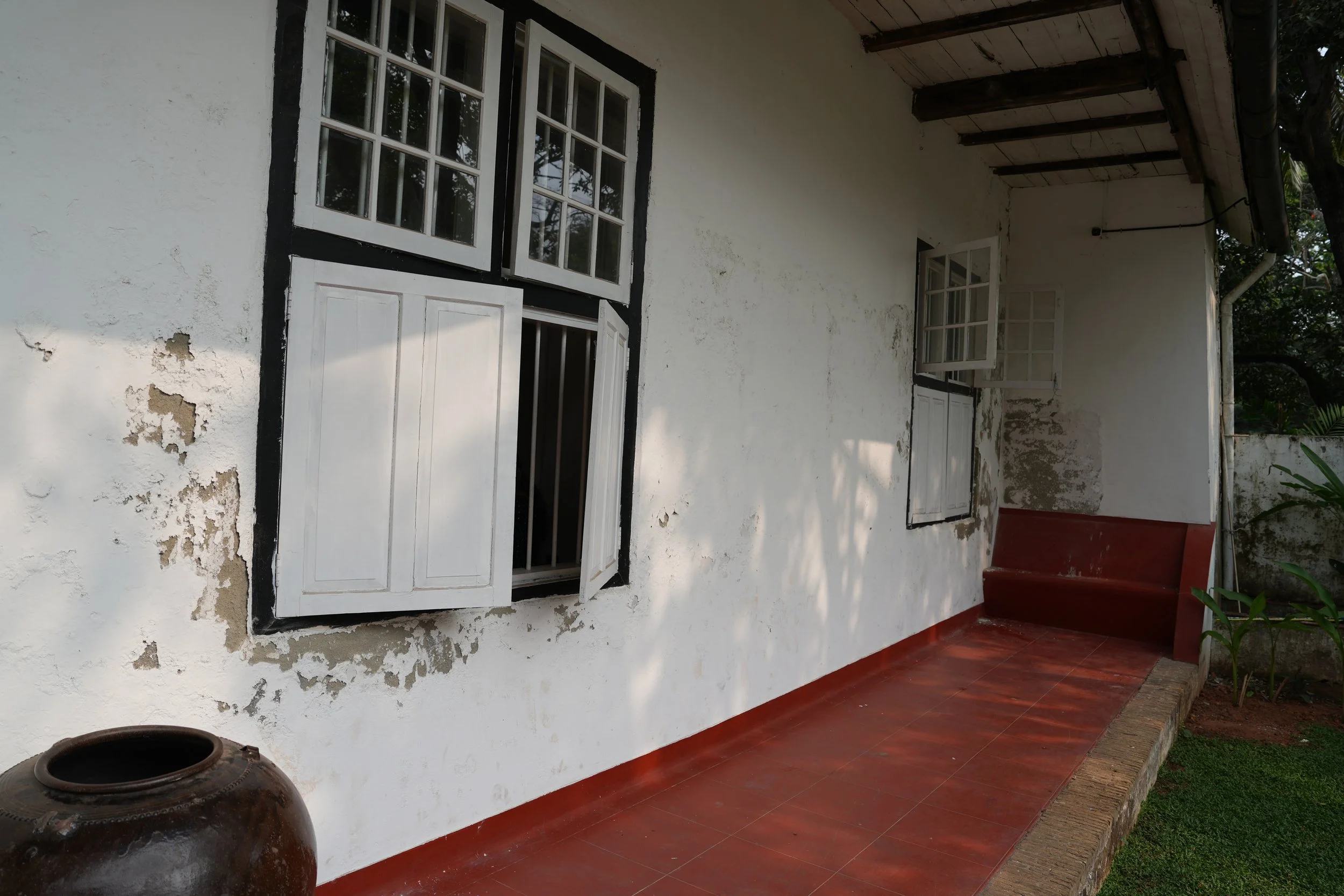
David Hall
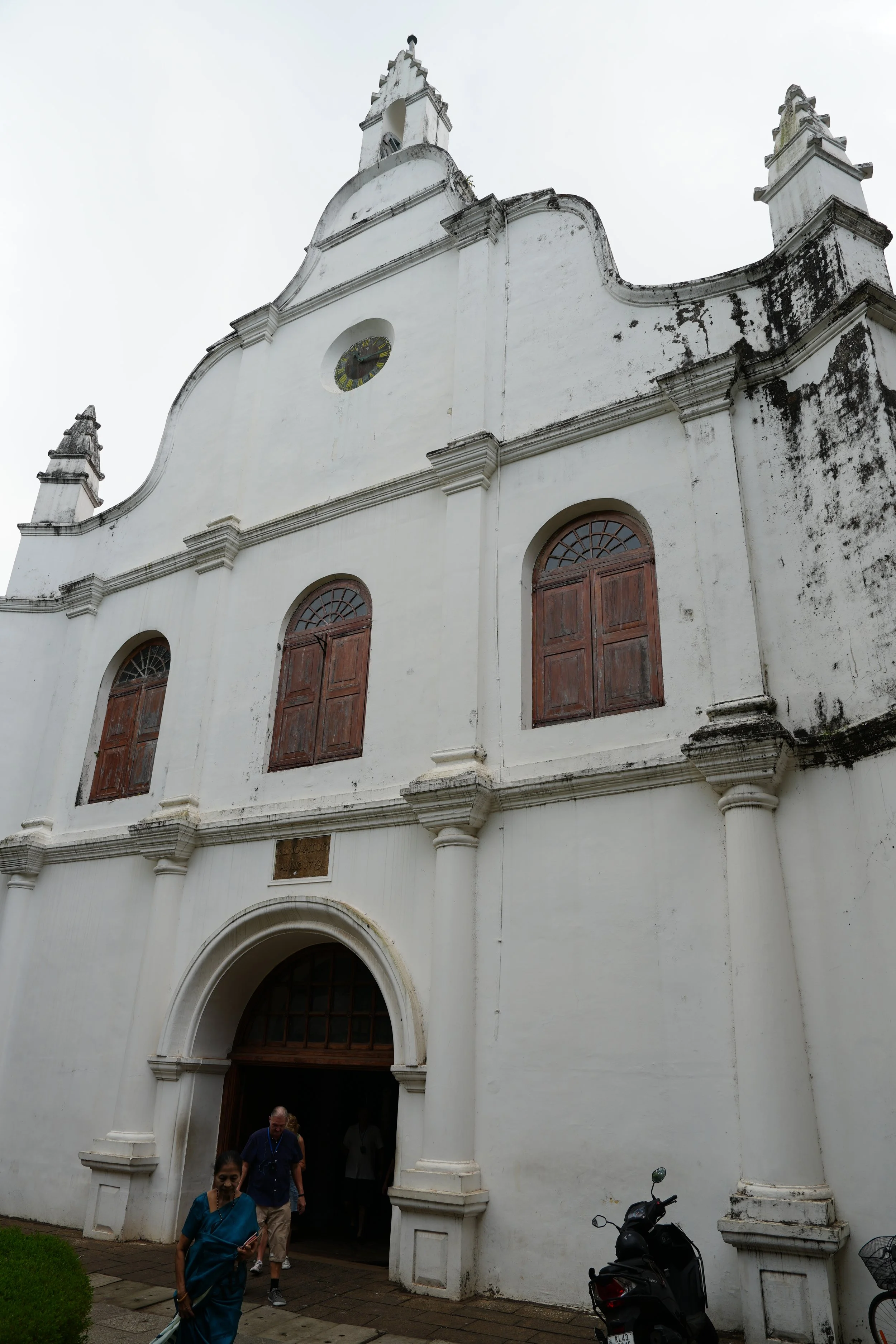
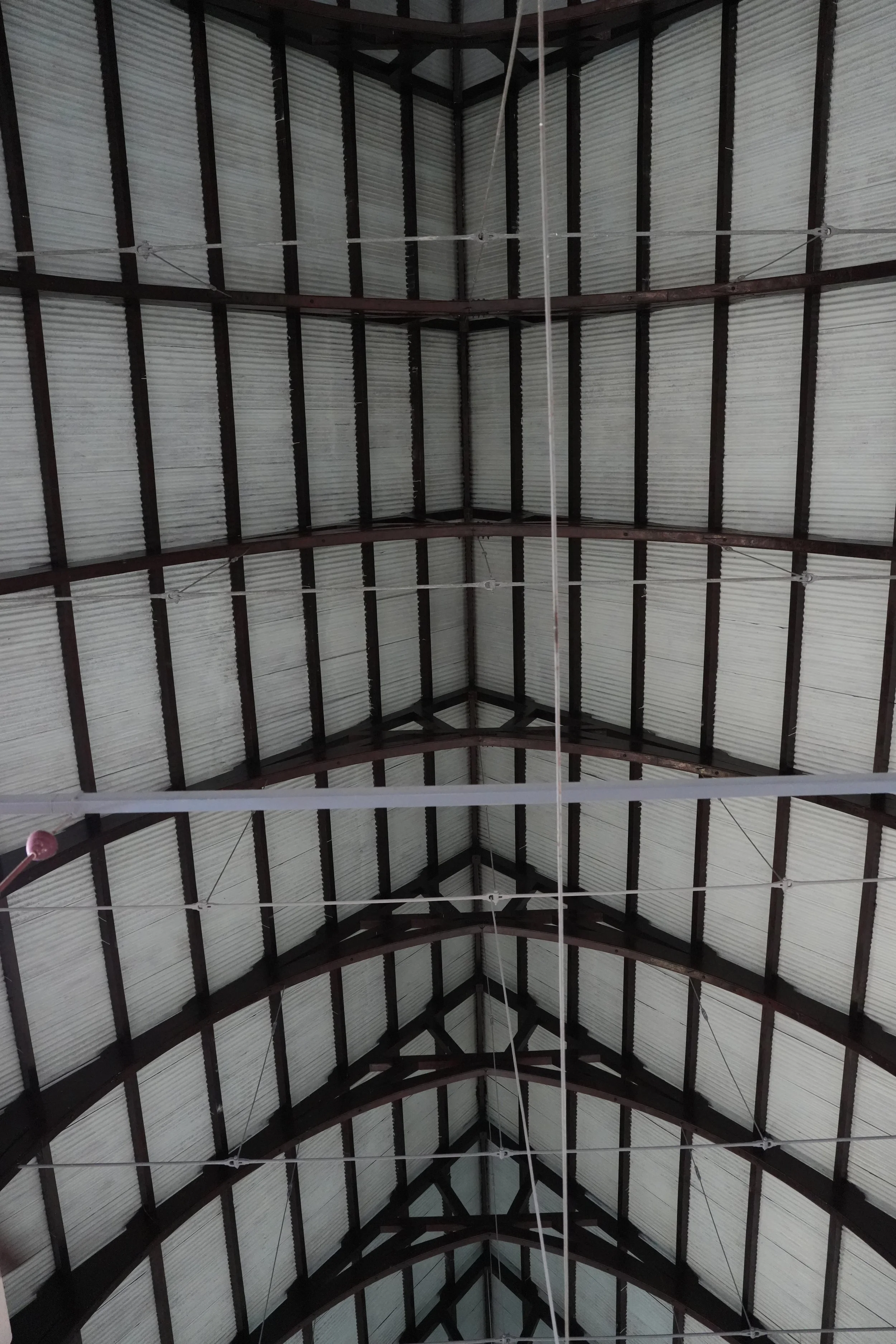
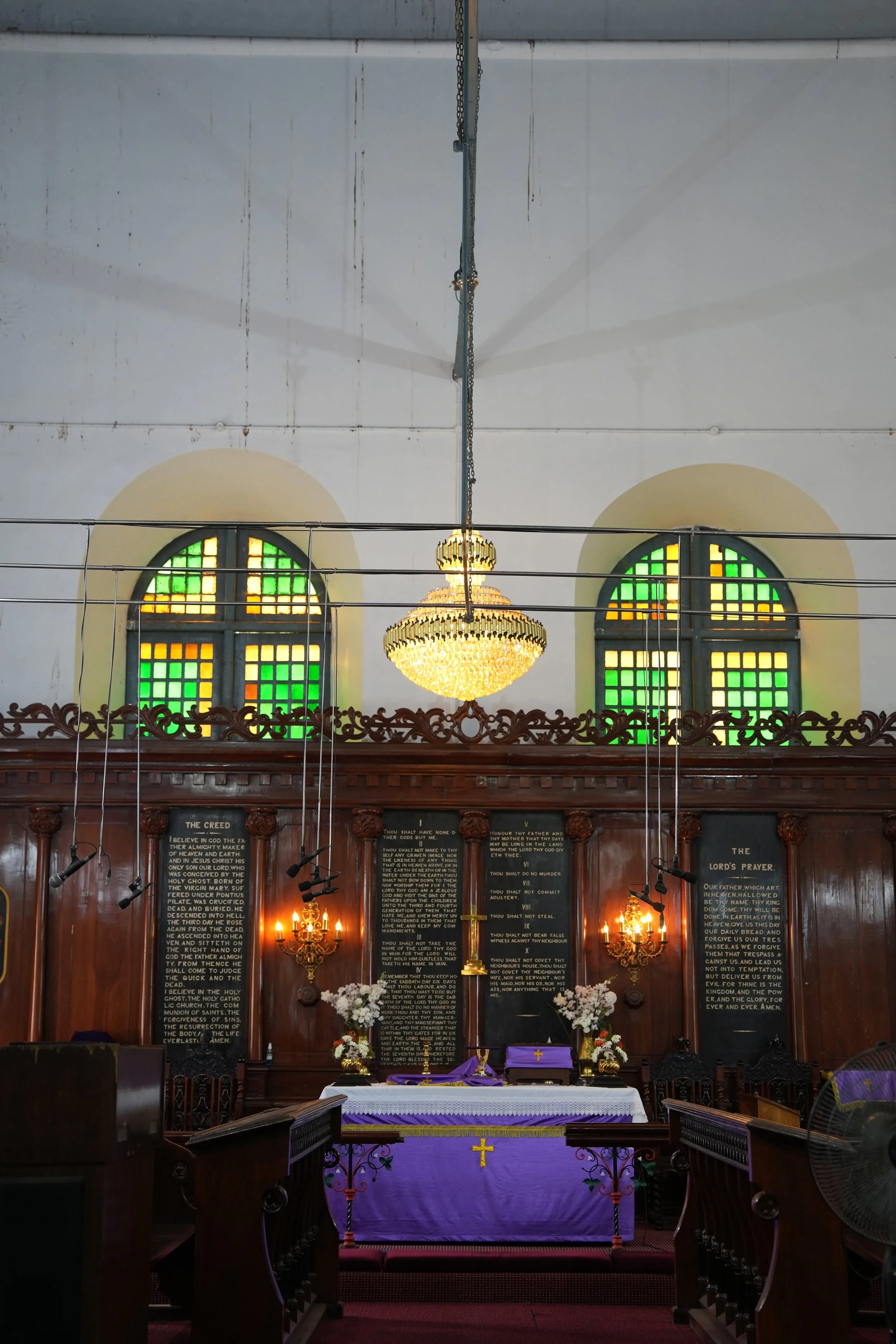
A short walk brought us to St Andrew’s Church, said to be the oldest European church in India, originally built by the Portuguese in the early 16th century. When we arrived a service was still in progress, so we waited outside in the humid air before being allowed in as the congregation drifted out. Inside, the church was simple but atmospheric, high wooden roof beams arching overhead, slow-turning fans hanging from long rods, and rows of dark wooden pews worn smooth by centuries of use.
Near the front was the spot where Vasco da Gama was first buried before his remains were later taken back to Lisbon, a small, easily missed detail that nevertheless connects this quiet church to the wider story of exploration and empire.
We continued on towards the waterfront and the fishing quarter, where the famous Chinese fishing nets stand along the shore like giant wooden silhouettes against the sky. The weather was overcast, the light flat and grey, which disappointed some of the photographers in the group, but it gave the place a subdued, working-day atmosphere that somehow felt more authentic than bright sunshine would have done.
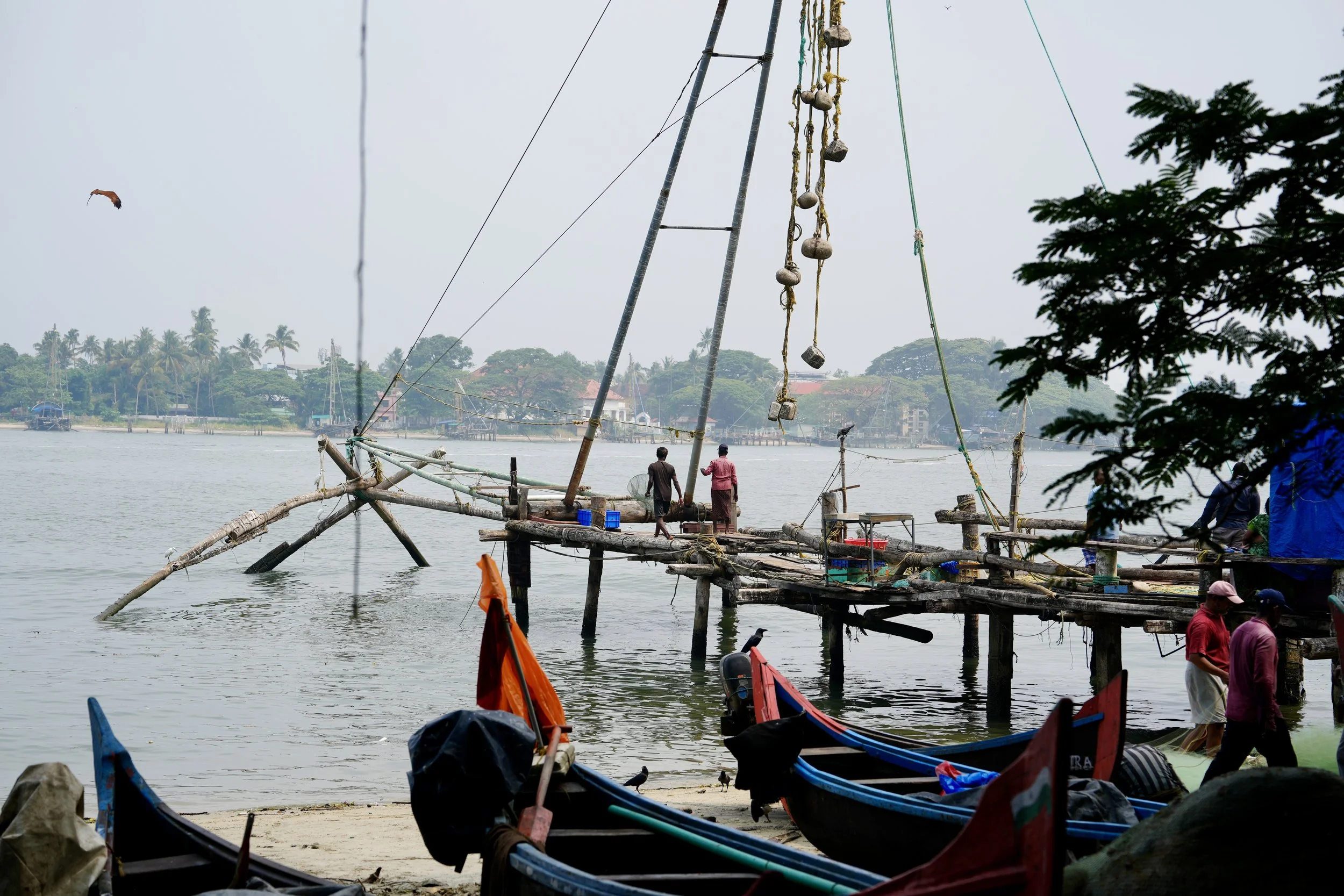
Chinese fishing nets at Kochi
The nets creaked slowly as they were raised and lowered using ropes, pulleys and heavy stone counterweights, the whole structure moving with a steady, deliberate rhythm that looked as though it had changed little for centuries. Long ropes stretched across the water, some of them dotted with white egrets balancing carefully as they watched for fish below, completely unbothered by the activity around them.
Closer to the shore, wooden fishing boats lay pulled up onto the sand, their paint worn and nets piled high inside them in tangled green heaps. Several fishermen sat in the shade repairing the nets by hand, working methodically, barely looking up as we passed. One man stood beside his boat checking the mesh, fingers moving quickly as if the motion was second nature after years of doing the same job every day.
Nearby, the morning’s catch had already been brought in. At a small open market beside the water, fish were laid out in shallow trays, their scales still wet and shining in the dull light. Others were being sorted and cleaned on wooden boards while only a few buyers looked on, discussing prices in voices we could not understand but whose meaning was obvious enough.
Out on the water, a brahminy kite drifted low over the shoreline, wings held steady as it searched for scraps, while further out small boats moved slowly across the wide grey channel. Beyond them, the far bank was softened by haze, palms and low buildings fading slightly into the distance.
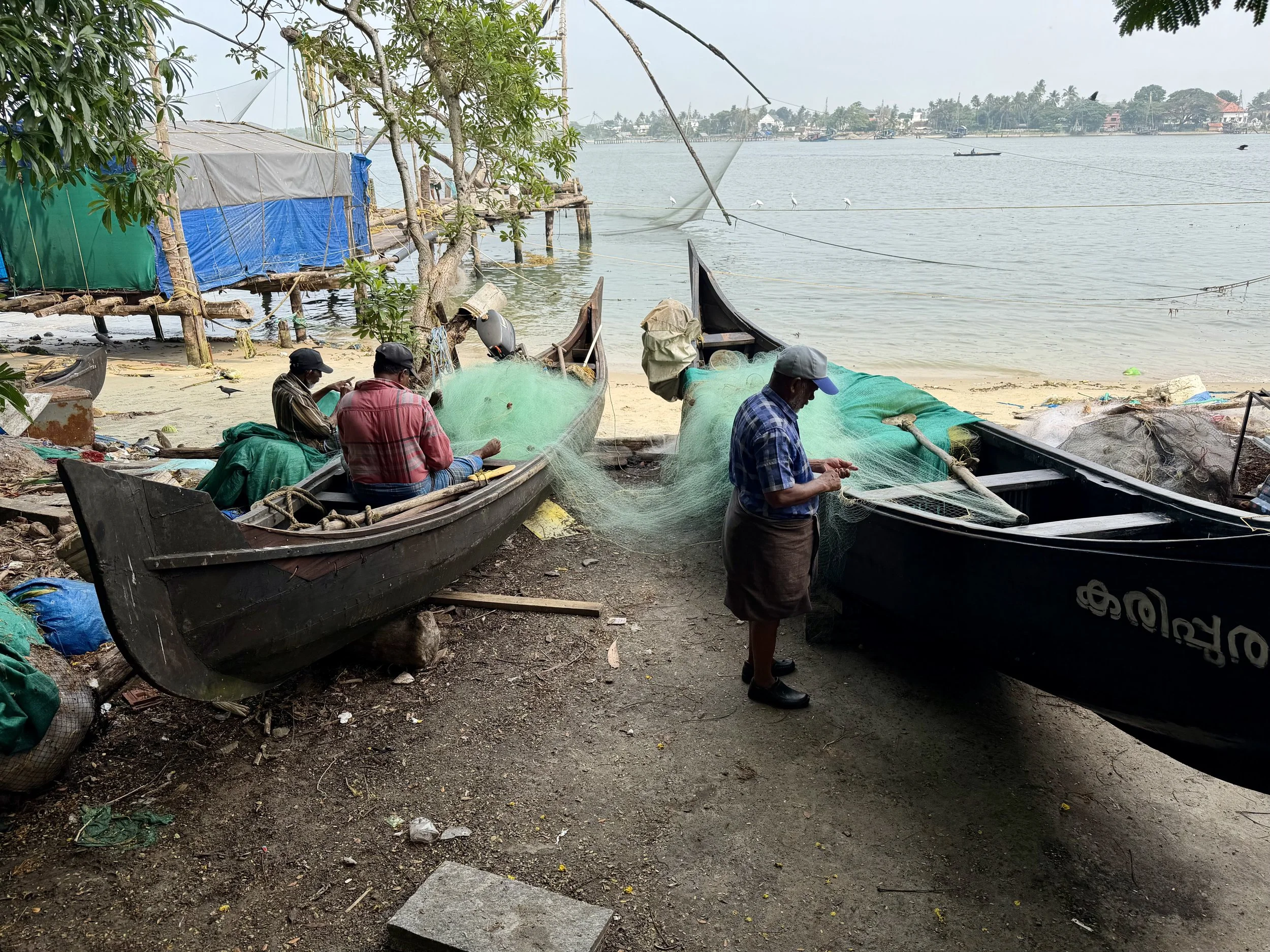
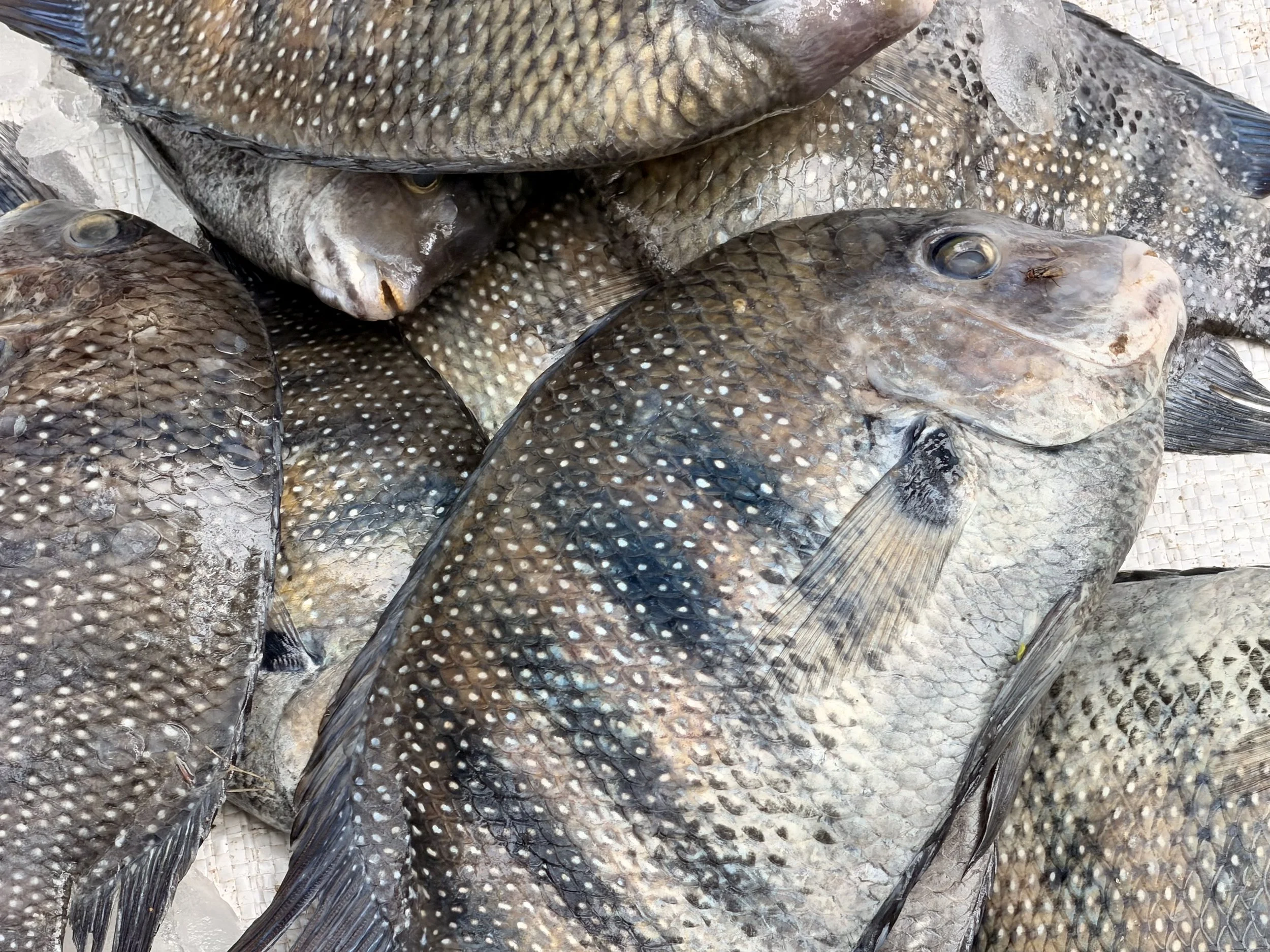
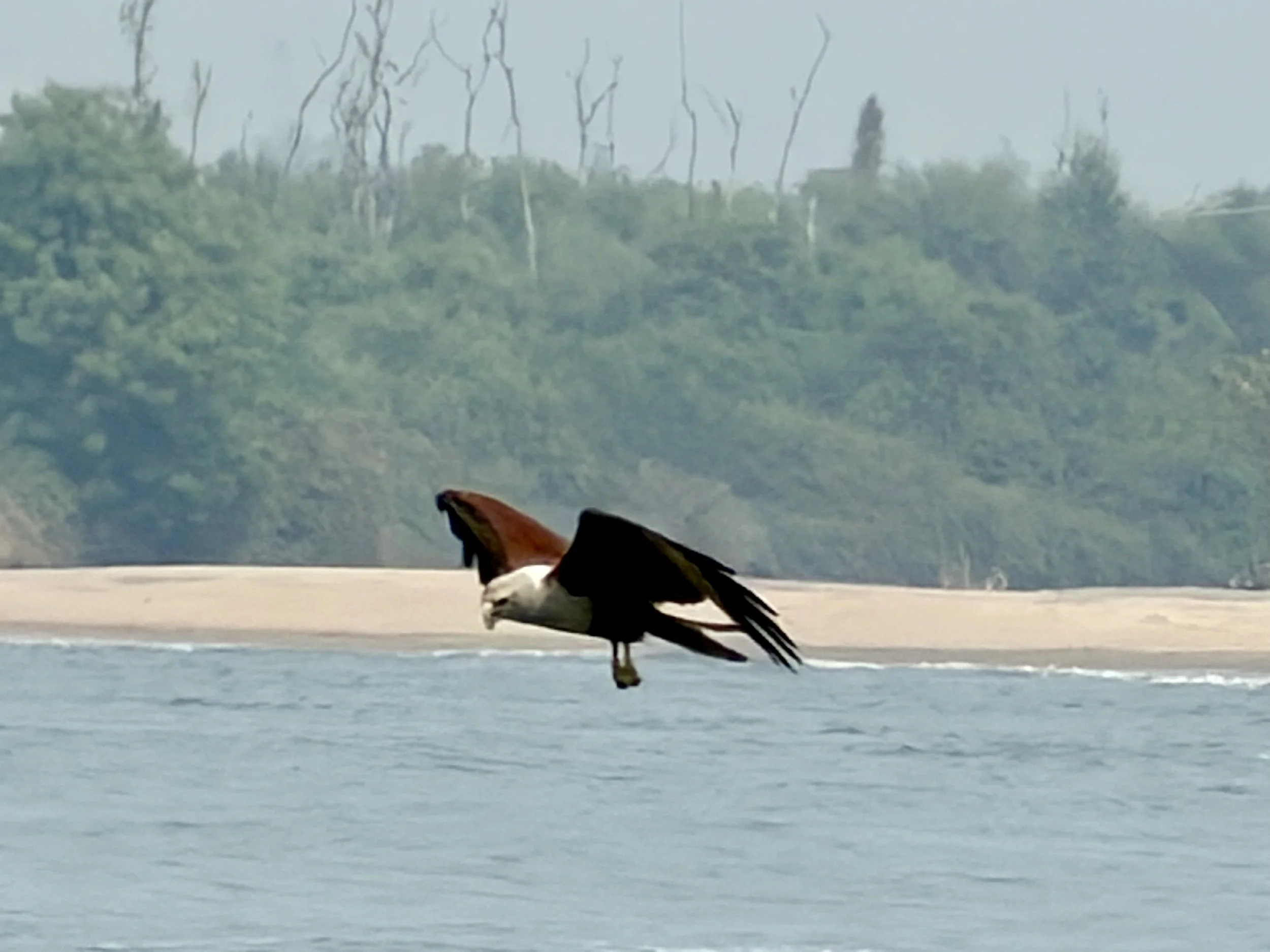
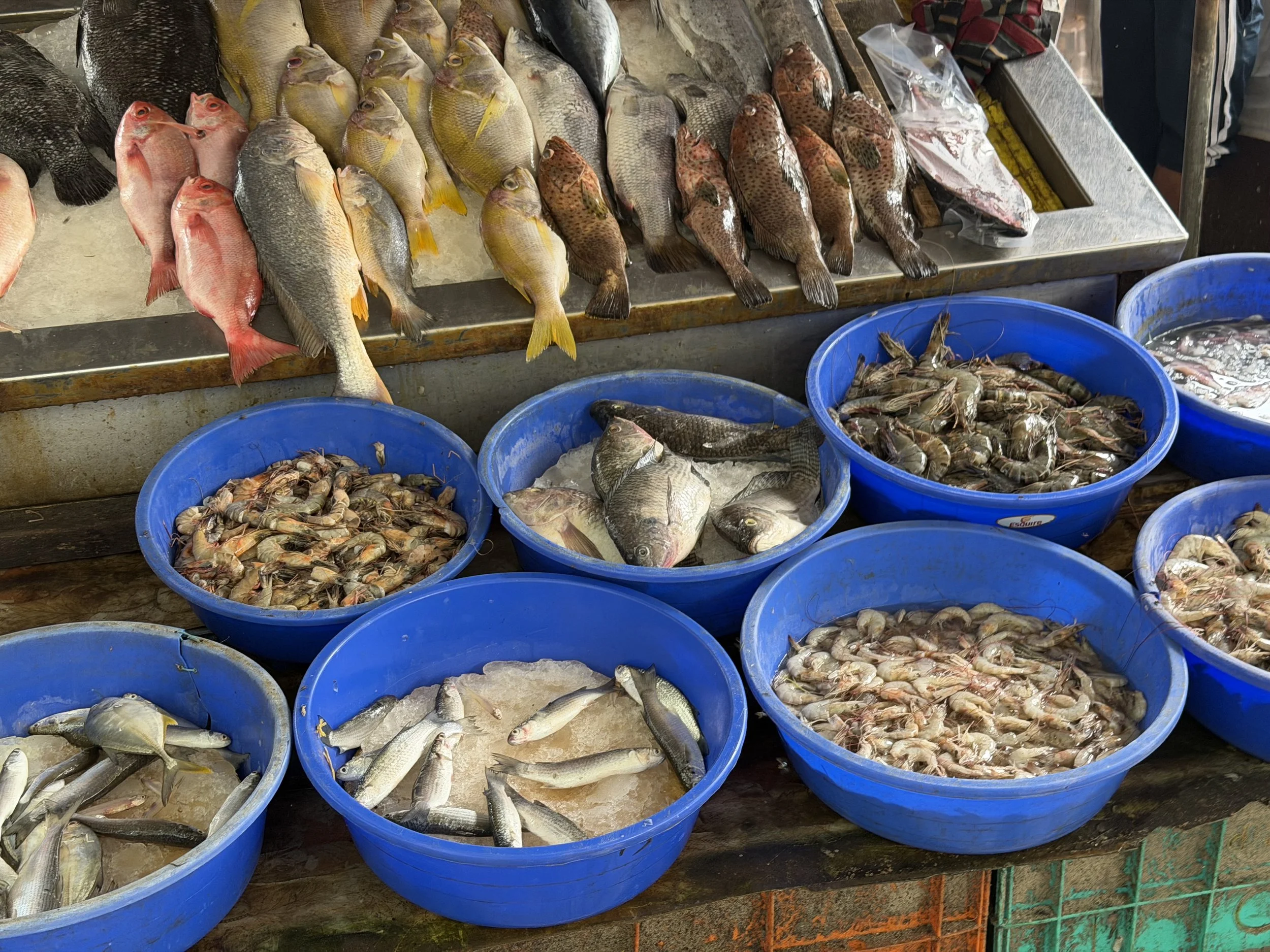
There was no sense of performance for tourists here, no attempt to make the place look picturesque. It was simply the ordinary business of the day continuing as it always had, the slow lifting of nets, the quiet repair of ropes, the sorting of fish, and the steady movement of the water itself. In the flat light and the humid air, the whole scene felt unhurried and timeless, less like a sight to be visited and more like a glimpse into a rhythm of life that carries on whether anyone is watching or not.
Our next stop was Mattancherry Palace, another short drive but another shift in atmosphere. The palace itself is not grand in the way the name suggests. Built by the Portuguese in the 16th century and later renovated by the Dutch, it feels more like a large traditional house than a royal residence, set around a simple central courtyard with dark wooden balconies looking down into the open space.
Inside, the rooms are plain, almost austere, but the walls tell the story. In several rooms every surface seems covered in murals, painted in deep reds, ochres, greens and faded golds, scenes from the Ramayana, the Mahabharata and other Hindu epics stretching across entire walls and ceilings. At first the colours look muted in the low light, but the longer you stand there the more detail appears — rows of figures with elaborate crowns and jewellery, gods with green skin and serene expressions, warriors locked in battle, arrows flying in every direction, demons, dancers, musicians, and whole stories unfolding panel by panel.
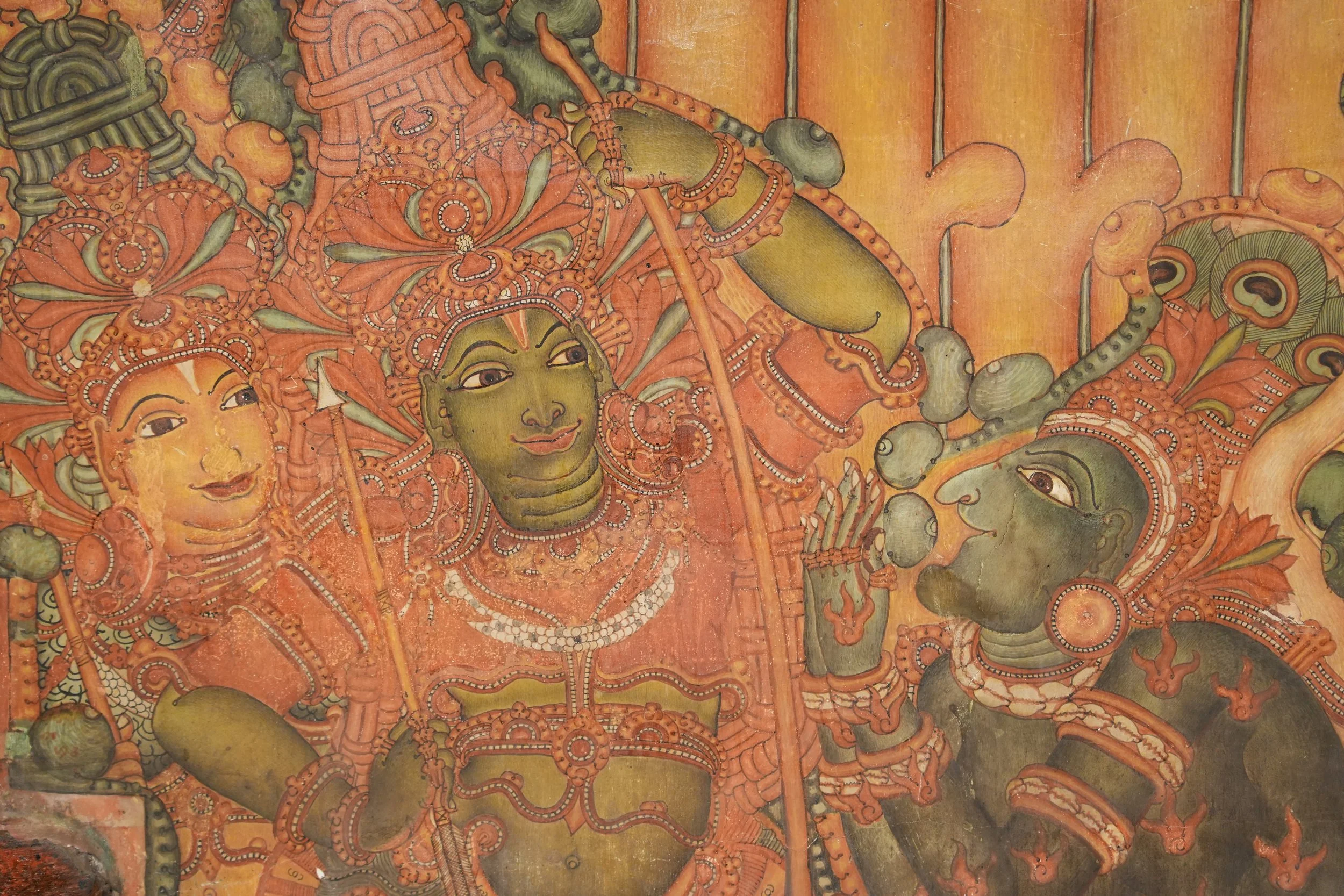
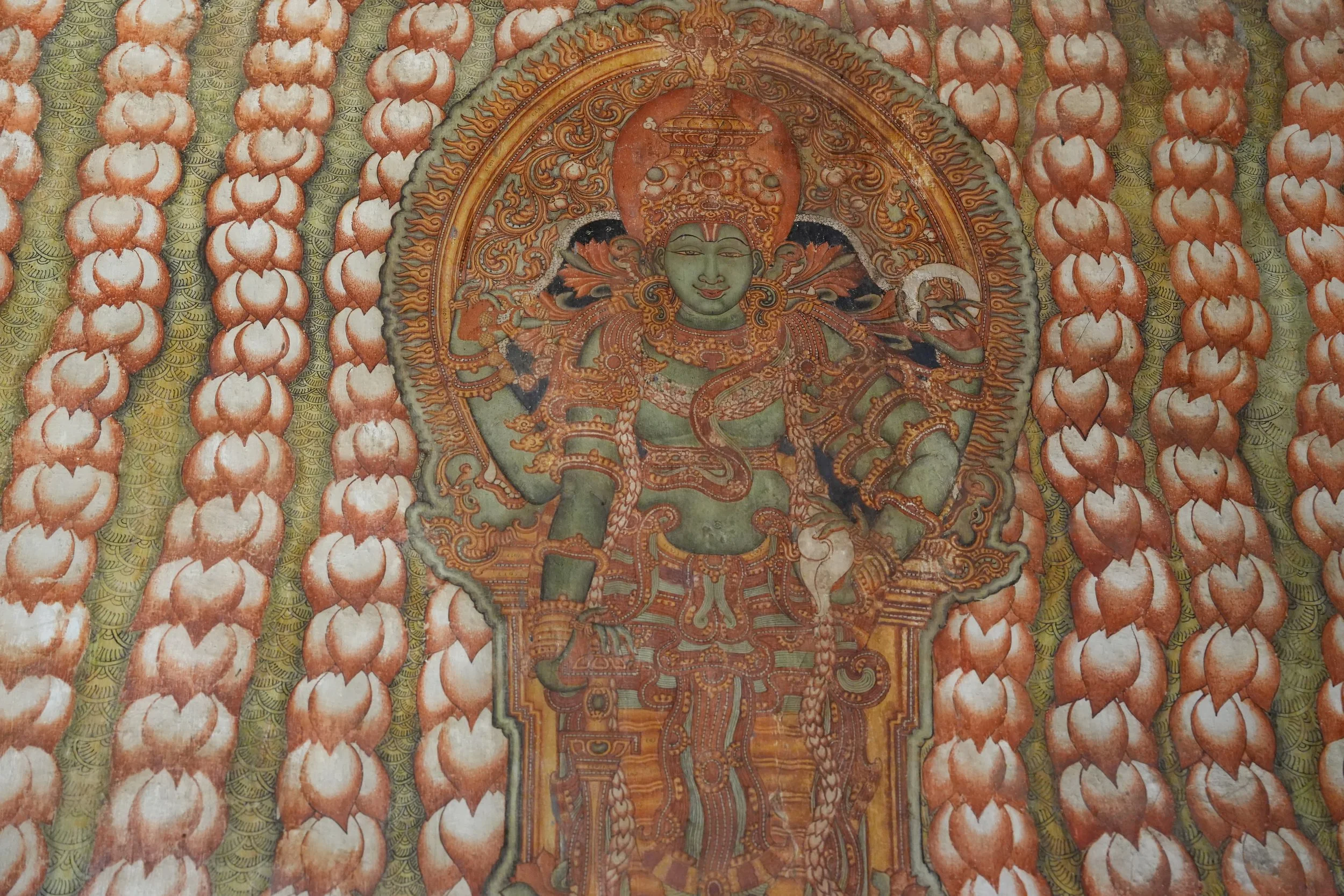
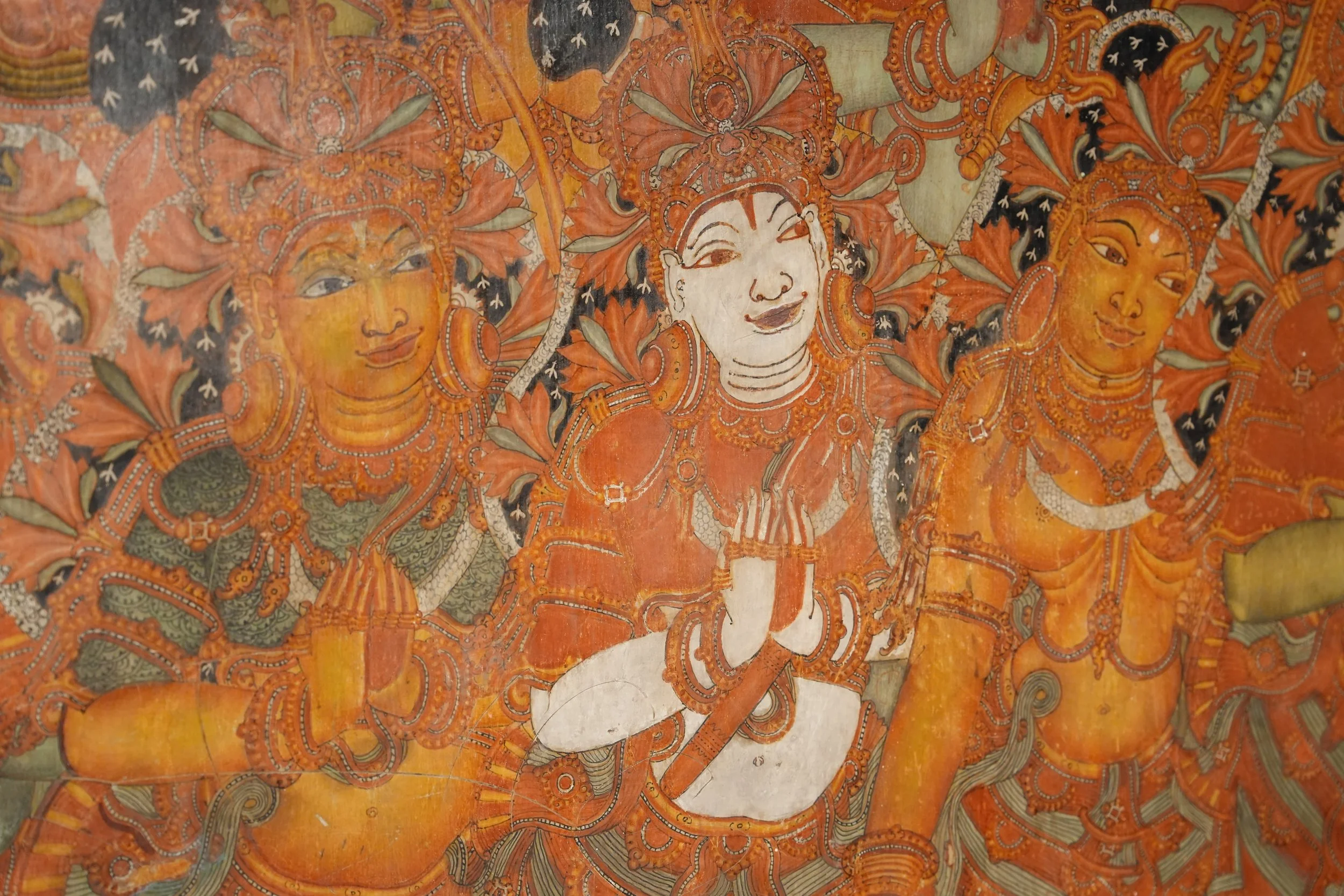
Some of the paintings are incredibly intricate, with fine lines and repeating patterns that must have taken months, if not years, to complete. Others are more dramatic, crowded scenes full of movement and energy, faces turned in every direction, eyes wide, arms raised, weapons drawn. The style felt very different from the Mughal art we had seen earlier in the trip.
It was hot and humid inside, the air heavy and still, and our guide, a new one for the Kerala part of the tour, was enthusiastic in his explanations, talking us through each panel in detail. By this point in the day, though, the heat was starting to get to me. I found a bench along the side of one of the rooms and sat down for a while, still listening through the little “whisper” earphones they give us, which meant I could hear everything without having to stand in the crowd. I don’t think I was the only one flagging a bit. Even the most dedicated listeners looked relieved when the guide finally announced that we were heading back to the hotel for lunch and free time until late afternoon.
People scattered in different directions once we were back. Some went straight to their rooms, others to the restaurant, but we decided to go out for a walk along the waterfront. The breeze coming off the water made it feel noticeably cooler, and for the first time all day there was no schedule, no guide, no coach waiting. Just time to wander.
We followed the path beside the lake and then drifted into the nearby market streets, where one thing immediately stood out, shop after shop selling suitcases. Apparently many people from this part of Kerala work overseas, particularly in the Gulf, and luggage shops are big business here. Our previous guide had told us this would be the best place on our tour to replace a broken case, and he was right.
After a bit of looking around, and a little light bartering that probably achieved no more than ten percent off, we came away with a new suitcase and the quiet satisfaction that comes from feeling you’ve made a reasonably good deal.
We walked back to the hotel carrying the case between us, slightly hot, slightly tired, but oddly pleased with ourselves. Not exactly a grand cultural moment, perhaps, but one of those small, ordinary travel memories that will probably stick just as much as the palaces and temples.
In the early evening we travelled back to the Fort Kochi area to attend a Kathakali performance, something none of us really knew what to expect from. The theatre itself was small and simple, more like a studio than a grand performance space, with rows of chairs facing a low stage lit by a single brass oil lamp.
Before the performance began, we were given a short introduction to the art form, which turned out to be far more helpful than I expected. One of the performers demonstrated the different facial expressions and hand gestures used in Kathakali, showing how whole emotions and stories are told without words. Happiness, anger, fear, pride, surprise, each expression exaggerated, eyes wide, eyebrows arched, fingers moving in precise, almost hypnotic patterns. Up close it felt slightly theatrical, even amusing at times, but it made it much easier to follow what came later. The performer also invited some of the guests on stage which also lightened to mood and ready for the performance.
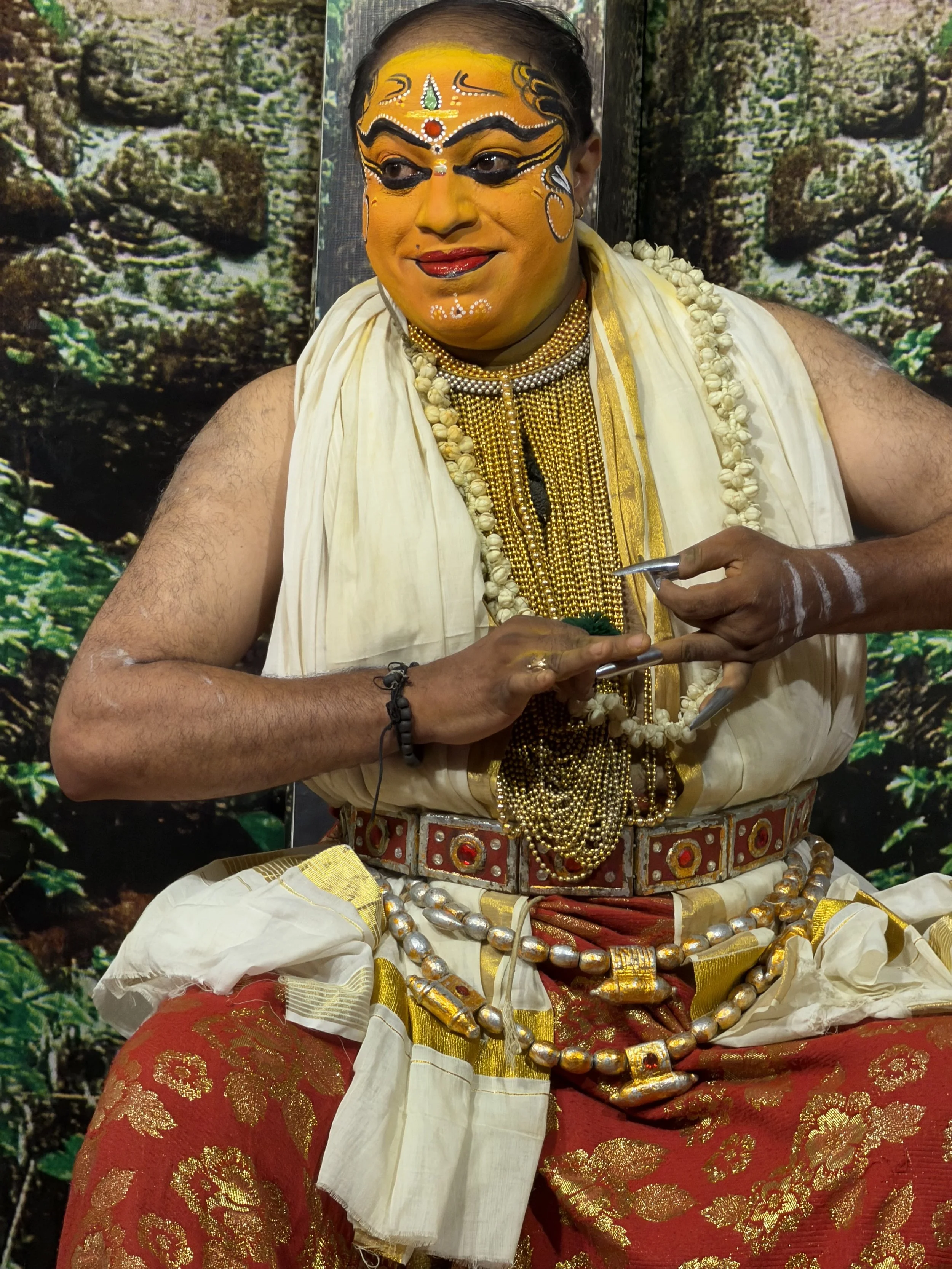
Kathakeli performer explaining the different facial expressions
Seeing the performer it quickly became clear why the preparation for a performance can take hours. The faces are painted in vivid colours, bright yellow, deep green, black and red, each colour representing a different type of character. The costumes are just as elaborate, layers of heavy fabric, huge skirts, strings of beads, metal ornaments, and towering headdresses that transform the performers completely.
When the performance itself began, the atmosphere changed immediately. The movements were slow and deliberate, every gesture controlled, every look held for longer than felt natural. The story, taken from traditional Hindu mythology, was acted out through expression, posture and gesture rather than speech, accompanied by the steady rhythm of drums and chanting from the side of the stage.
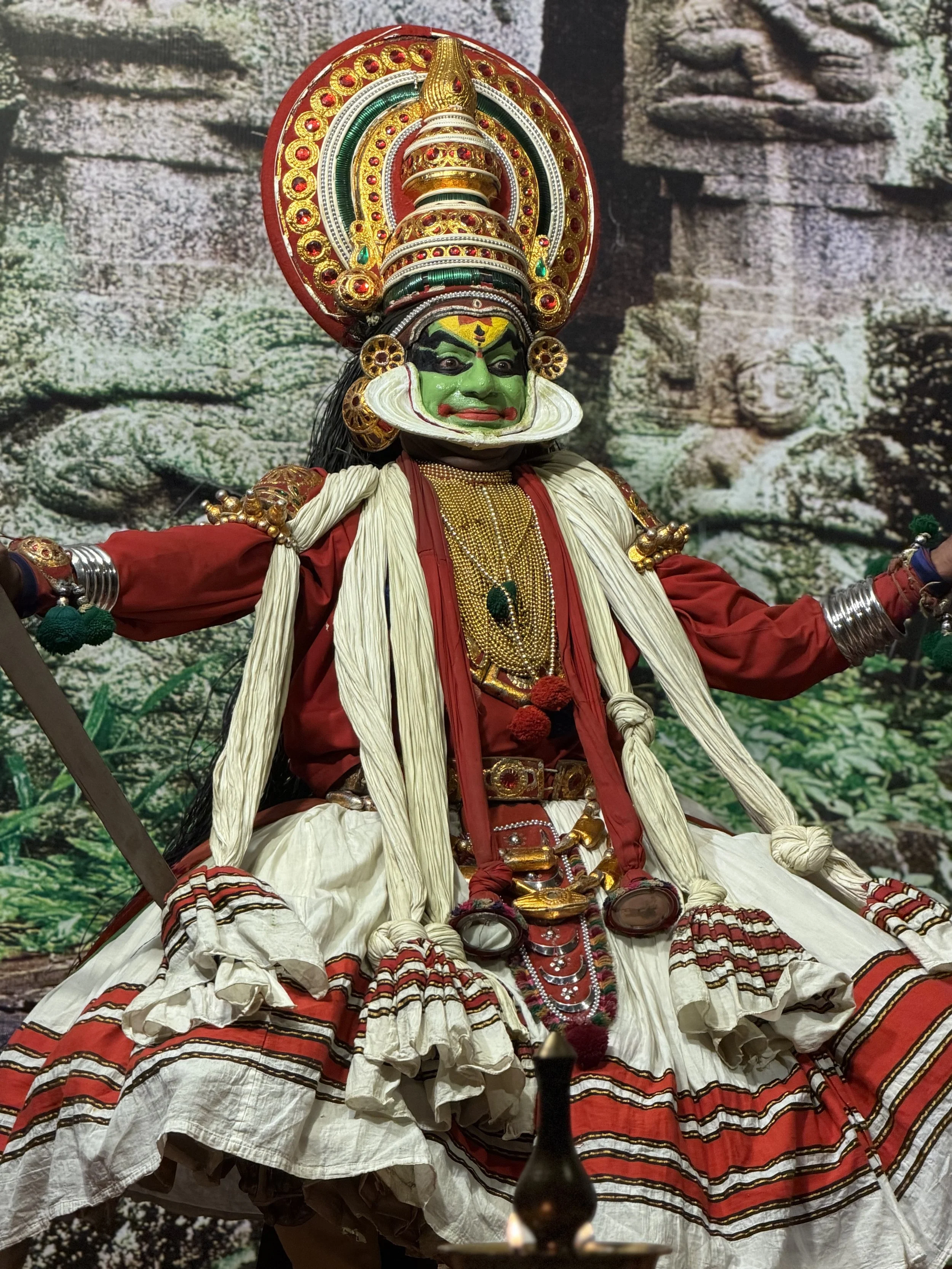
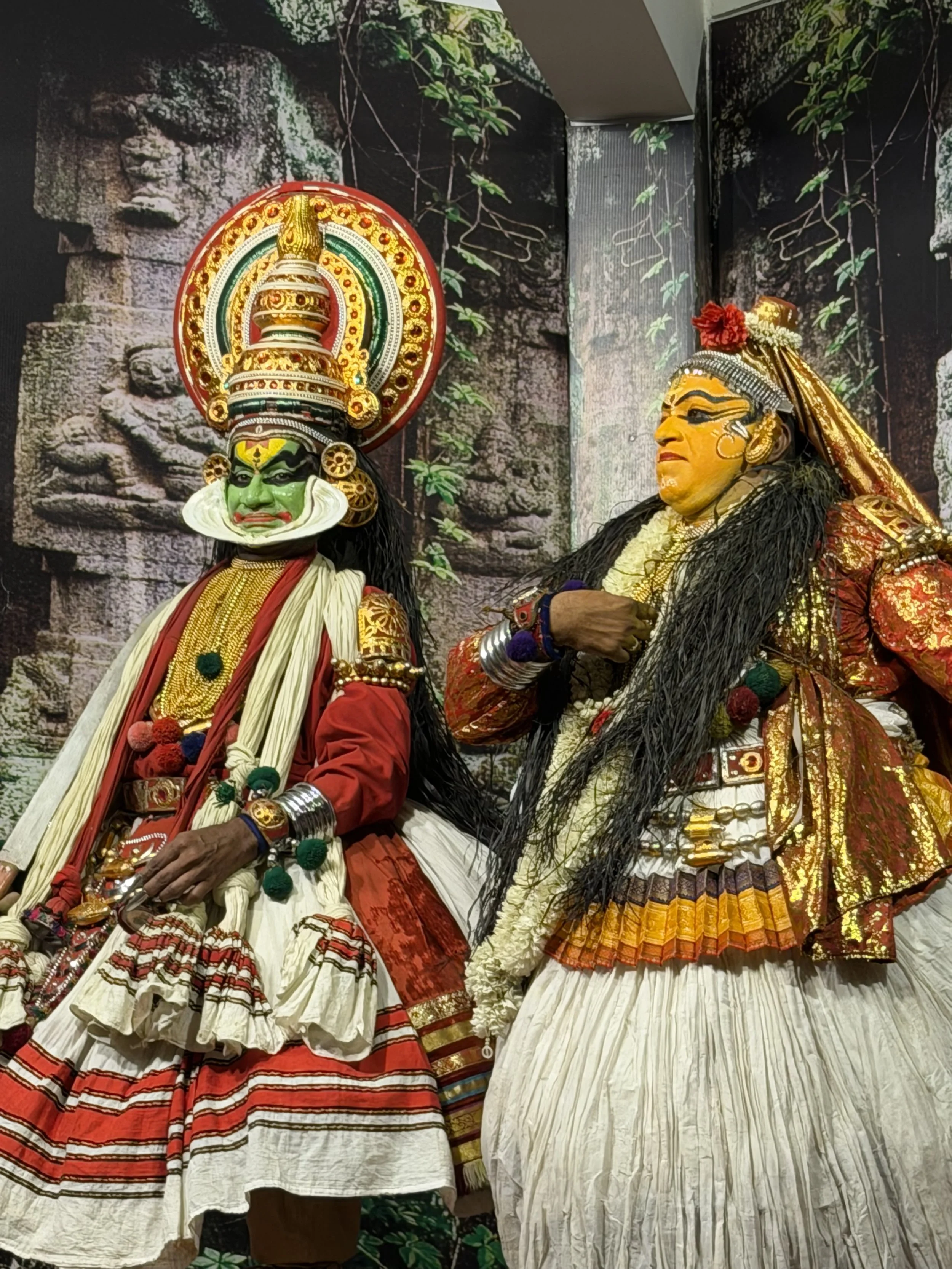
At first it felt unfamiliar, even slightly strange, similar to the Peking Chinese Opera on our visit to China, but the longer it went on the more absorbing it became. The exaggerated expressions that had seemed almost comic during the demonstration suddenly made sense when used in the story. The characters felt larger than life, part pantomime, part dance, part ritual.
Watching the performers up close, it was impossible not to admire the physical effort involved. The costumes looked heavy, the make-up thick, the headpieces enormous, yet every movement remained precise, every expression controlled down to the smallest flick of the eyes.
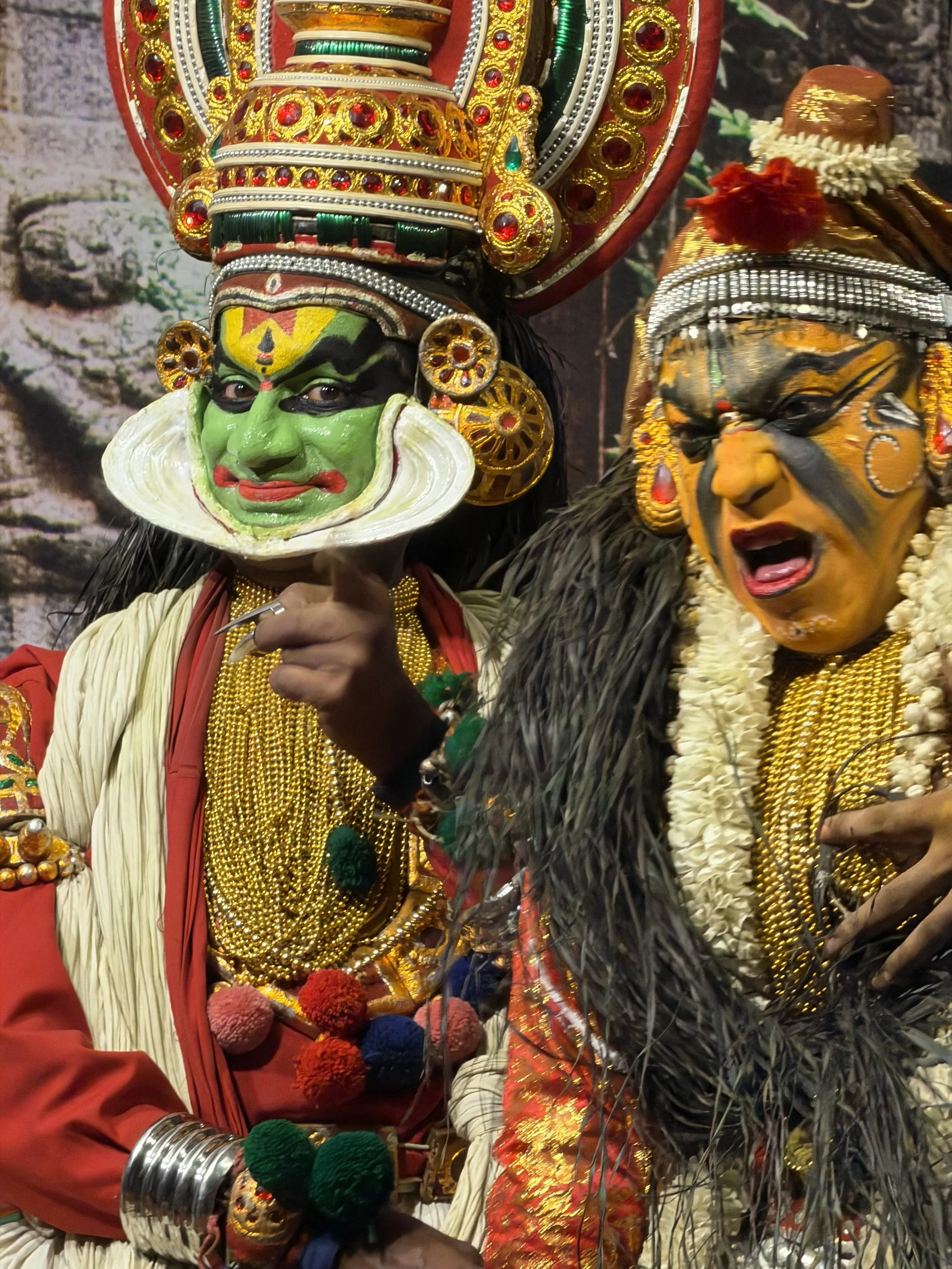
The last scene where the princess turns into a demon and howls
It was one of those experiences we might not have chosen ourselves, but by the end I was glad we had gone, and for many of us, proved the highlight of the day.
Our final stop on what had very much become a tick-the-box kind of day was a visit to a local home for a cookery demonstration and dinner. After the pace of the afternoon, I think most of us were wondering how much energy we had left for one more activity, but it turned out to be a good way to end the day.
Unlike our earlier cookery experience in Jaipur, this really did feel like someone’s home rather than a place set up purely for tourists. We were welcomed inside with glasses of lemon juice and shown into a simple coutyard where the family talked us through the dishes they were preparing. The demonstration was for a traditional Kerala fish curry along with a soft white pancake made from rice flour and coconut milk, lightly sweet and cooked in a small pan so that the edges became thin and crisp while the centre stayed soft.
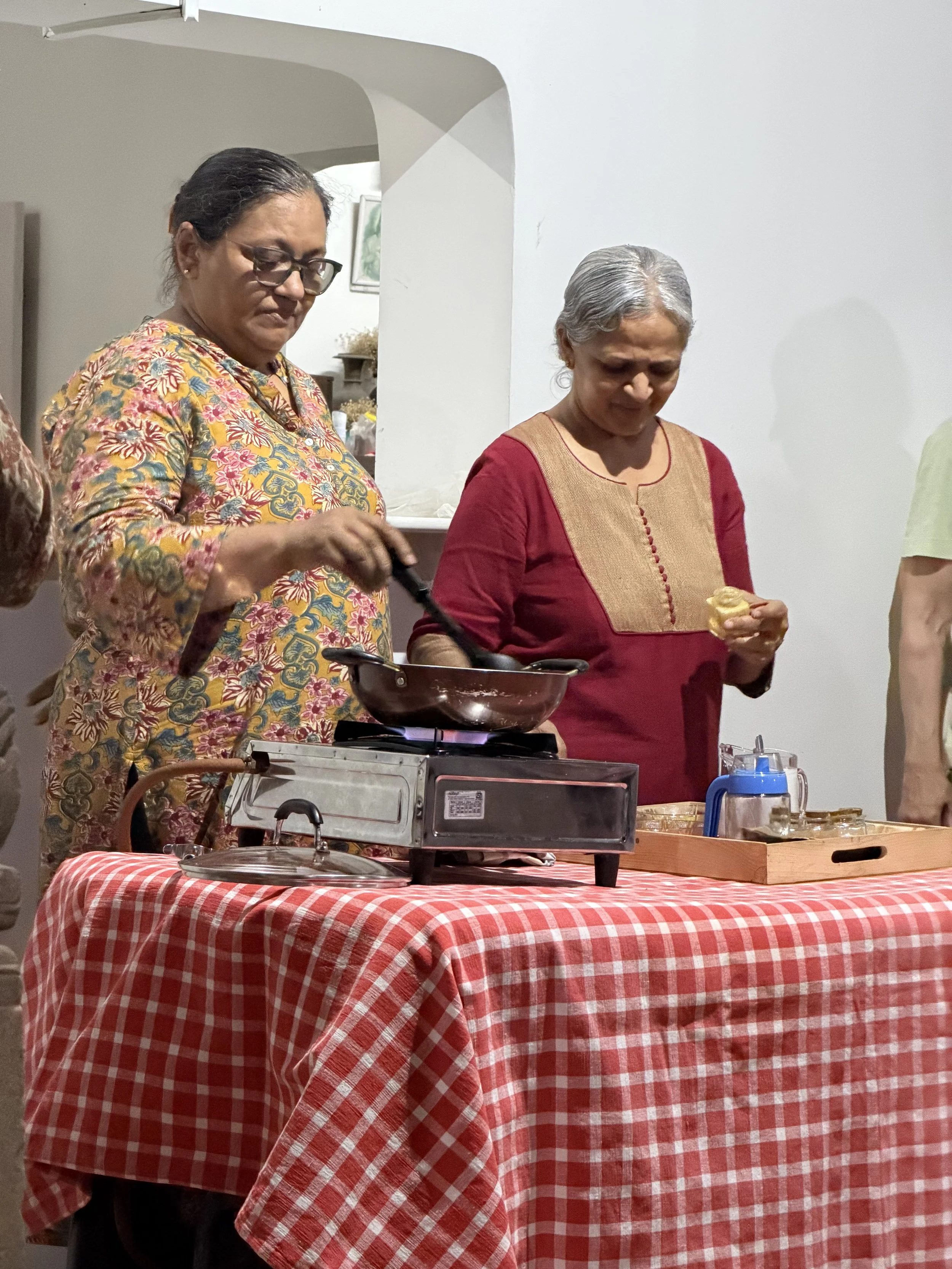
Kerala cookery demonstration
The hosts were warm and friendly, though even they joked that we looked a little tired after the day we had had. By this point the heat, the travelling and the constant moving from place to place had caught up with most of us, and the group was noticeably quieter than usual. Still, once the food arrived, spirits lifted again. The curry was excellent, full of coconut and spice without being too hot, although the pancakes were not to everyone’s taste.
We sat for a while, talking quietly among ourselves, everyone seeming to slow down at last after a long, busy day. It wasn’t a grand occasion, just a simple meal in a family home, but in its own way it felt more real than some of the places we had visited earlier.
Eventually we climbed back onto the coach for the short drive to the hotel, and I think there was a shared sense of relief as well as satisfaction. It had been one of those days where you see a great deal but barely have time to take it in, a day of history, culture, laundry, murals, fishing nets, suitcases, theatre and cooking demonstrations all packed together.
Tomorrow, the pace changes completely. We leave the city behind and board the riverboat, and for the first time in days there is nothing on the schedule except the journey itself.