Jaipur: Within the Walls of Amer
Jaipur
At just about the halfway point of our tour, we reached Jaipur for two full days of various activities. After the intensity of some of the cities we had already visited, Jaipur felt noticeably different. There is space here (although this is relative). The roads are wider, the roundabouts larger, the traffic somehow more ordered (in parts). Much of the old city was carefully planned in the 18th century under Maharaja Sawai Jai Singh II, and that sense of geometry and intention still lingers.
And yet, like everywhere we have been in India, contrasts sit side by side. There are modern shopping malls, polished glass fronts and newer, larger cars. Then at the same junctions, people weave between vehicles selling flowers or trinkets, and others sit quietly at the roadside with their belongings gathered around them. Prosperity and hardship, never far apart.
Amir Fort
Our first morning began early with a visit to Amer Fort (often called Amber Fort), which rises dramatically above Maota Lake. Arriving before the main surge of visitors felt like a small victory. From the water’s edge, the honey-coloured walls climbed up the hillside in long defensive lines, punctuated by watchtowers and gateways. The fort seems to grow out of the rock itself, its ramparts snaking along the ridgeline like a smaller, desert-hued echo of the Great Wall.
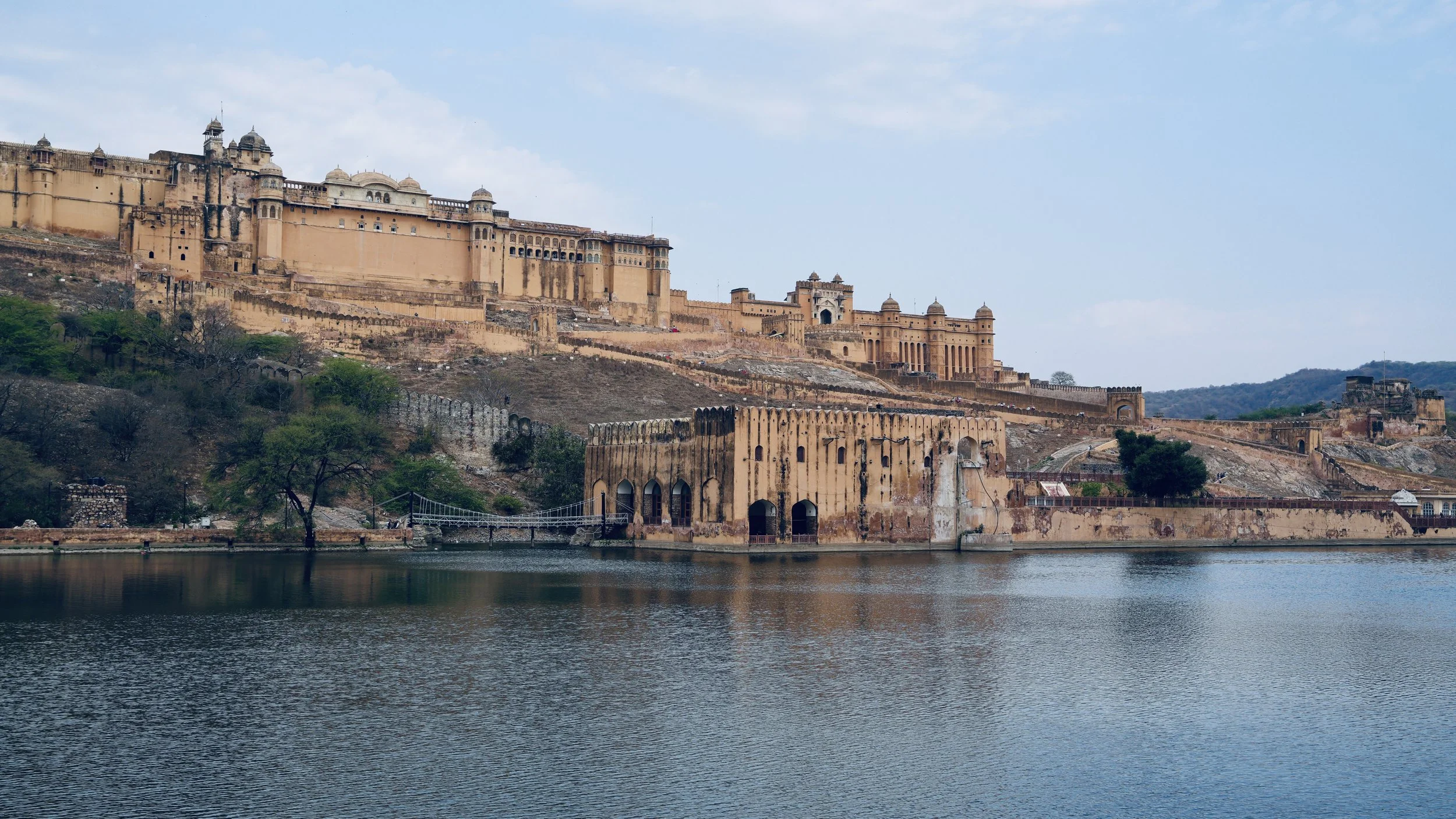
Amer Fort
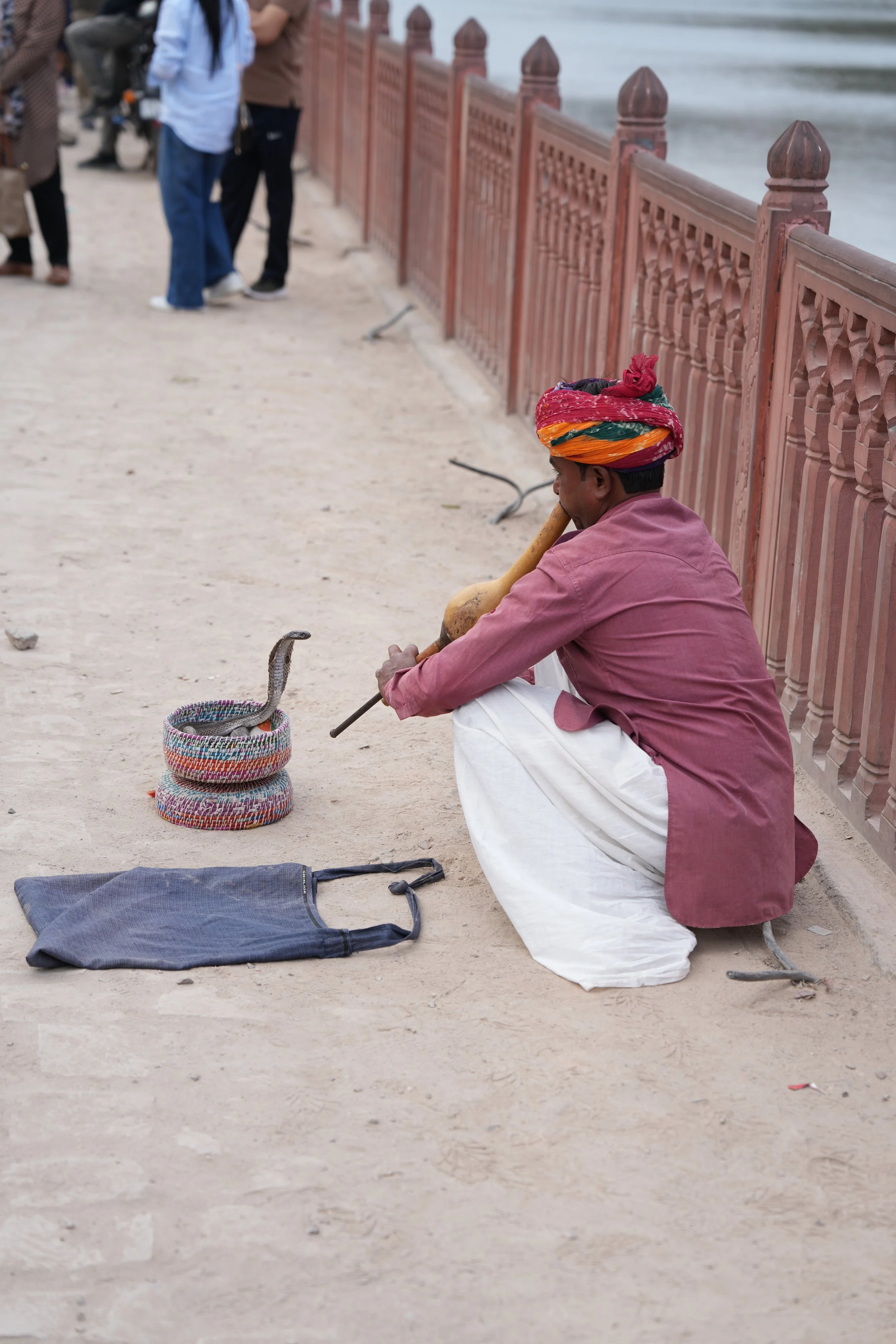
Snake Charmer at Amer Fort
Below, the lake was still and faintly reflective, softening the hard geometry of the walls. Jaleb Chowk and the lower fortifications cast pale ochre reflections into the water. A narrow pedestrian bridge crossed towards the base, while above it all the main palace complex dominated the skyline.
Along the lakeside walkway, a snake charmer sat cross-legged by the railing, his bright turban vivid against the dusty tones of the stone. A cobra rose from a woven basket as he played, a scene that felt almost theatrical against the monumental backdrop of the fort. Tourists paused, watched, photographed, then moved on.
We swapped our coach for jeeps to climb the steep approach road. The alternative is to walk, or to ride one of the elephants that carry visitors up each day. The elephants were already at work, painted and adorned, but for many of us that option would have felt uncomfortable. The jeeps, though caught in a sluggish line of traffic, felt the more sensible compromise, even if, at times, walking might genuinely have been quicker.
At the top, we passed through the inevitable corridor of sellers before entering the first grand courtyard. The scale of the place becomes clearer once inside. High sandstone walls rise on all sides, pierced by symmetrical arches and crowned with domed pavilions. The morning light caught the warm pinks and golds of the stone, while shadows pooled under the arcades.
The courtyard filled steadily. This is one of India’s most visited monuments, rivalled only by the Taj Mahal in terms of popularity, and the crowds reflect that. Families posed for photographs. Groups clustered around guides. Couples in elaborate wedding attire staged pre and post-wedding shoots, bright fabrics flashing against the muted stone. It did slightly dilute the atmosphere of grandeur, but it also felt unmistakably alive, a monument not frozen in time but fully absorbed into contemporary India.
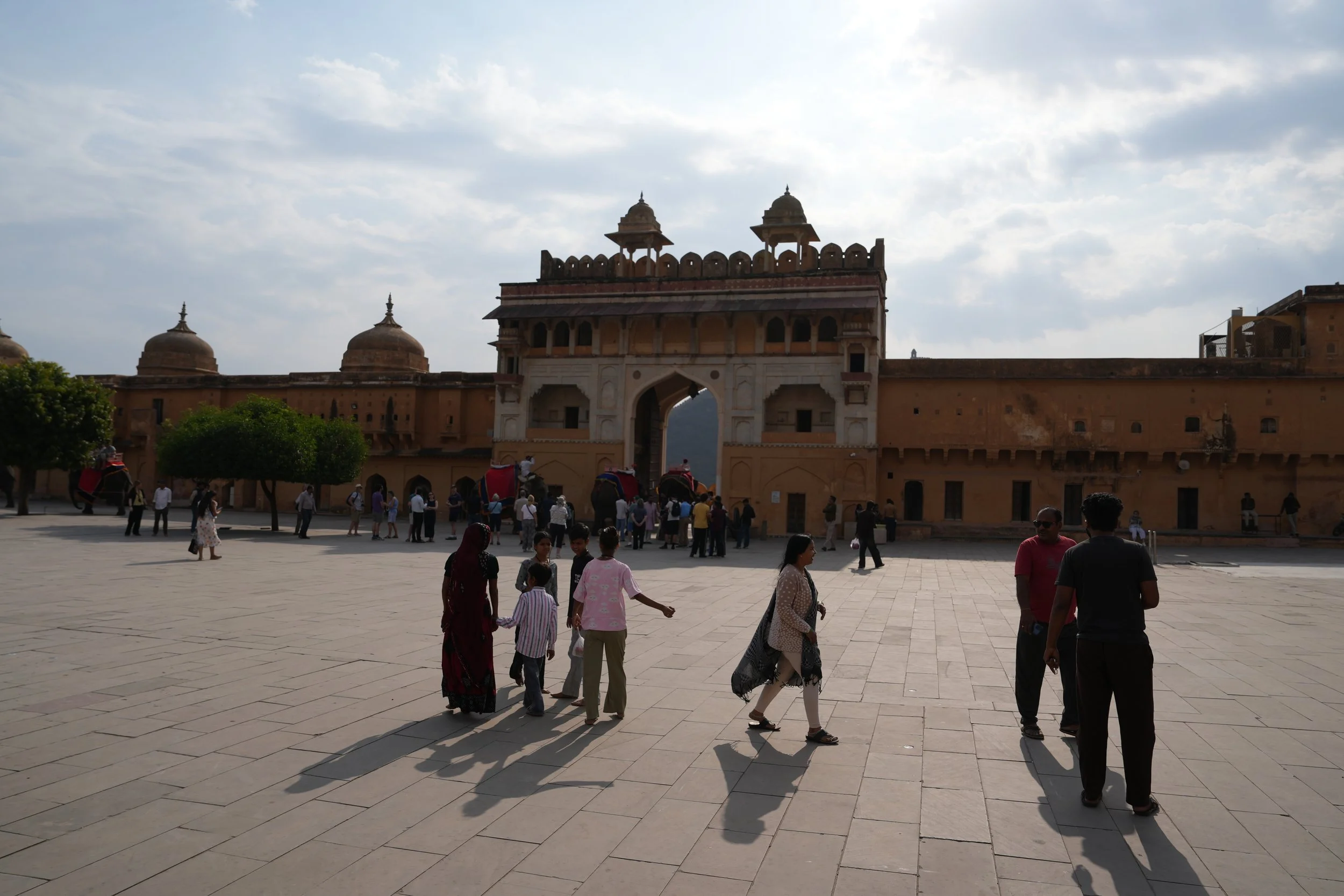
Elephants bringing more visitors, before it became too crowded
We climbed the steep, uneven stone steps to the next level of the fort, the section often referred to as the Diwan-i-Aam — the “Hall of Public Audience,” sometimes nicknamed the House of Commons. The staircase itself felt like part of the experience: worn treads, shallow rises, the sandstone warm underfoot. At the top, the space opened suddenly into a grand courtyard framed by a richly painted gateway.
The façade was far more intricate than it first appears from a distance. Panels of faded pinks, soft greens and ochres were filled with floral motifs, delicate borders and lattice screens. Above the main arch, honeycomb jaali windows filtered the light, while small domed chhatris capped the roofline. Up close, there were hand-painted flowers, geometric patterns, tiny niches and arches layered within arches. It felt both decorative and defensive, beauty contained within strength.
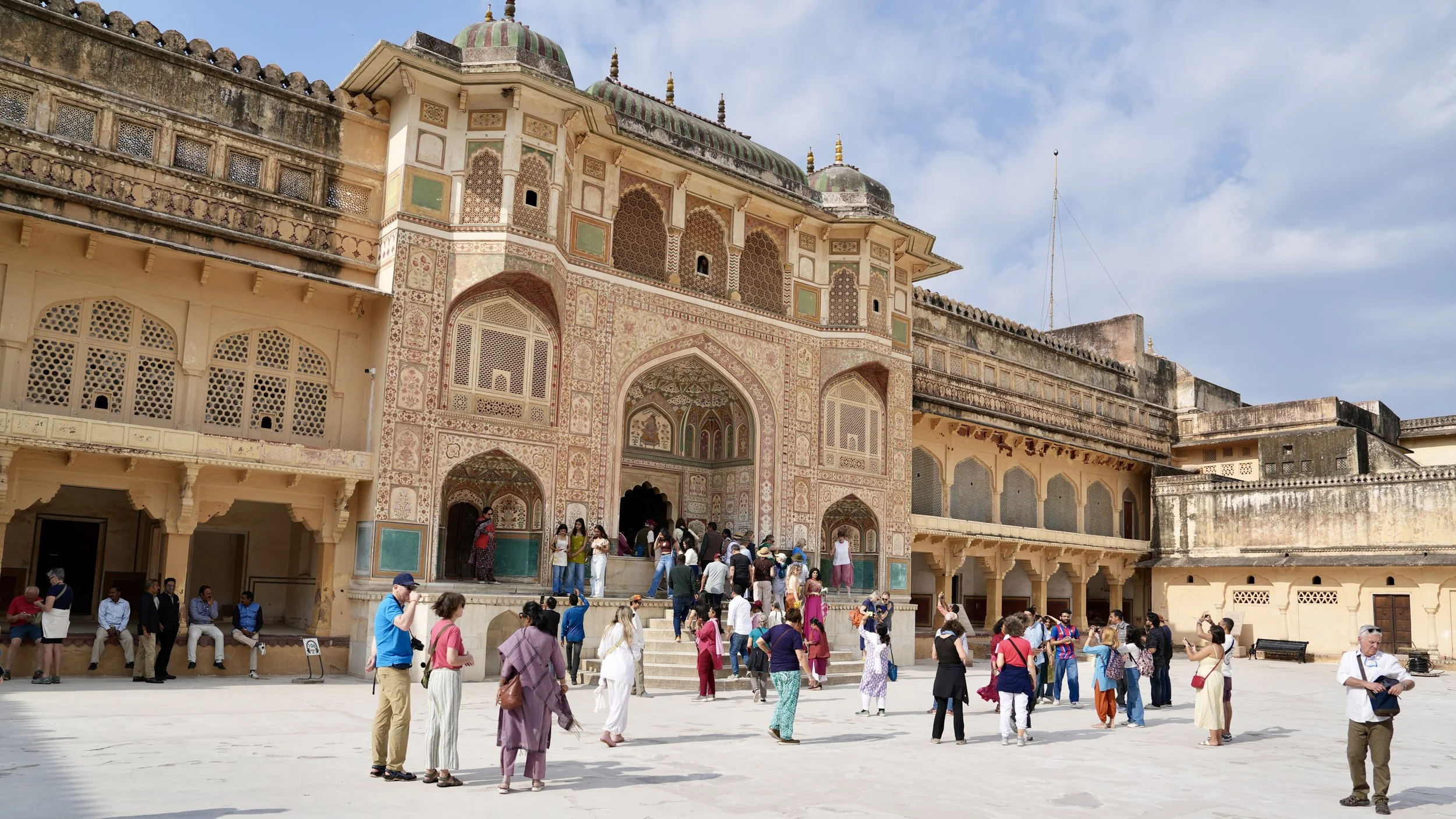
The “House of Commons” courtyard
From the terraces, the views were extraordinary. Below lay Maota Lake with its formal Mughal garden laid out in symmetrical rectangles, like a patterned carpet floating on water. Beyond that, the hills rose steeply, stitched together by long defensive walls that ran along the ridgelines for kilometres. They loop and climb over the Aravalli hills in a way that inevitably invites comparison with the Great Wall of China. The scale is different, but the intent, visibility, dominance, protection, is the same. When we visited China the wall was edged with snow and ice; here the air shimmered in 31-degree heat.
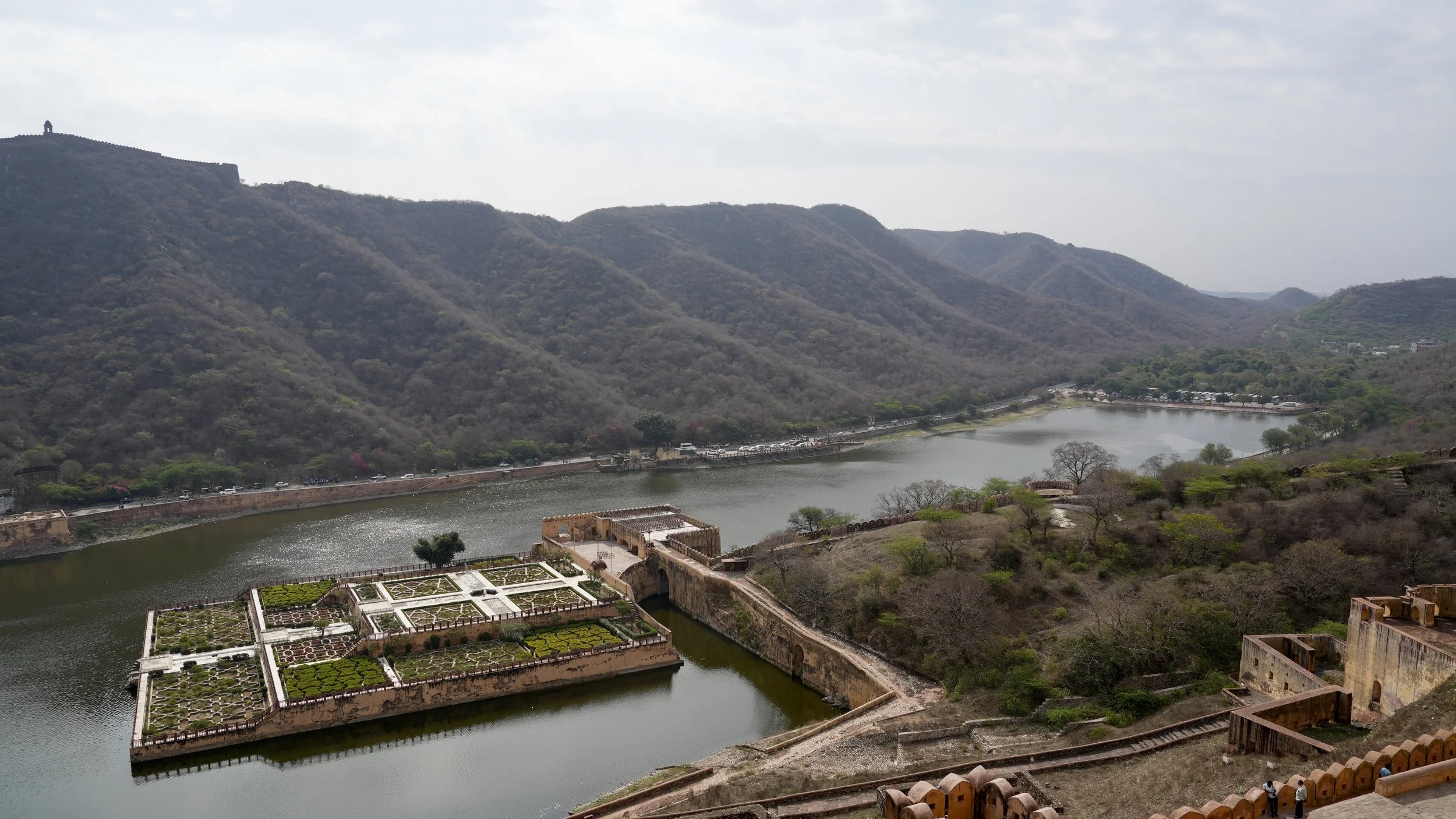
Maota Lake
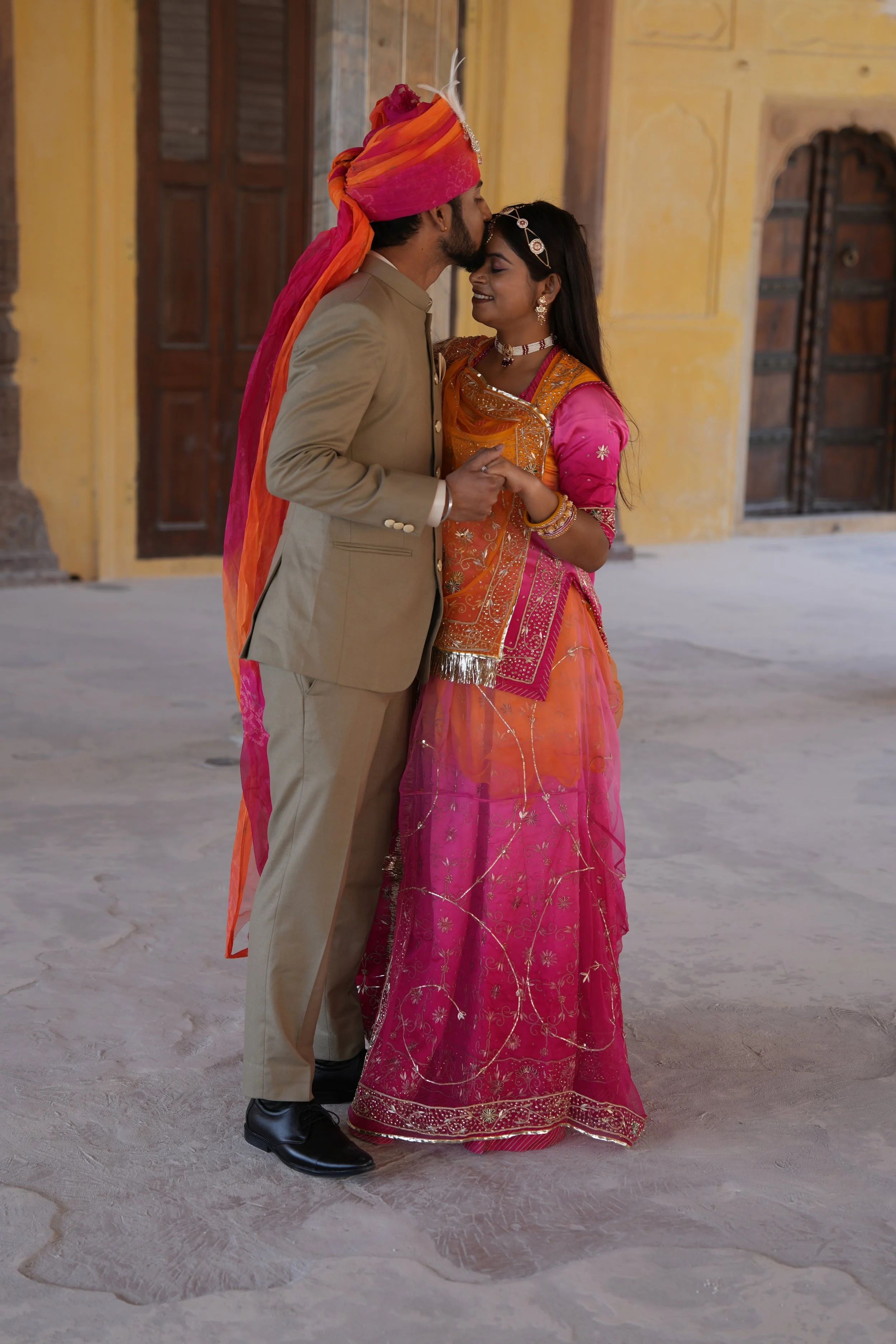
Prospective bride and groom
In the courtyard, more couples in elaborate dress posed for wedding photographs. One bride in a vivid pink and orange lehenga sat on the steps while a videographer crouched low to capture the perfect angle. Her groom, in a tailored beige suit and bright turban, leaned in for a staged kiss on her forehead.
Assistants hovered, adjusting dupattas and jewellery. At one point, members of our group were politely shuffled aside to keep the background “clean,” which didn’t go down especially well. It was hard not to feel that the fort had become a backdrop rather than the main event.
We moved through a series of courtyards over the next half hour, each unfolding into the next. Eventually we reached the Zenana — the women’s quarters. The layout here is clever and revealing. The Maharaja had multiple wives, each with her own suite arranged around a central courtyard. The design allowed him to visit any of them without the others seeing. Privacy engineered into stone. The architecture speaks quietly of power, hierarchy and domestic politics, as much as romance.
By now the heat was pressing down. I found a patch of shade against one of the thick walls and sat for a few minutes, letting the noise wash past. The sandstone seemed to hold the warmth and reflect it back. Even the pigeons had retreated into cooler ledges.
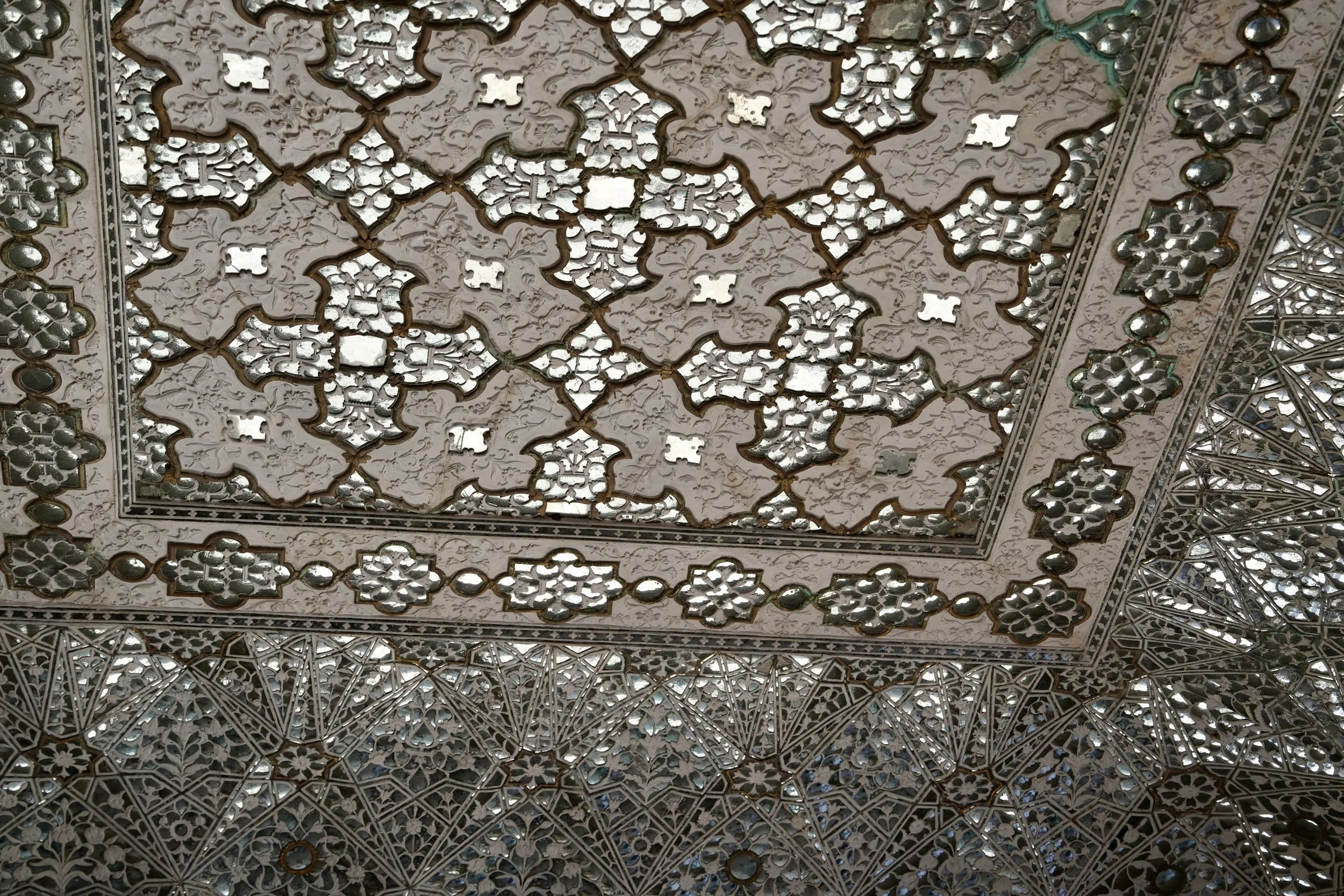
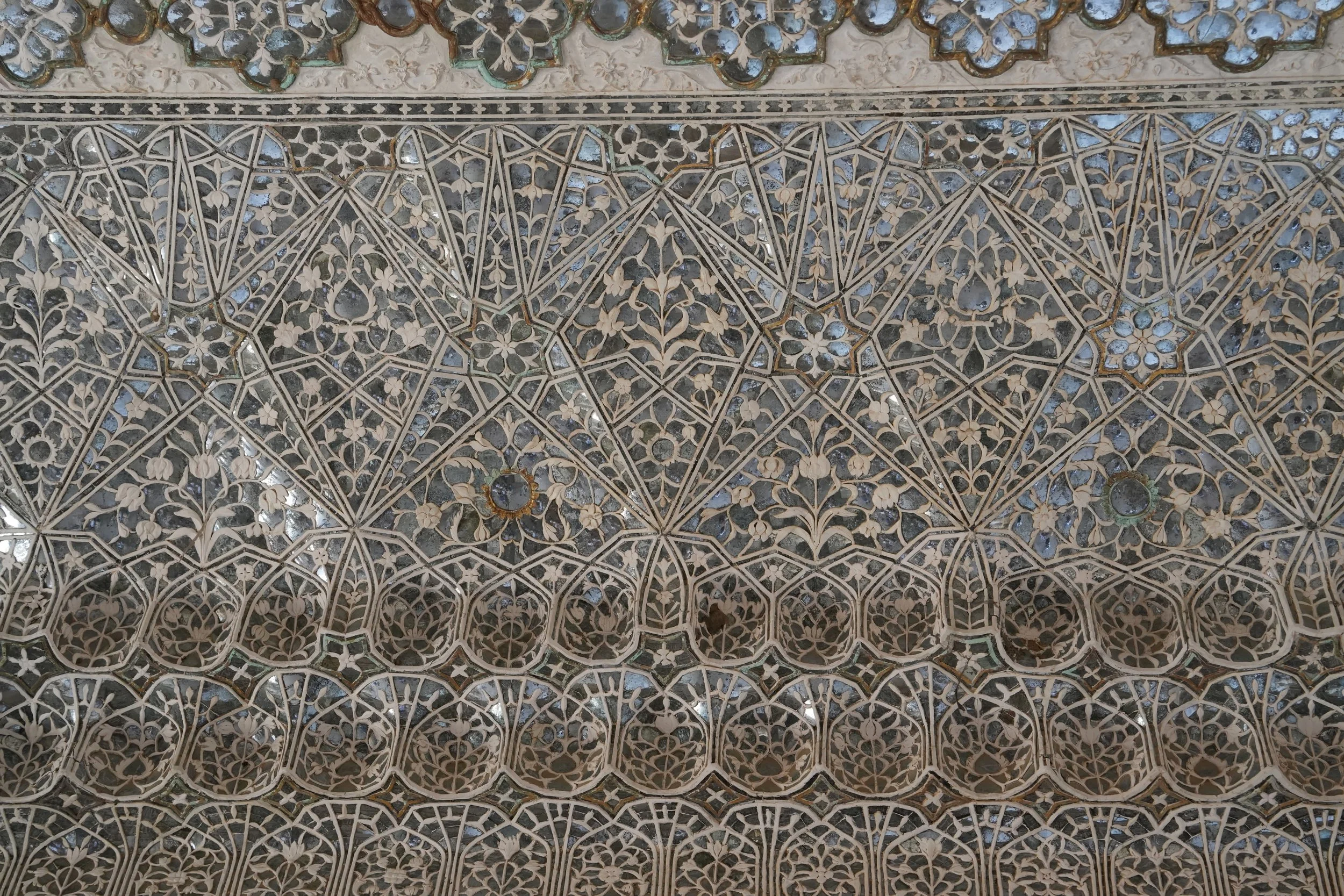
One of the architectural highlights was the Sheesh Mahal, the Mirror Palace, where thousands of tiny mirrors are set into the walls and ceilings in intricate patterns. The crush of visitors made it difficult to linger. Large groups pressed forward, phones raised, guides speaking over one another. It was hard to find the quiet moment that such a space deserves.
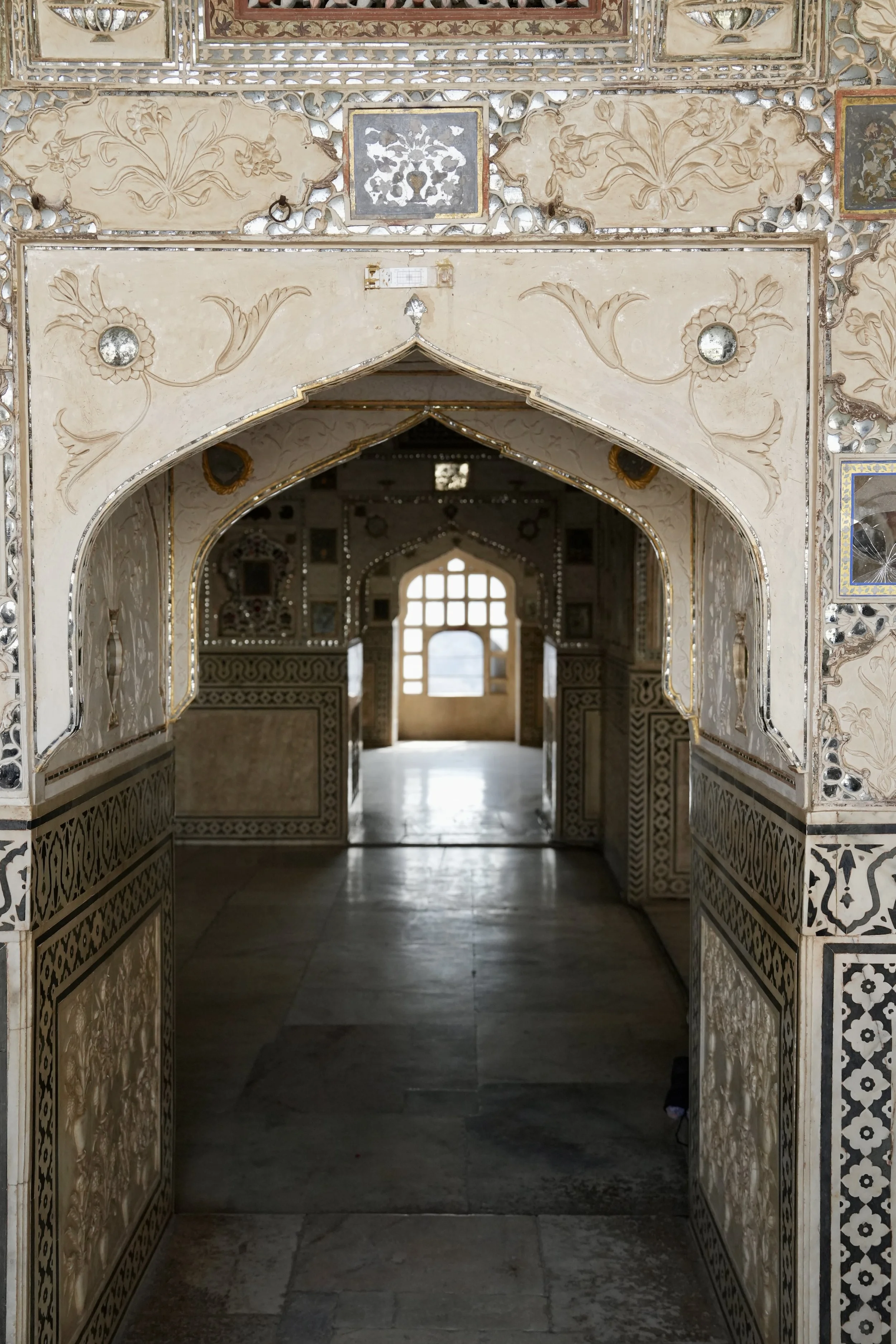
Eventually we made our way back down to the first courtyard and located our jeeps. Looking back at the painted gateways and layered arches, I felt slightly conflicted. There is no question that Amer Fort is grand, historically significant, architecturally complex, dramatically set. And yet, for me, it was the most disappointing visit so far.
Perhaps it was the early start, or the heat, or simply the weight of expectation. Perhaps it was the sheer volume of visitors and wedding shoots that turned parts of it into a stage set. Whatever the reason, it didn’t quite carry the spiritual stillness of the Golden Temple or the quiet magic of the Taj Mahal at sunrise.
Still, as the jeep wound its way back down past the lake and the long defensive walls, it was impossible not to admire the ambition of the place, a palace built to command both land and imagination, even if, on that morning, it struggled to command mine.
Mausoleum of the Maharajas
On the way back from Amer, we paused at the Water Palace, sitting low and symmetrical in the middle of Man Sagar Lake. Built in the 18th century in red sandstone, it looks almost unreal from the roadside. Five storeys in total, yet only the top floor visible above the waterline. The rest lies submerged, an elegant illusion of lightness that is, in reality, a feat of careful engineering. It’s closed to visitors, which somehow adds to the mystique.
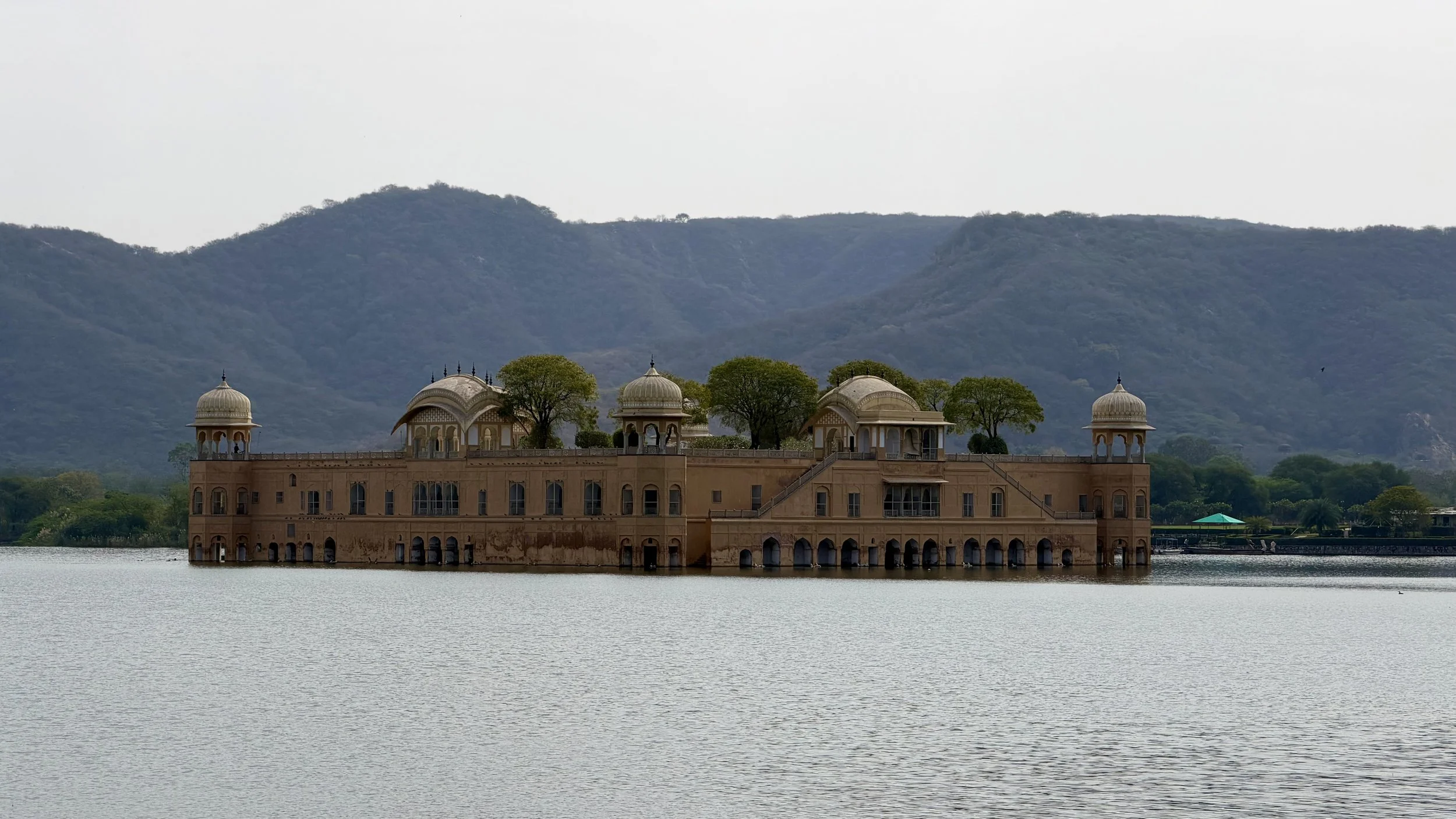
Jal Mahal, Jaipur
From there we climbed into waiting jeeps, the approach to the mausoleum isn’t possible by coach, and set off on what can only be described as an enthusiastic drive through Jaipur traffic. Motorbikes skimmed past on either side, cows stood with serene indifference in the road, pedestrians stepped confidently into gaps that didn’t really exist. For some in our group it was the unexpected highlight of the day; for others it was an exercise in quiet resilience until we arrived intact.
The mausoleum itself was Royal Gaitor Tumbas, the royal cremation ground of Jaipur’s Maharajas. After the heat and bustle of Amer Fort, the contrast was immediate. Pale marble cenotaphs stood in gentle rows against the hills, each one delicately carved with domes, columns and fine latticework. It was calm. Not empty, but not busy.
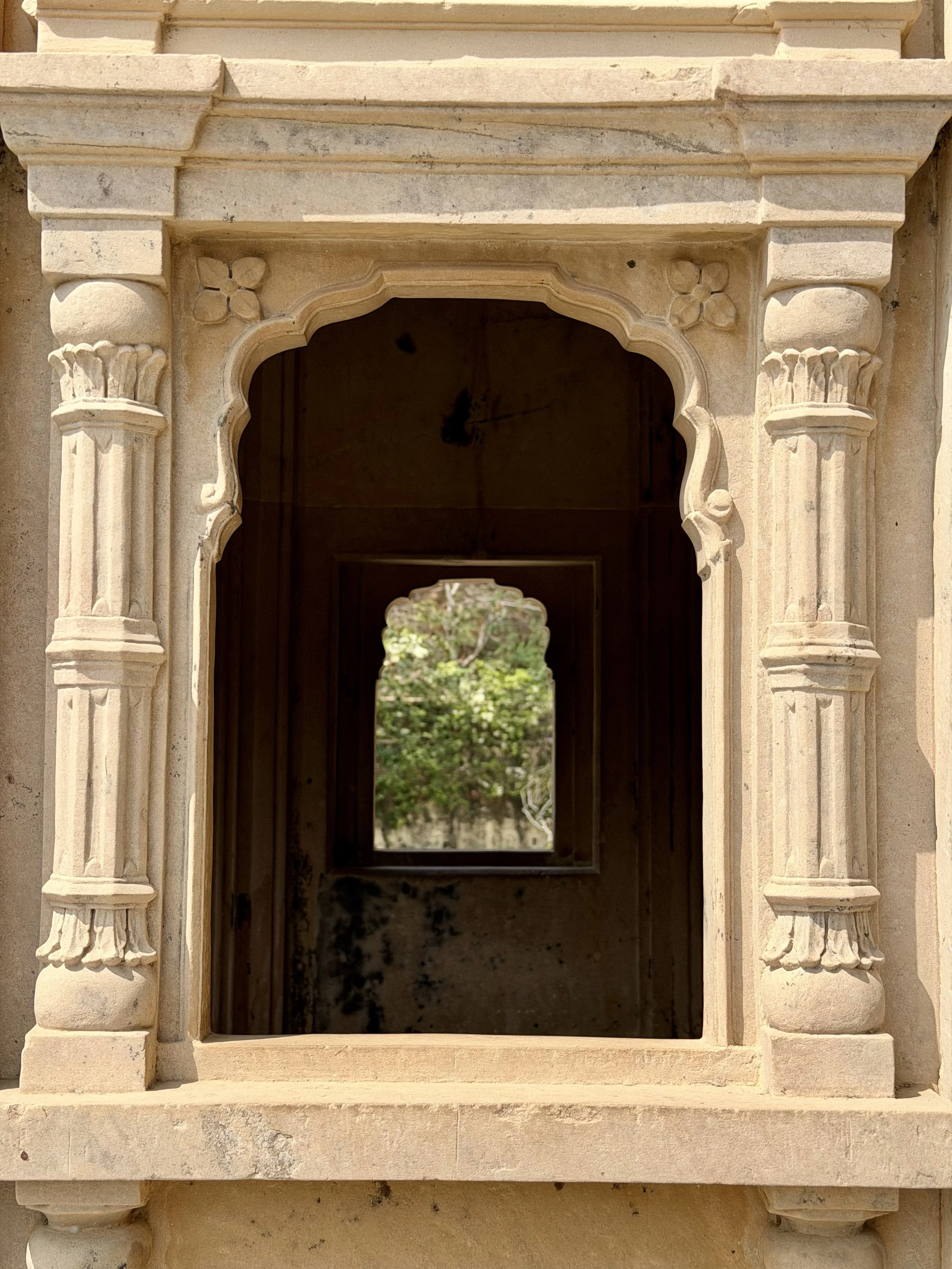
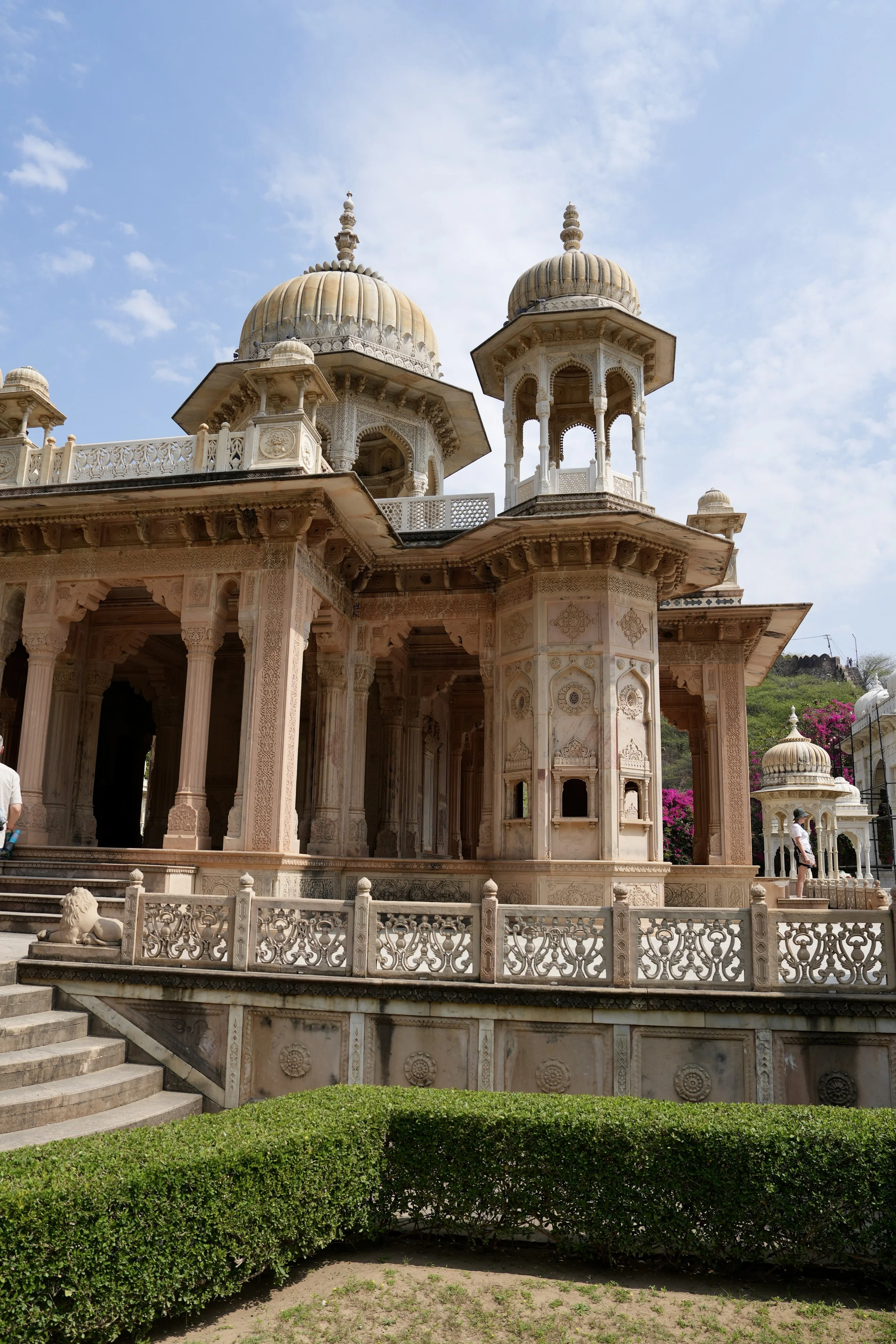
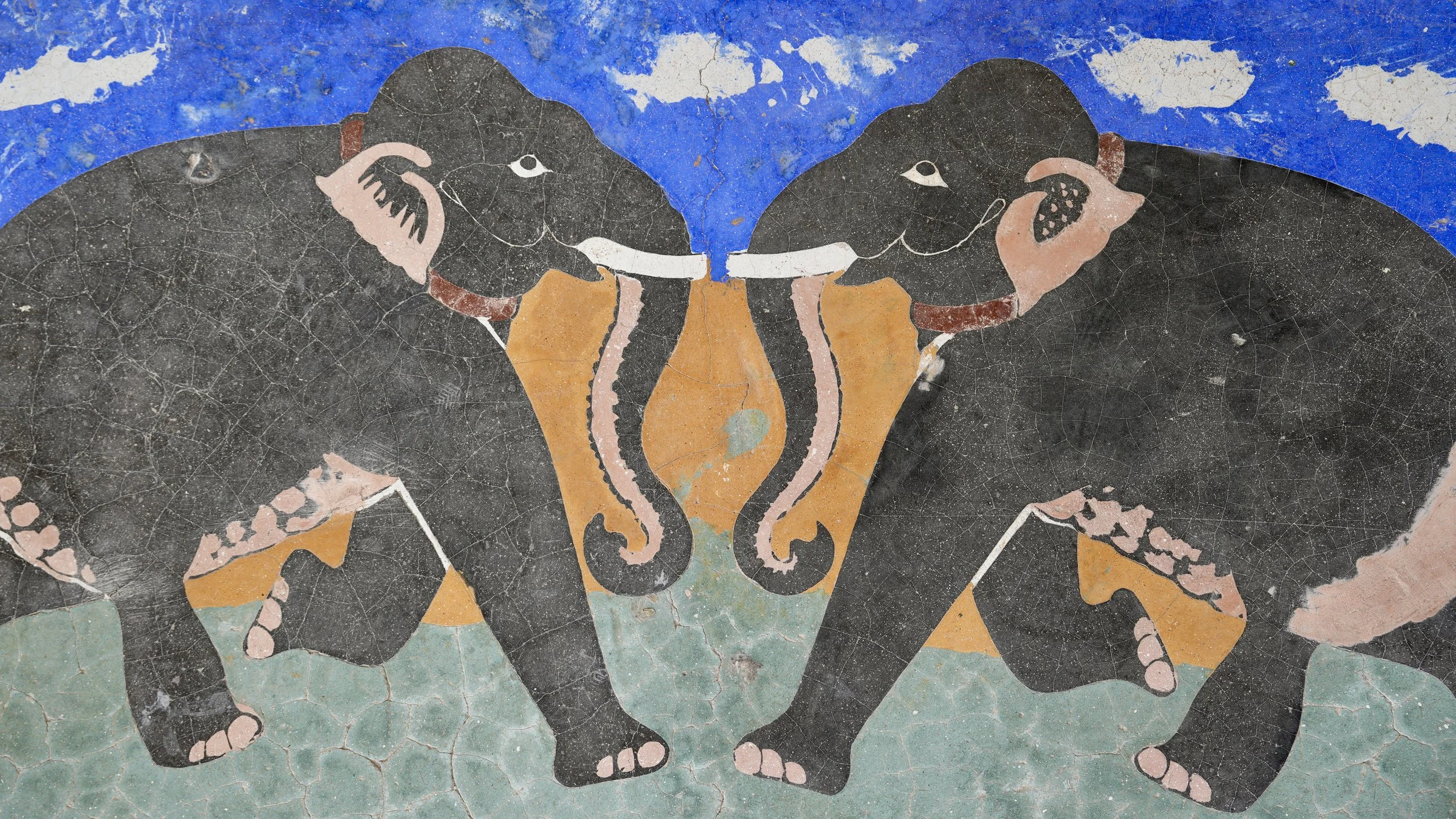
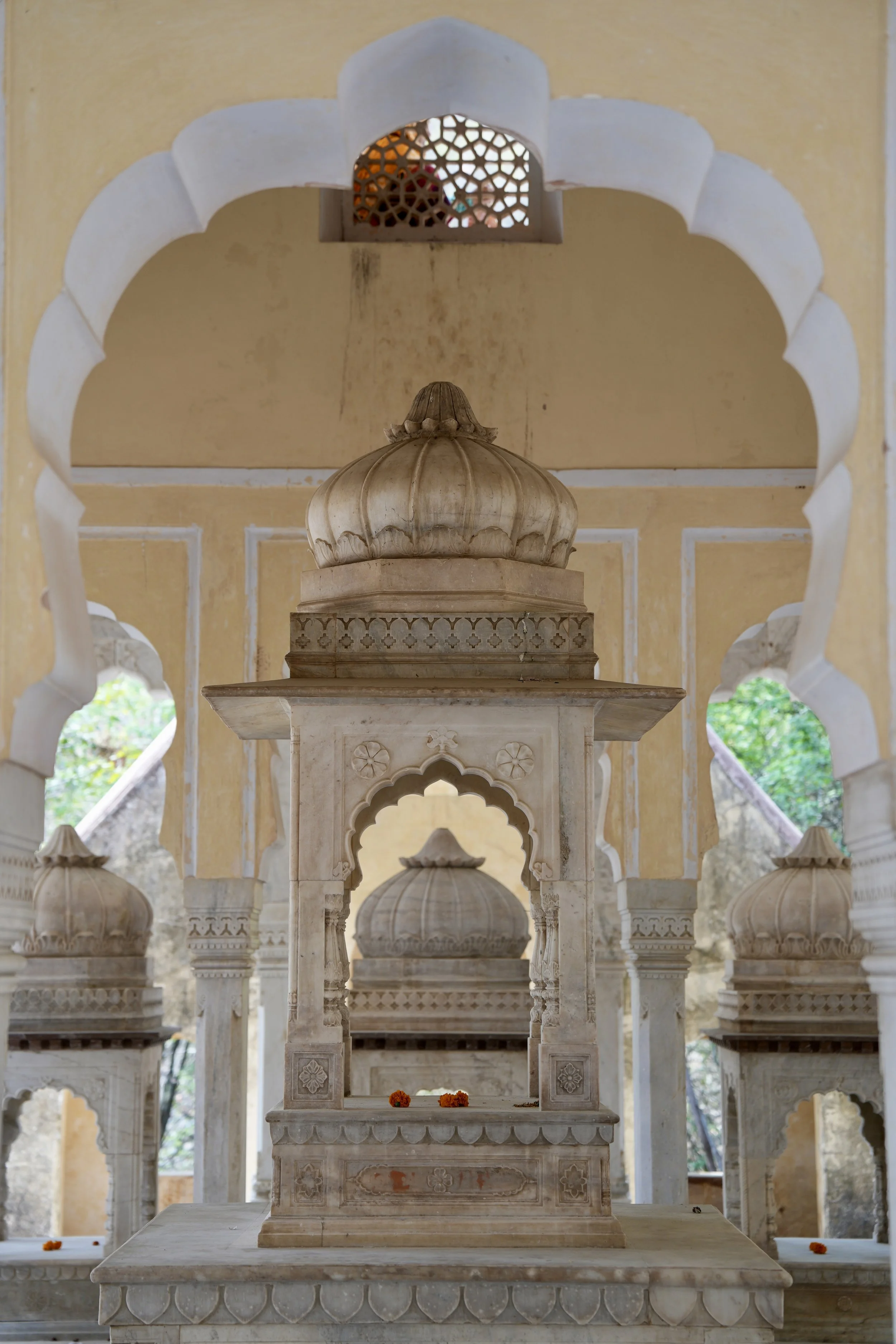
Our guide gave his usual concise explanation, who was commemorated where, the symbolism in the carvings, the Rajput traditions of honour and remembrance, and then left us to wander. I found it unexpectedly absorbing. Not just the monuments themselves, but the life around them.
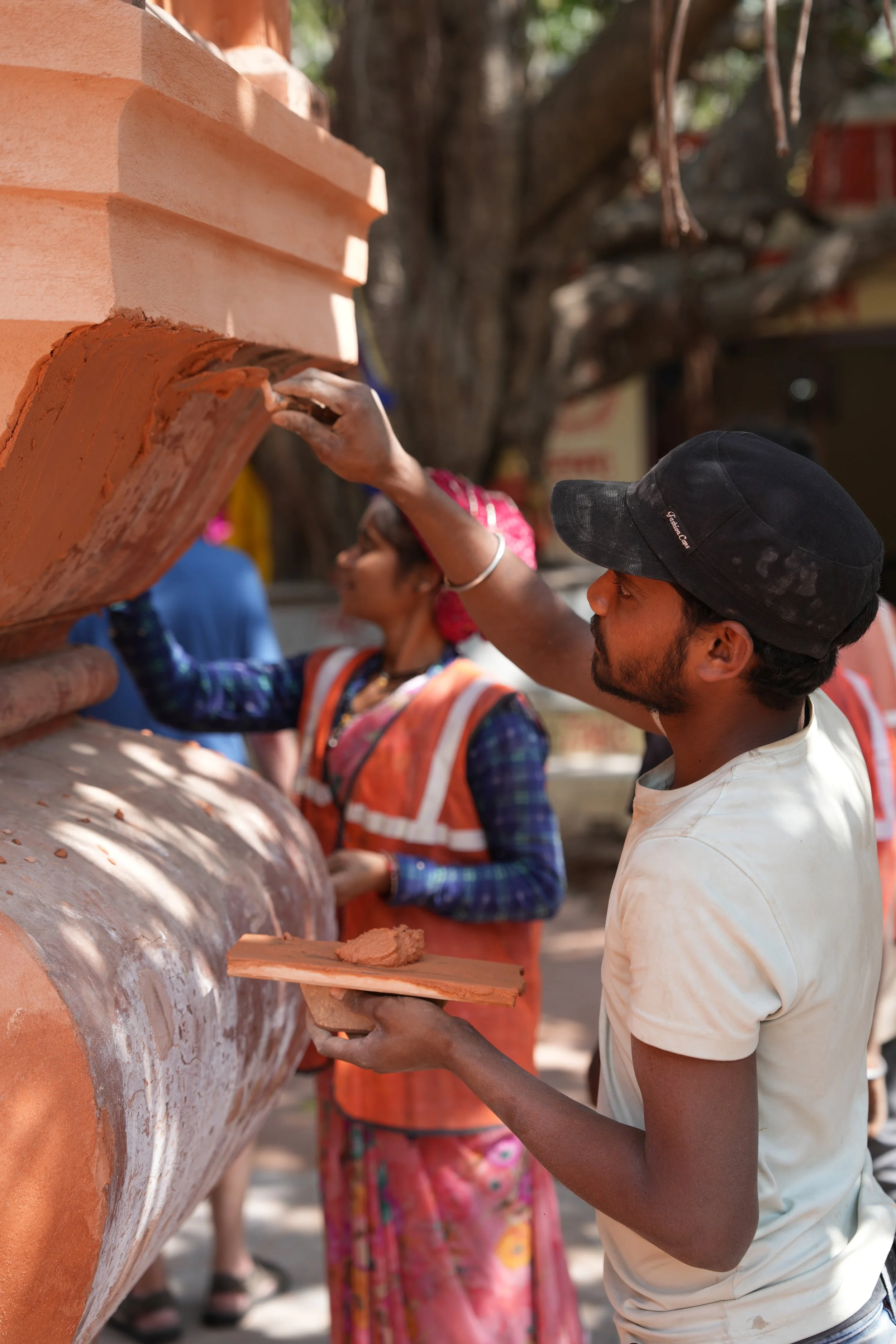
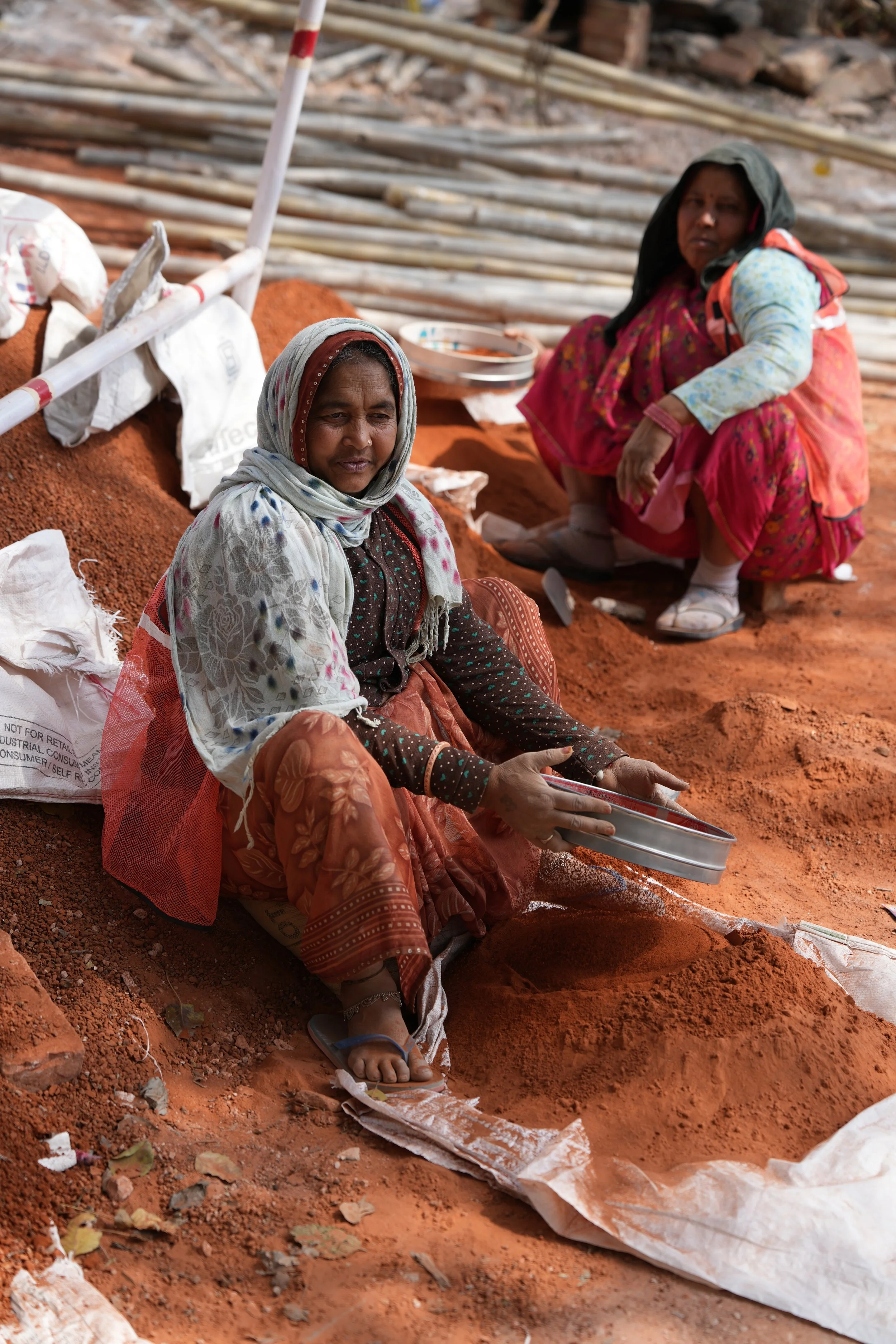
Restoration work was underway in several areas. Teams were carefully applying fresh lime plaster, layering render by hand with a patience that felt almost devotional. You could see the rhythm of it: scoop, smooth, step back, adjust. Women worked alongside the men, some with young children nearby, others carrying or shifting sand for the mix. It wasn’t hurried; it was steady, deliberate craftsmanship.
We sat for a while in the courtyard. A group of Indian women chatted in the shade, their voices low and companionable. A few couples sat quietly together, enjoying the peace and quiet. The place had a dignity to it, not grand in the way of Amer Fort, but more human in scale.
This felt like the pause I’d been hoping for. A gentler end to the morning. I’m grateful our guide chose it.