Ranthambore - In Tiger Country
Early Dawn
Another highlight day on the tour: two safaris into Ranthambore National Park in search of Bengal Tiger — one at first light and one again in the late afternoon, with a few quiet hours in between to let it all settle.
We gathered before dawn by the hotel pool, coffee and biscuits in hand, the air still cool. Several groups were waiting, passports ready for inspection, a slightly vague warning about mobile phones repeated more than once. At 6am our canter, a 20-seater open-top truck with tiered bench seats, arrived and we climbed aboard. As we drove towards the park, the sky slowly lightened to a pale wash of blue and gold.
At the entrance checkpoint an Indian lady in uniform stepped aboard and randomly checked passports while a line of canters and jeeps waited their turn. Once we had the signal to move on, we rolled into the forest. Spotted deer moved lightly between the trees. Peacocks picked their way through the undergrowth. The dry grasses were already catching the early sun.
Not long into the drive the vehicles ahead of us slowed, then stopped. A ripple passed through the canters, cameras lifted, people stood, lenses pointed forward. Tigers. Not deep in the forest, but close to the track.
We waited our turn. From the back of the canter you could see the scene ahead: rows of vehicles, passengers on their feet, phones and cameras held high, everyone craning for a better angle... and a vague outline of a tiger between the trucks. The lack of coordination between drivers was obvious and, if I’m honest, mildly frustrating. Our guide grew visibly impatient. So did some of us.
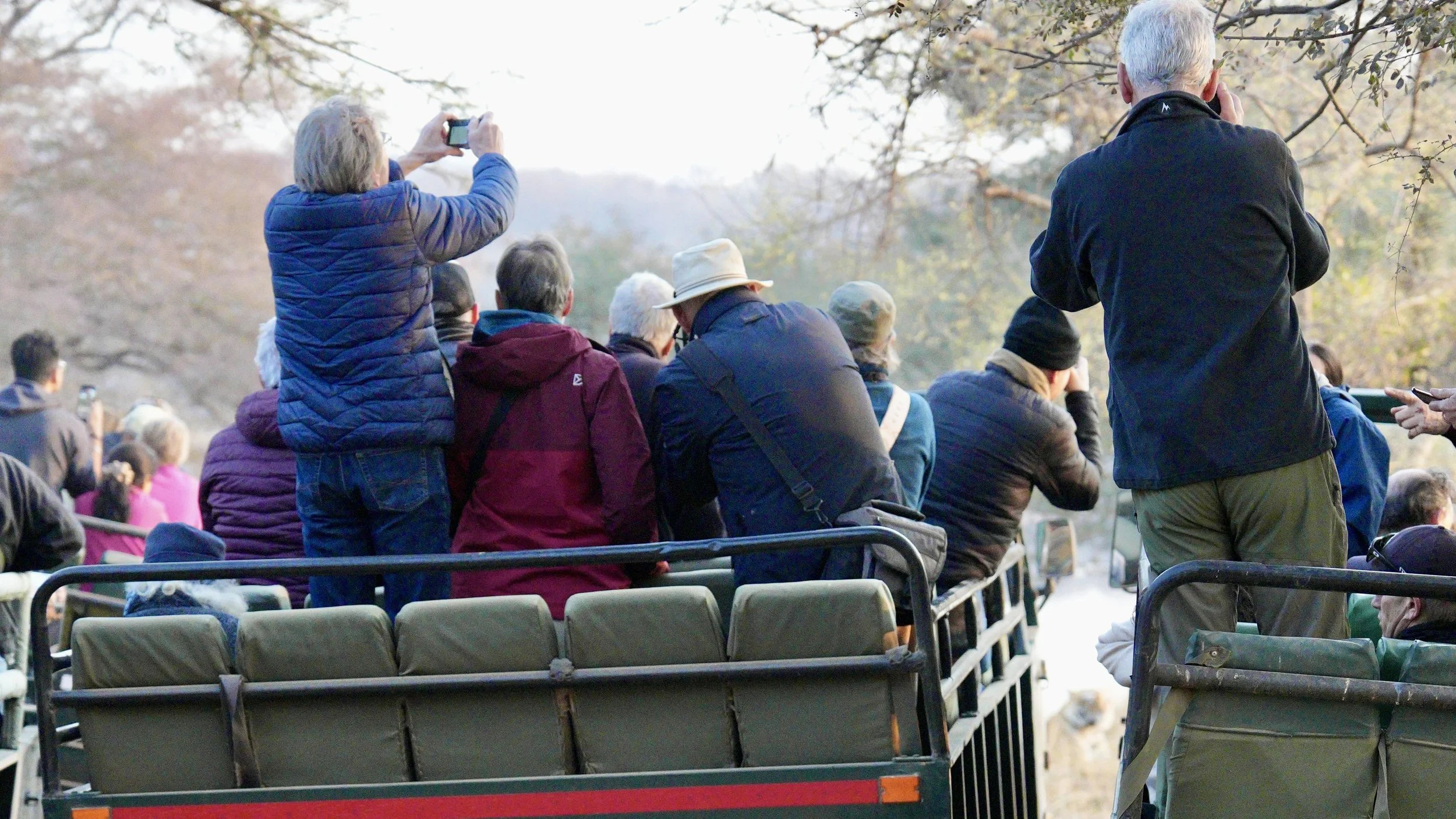
Frustration in the park
Tigers!
Eventually two canters pulled away and the view opened.
There they were, two brothers, about two and a half years old and already powerful animals, lying in the dry grass just off the road. One looked directly towards us, head tilted slightly, pale eyes steady and untroubled by the line of vehicles. The other rose and moved through the scrub, muscles rolling beneath the striped coat, pausing to glance back over his shoulder. For a few minutes they interacted quietly, a nudge, a shift of position, the easy familiarity of siblings who have grown up together.
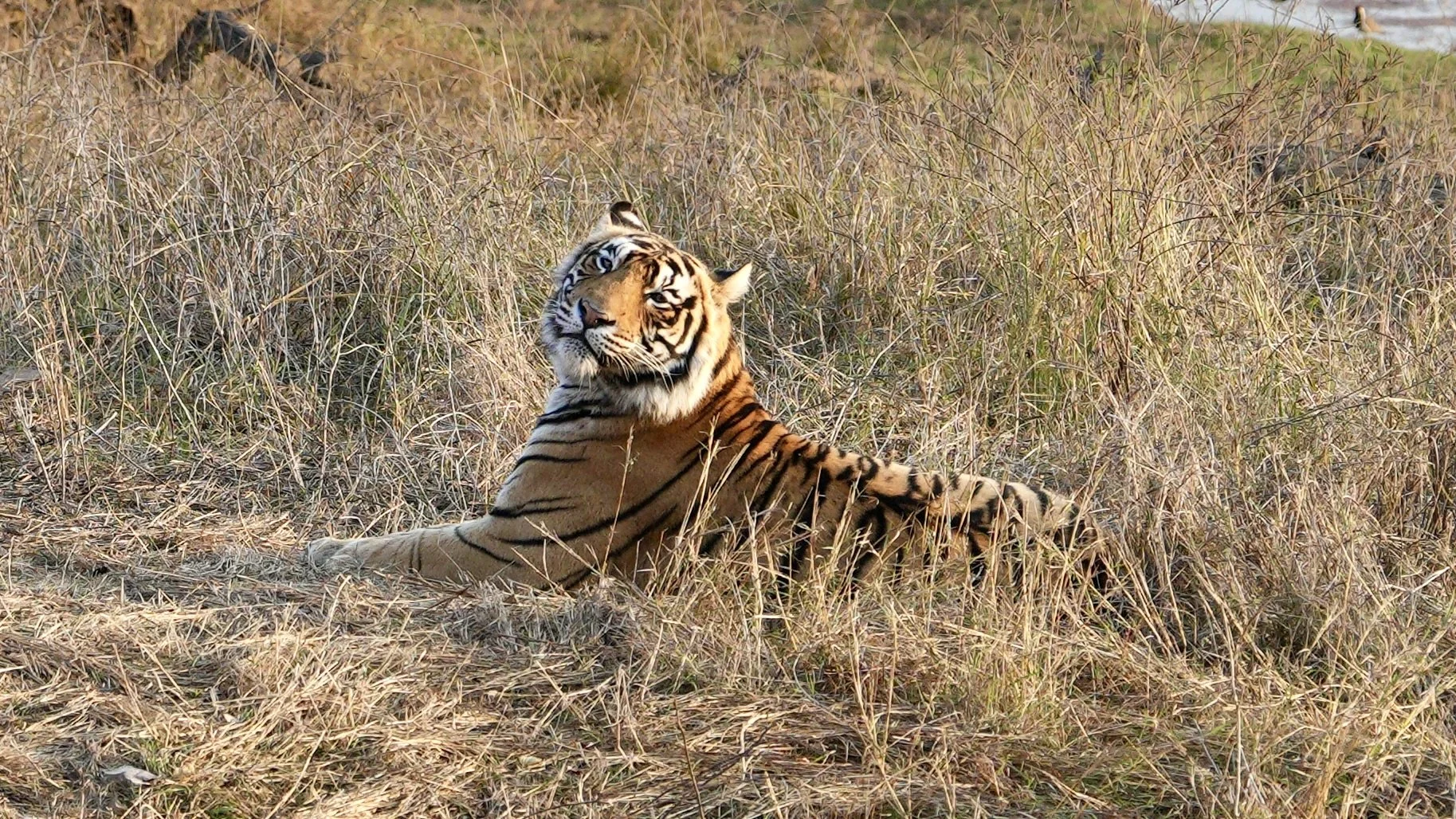
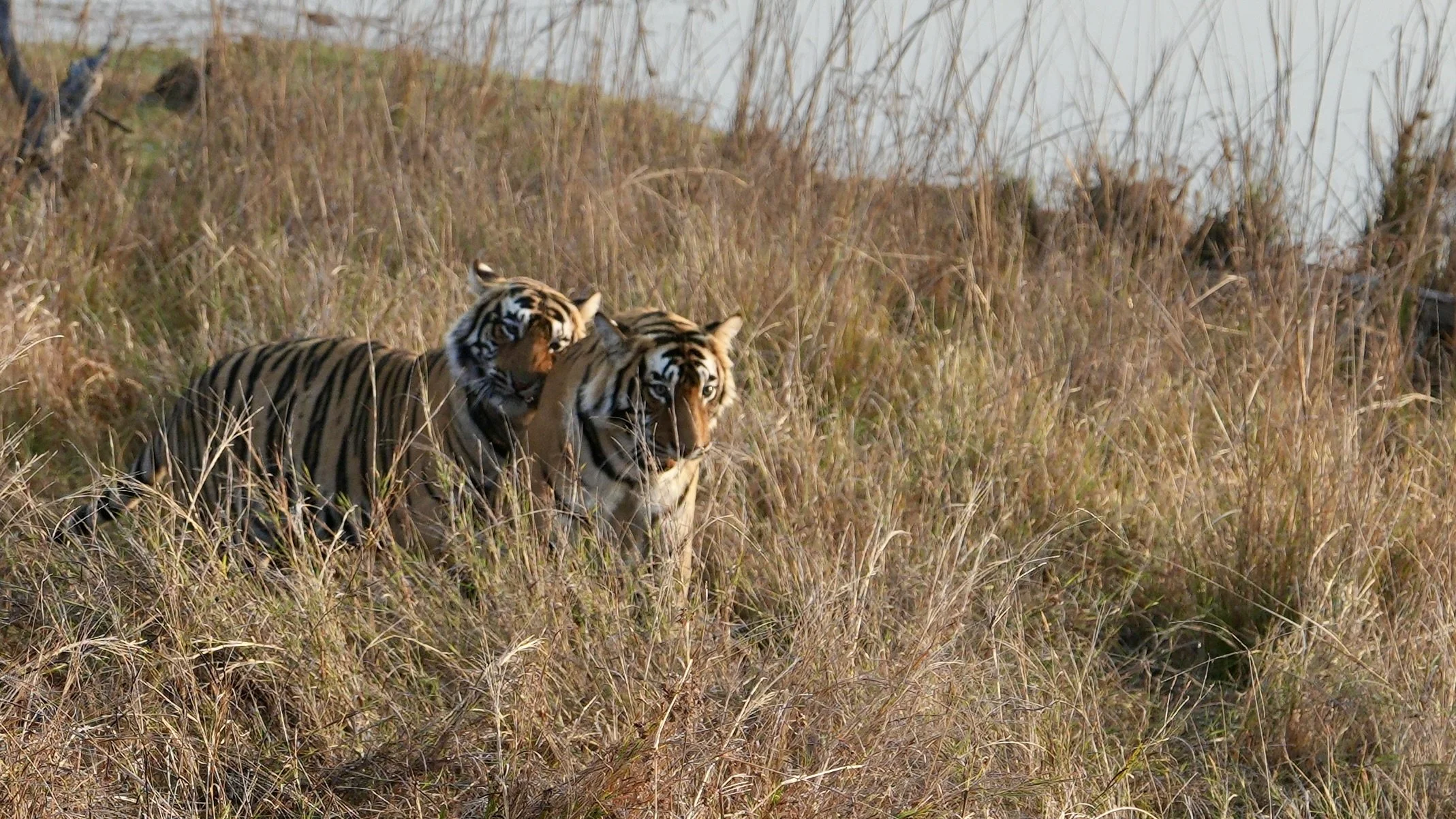
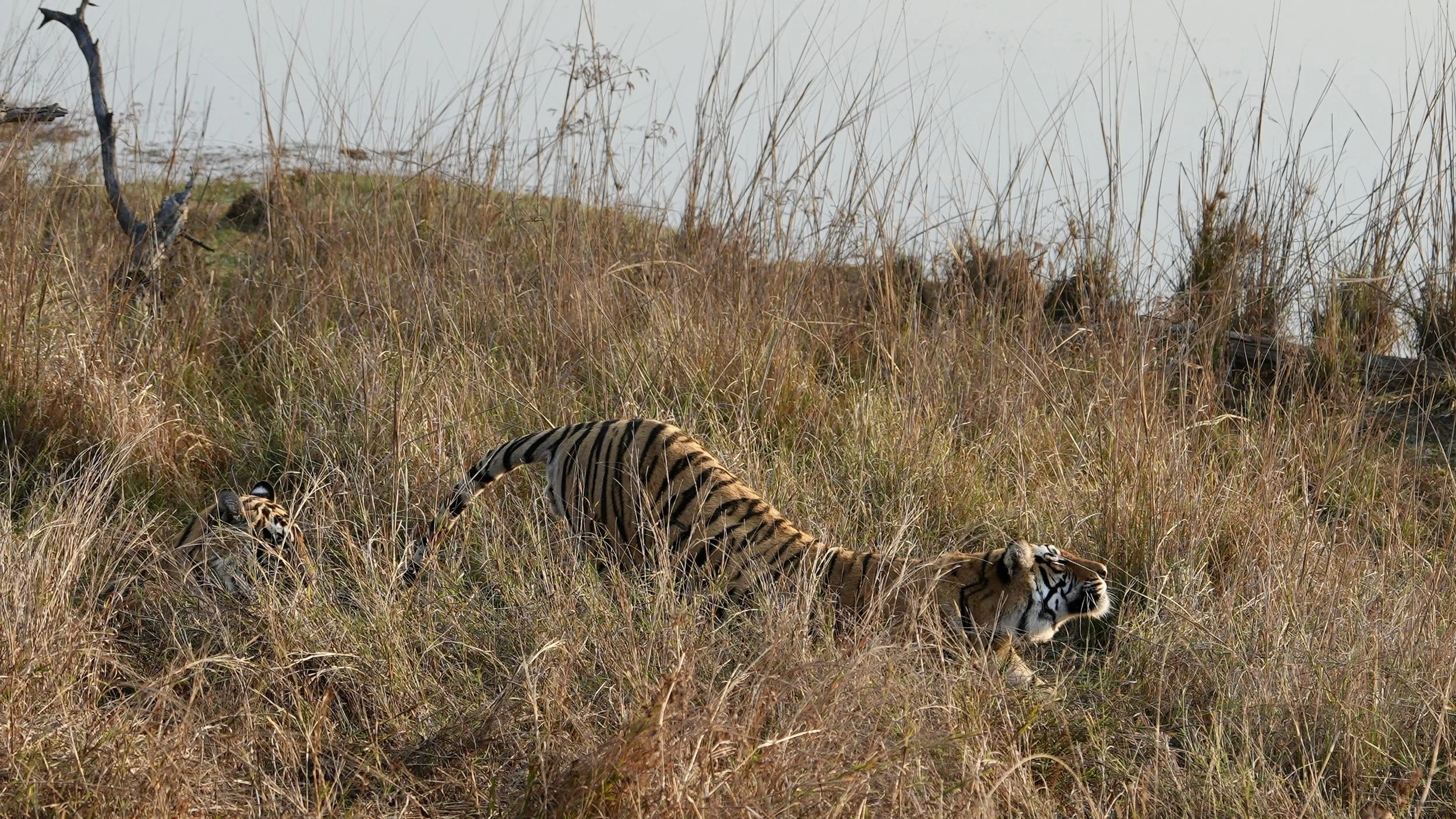
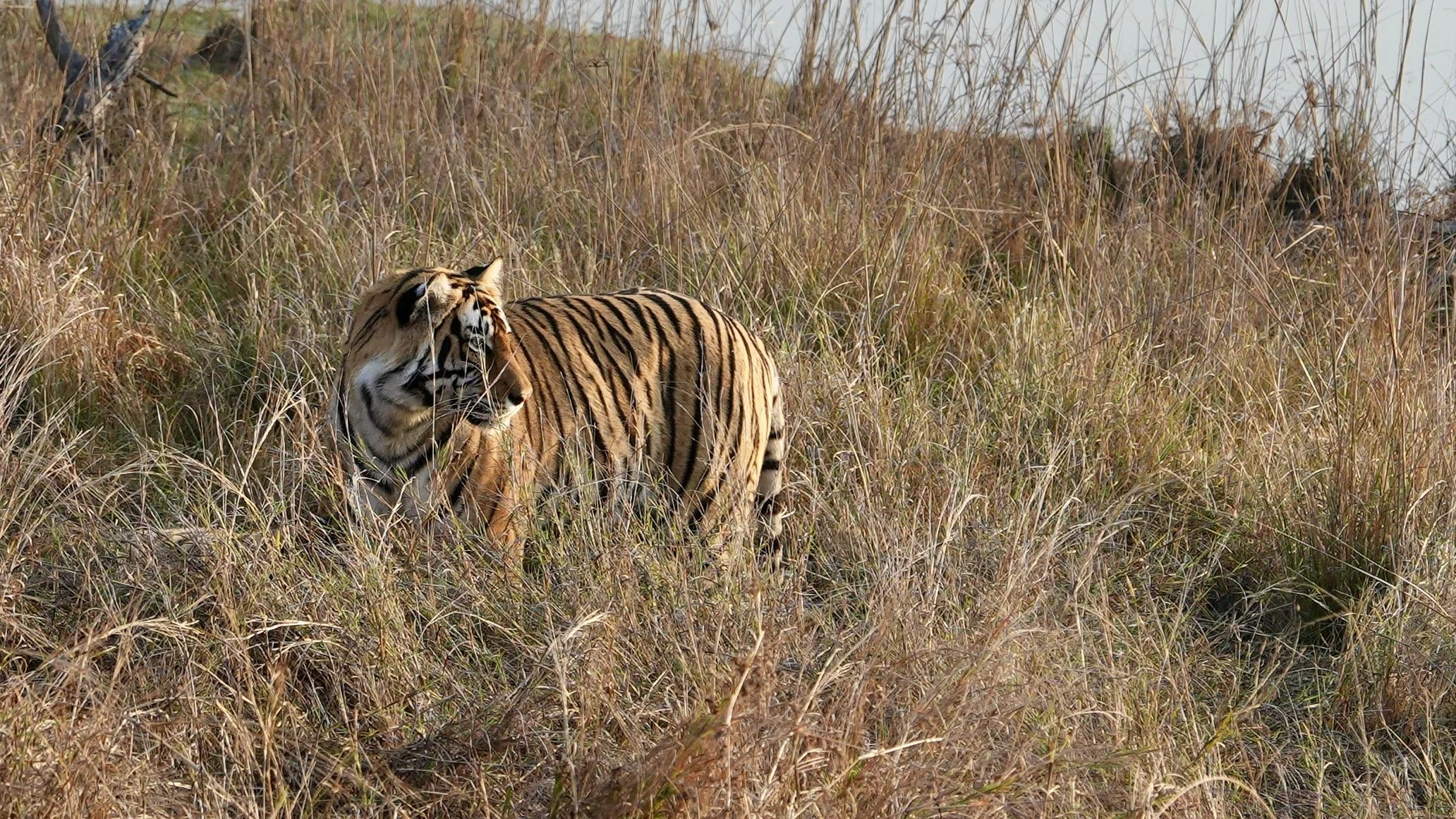
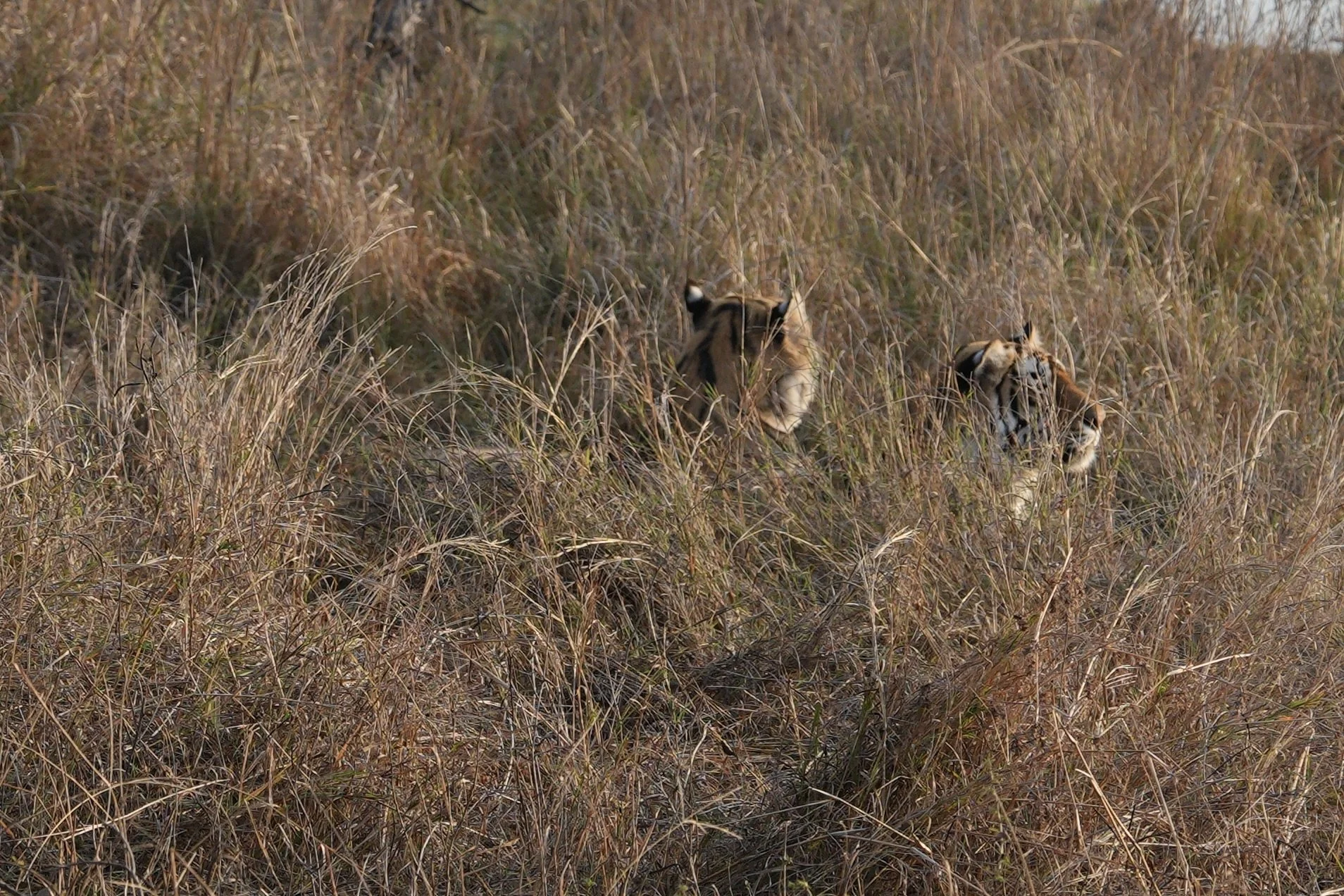
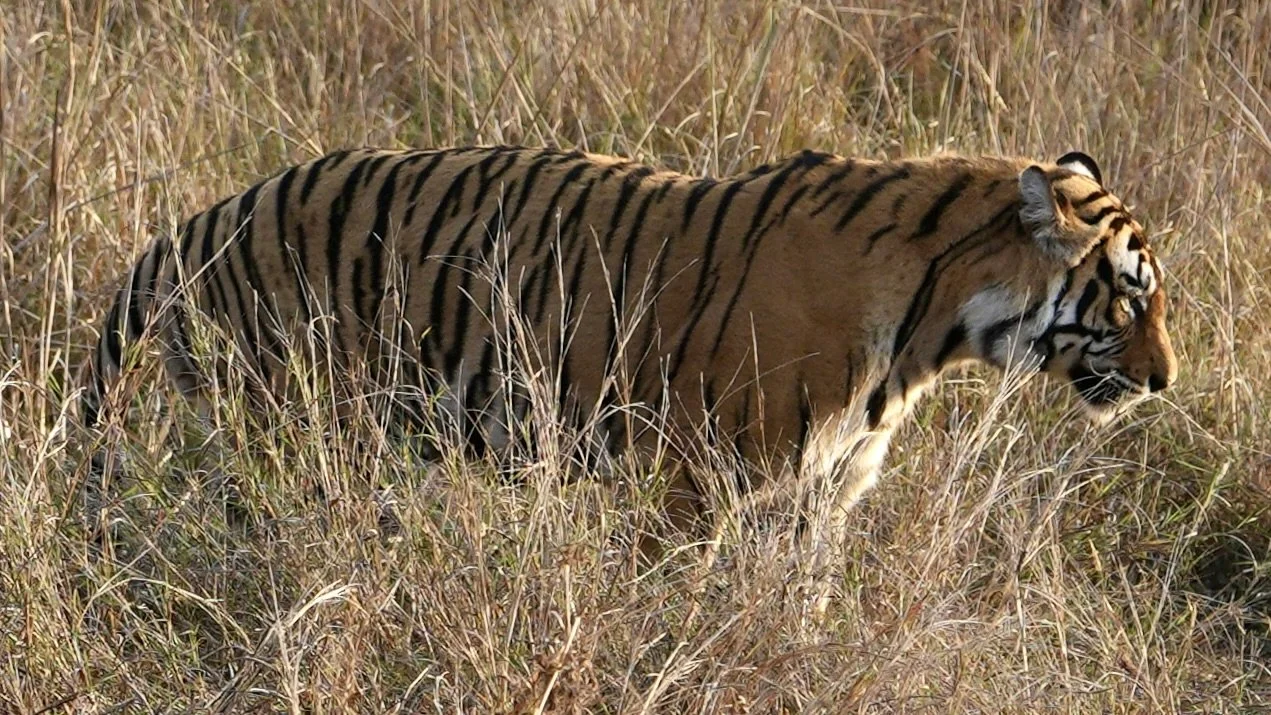
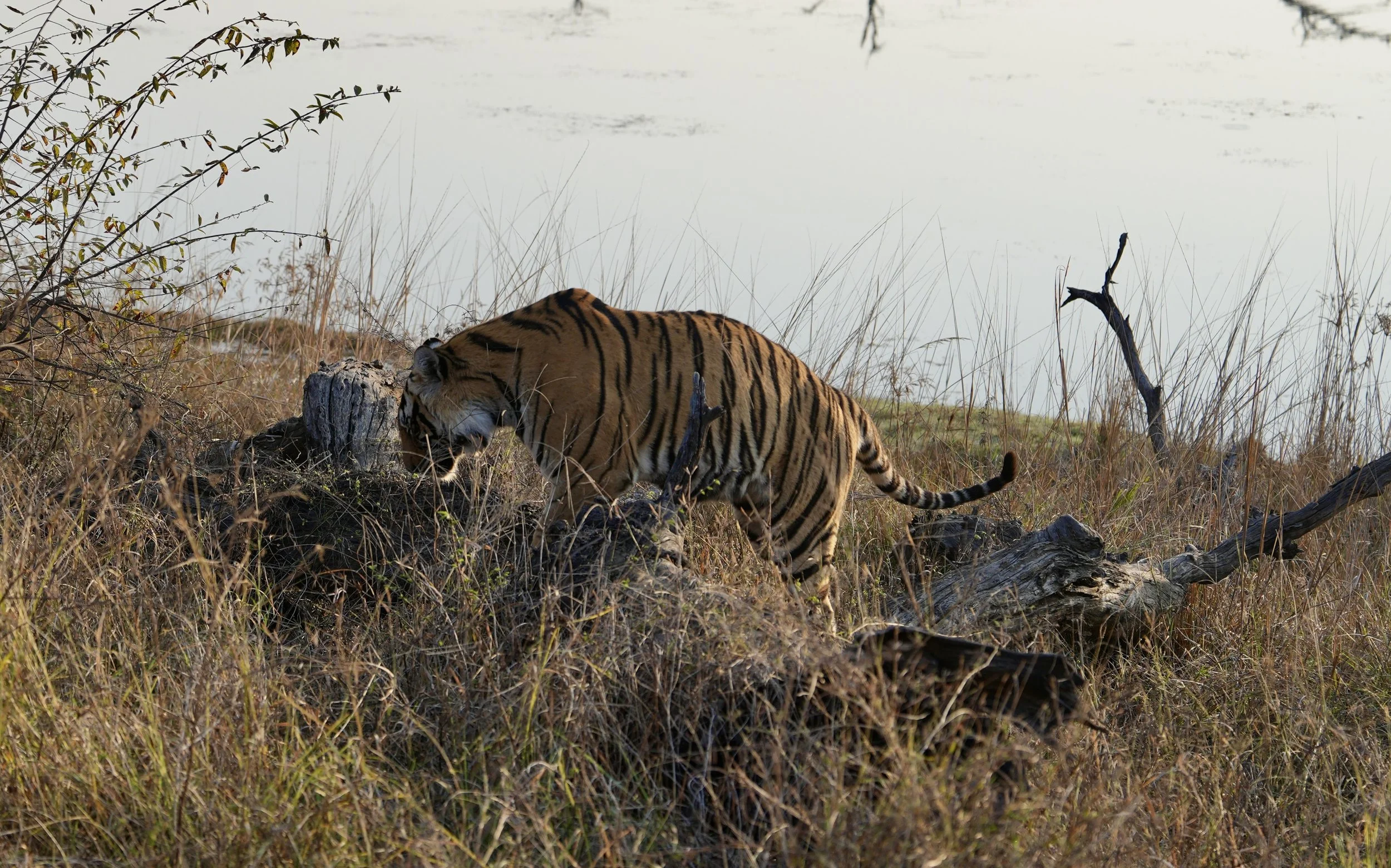
One of them then walked towards the lake, disappearing briefly into taller grass before emerging in profile, the light picking out the curve of his back and the clean lines of his markings. Later, stretched forward in a long, deliberate movement, he lowered himself again, almost dissolving into the dry reeds. In the final moments we watched one sit at the water’s edge, back to us, facing the bright reflection of the rising sun across the still surface, a surprisingly peaceful image after the intensity of the sighting.

Tiger in the sunrise
It was a generous encounter. Close, prolonged and calm. We stayed as long as we were permitted before the guide signalled it was time to move on, leaving the brothers to their morning and heading back into the forest to look for whatever else Ranthambore might choose to reveal.
Beyond Tigers
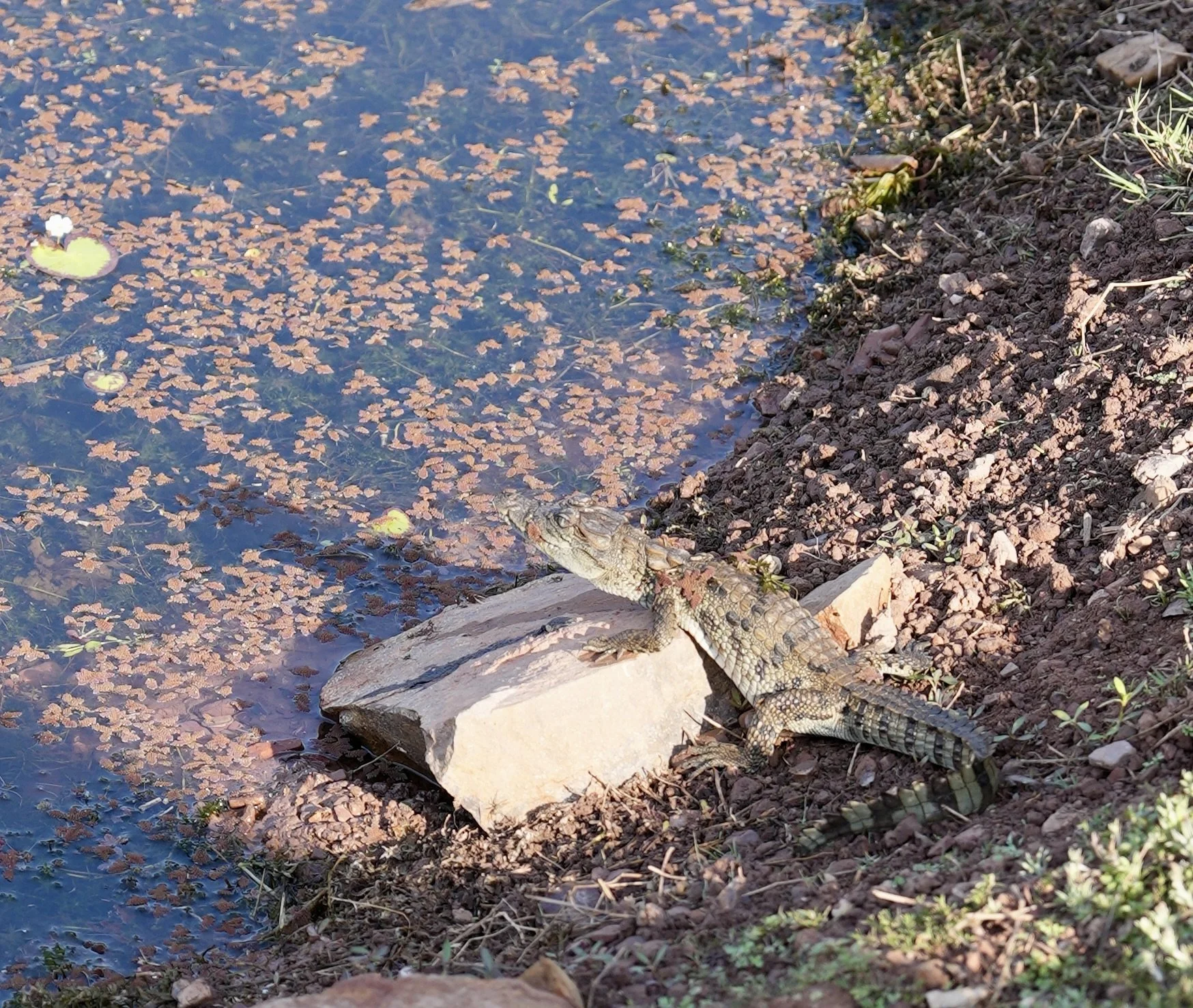
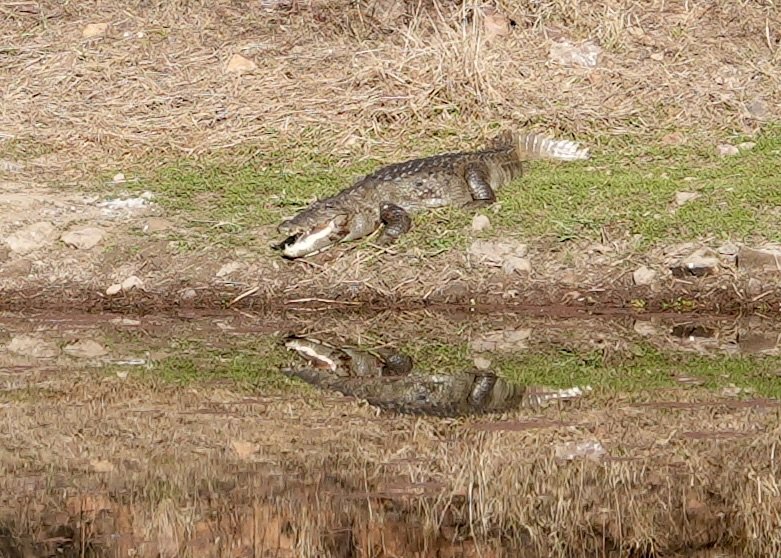
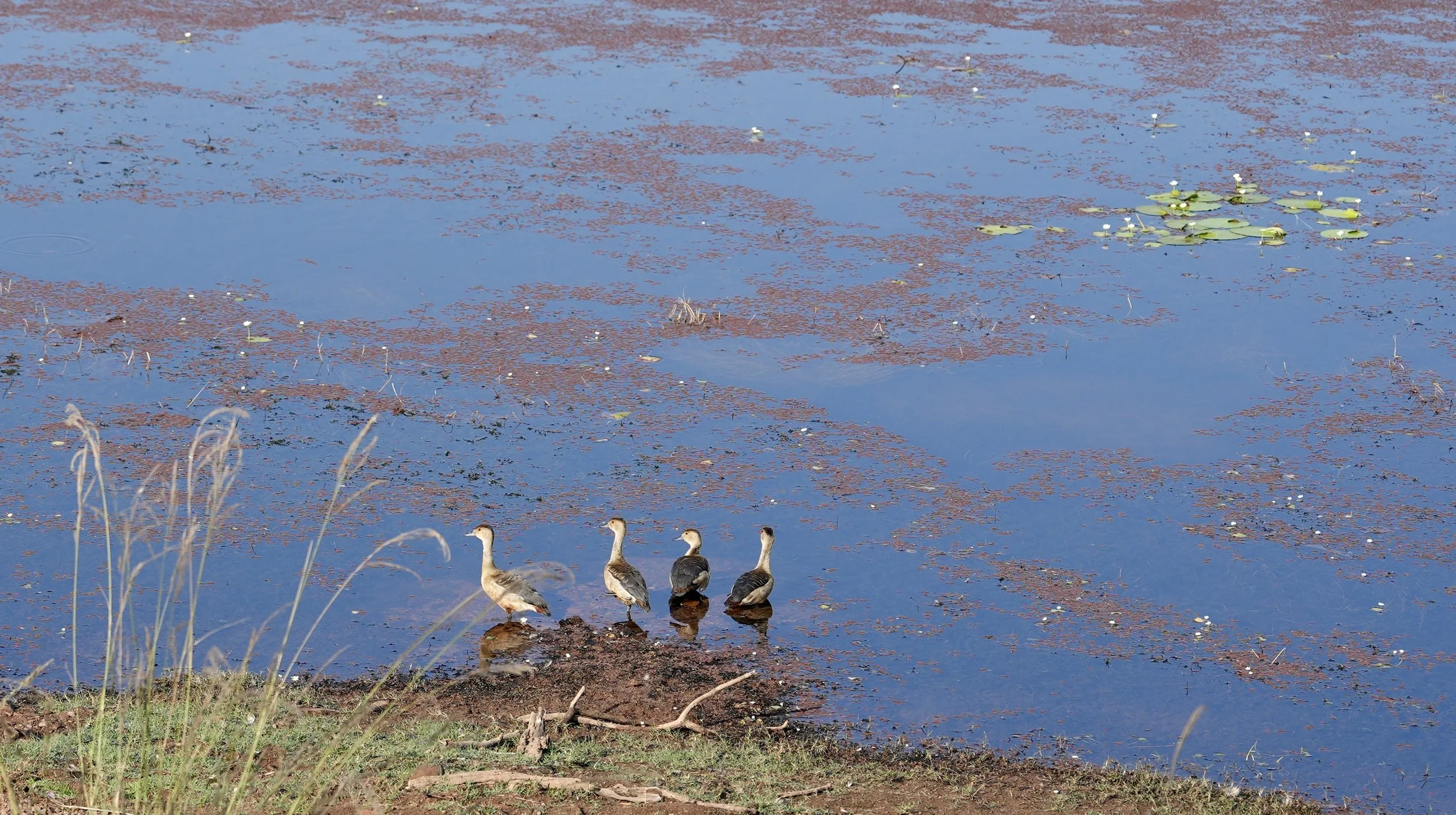
Further on, by one of the lakes, four ducks stood ankle-deep at the water’s edge, their reflections broken by patches of floating weed and tiny white water lilies. The surface was mottled with rust-coloured vegetation, the blue sky mirrored between the gaps. Just along the bank a crocodile lay motionless on the mud, jaws slightly open, its ridged back perfectly echoed in the still water below. A young crocodile rested half in shadow near a rock, so well camouflaged it took a moment for the eye to register what it was.
Inside the park, even the smaller moments felt part of the wider theatre of Ranthambore. At a rest stop, one of a number of rufous treepie landed lightly on the rail beside us, slate-grey head catching the early light, its warm chestnut body almost glowing against the dusty backdrop. It paused, alert and self-possessed, long black-and-white tail balancing neatly as it surveyed the track ahead. Treepies are clever, watchful birds, members of the crow family, and often among the first to sound an alarm if something larger is moving through the forest. For a few quiet seconds it held our attention completely, a reminder that in Ranthambore it isn’t only the tigers that deserve a second look.
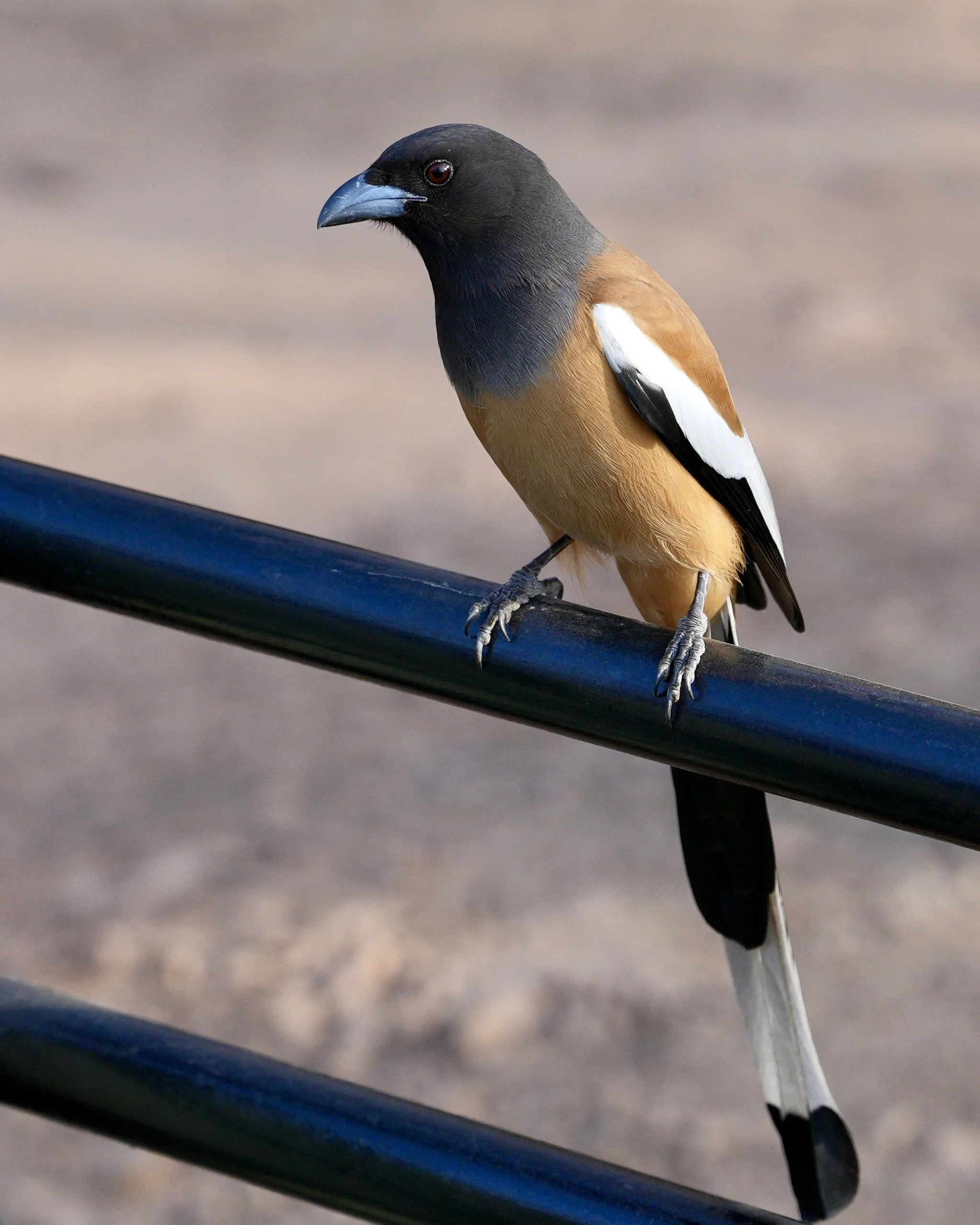
A Rufous Treepie
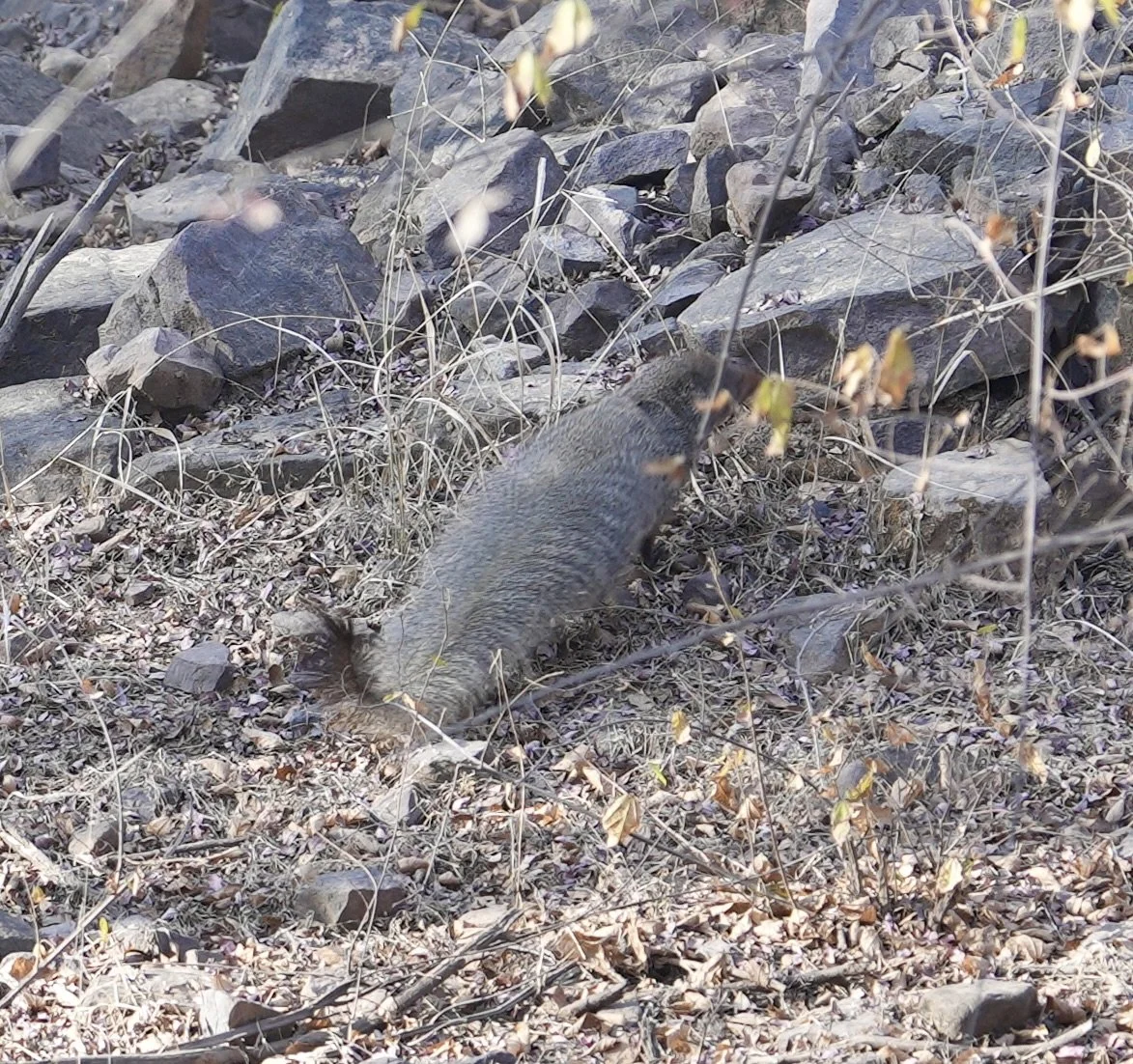
In the drier woodland a mongoose darted between stones and fallen leaves, tail held stiffly behind it as it nosed through the undergrowth. Spotted deer grazed calmly among the trees, white speckles bright against their warm coats. One stag, antlers neatly branched, crossed the dusty track ahead of us with an easy confidence before disappearing into shade; another lay resting beneath a thin trunk, chewing methodically while keeping one ear turned towards us. In the distance, a wild boar moved steadily through the trees, head down, indifferent to our presence.
Peacocks appeared intermittently, flashes of iridescent blue and green among the muted browns, sometimes perched, sometimes picking delicately along the forest floor. None of these encounters carried the drama of the tigers, yet together they formed the texture of the place: water, mud, dry grass, filtered light through sparse canopy, and animals simply going about their day.
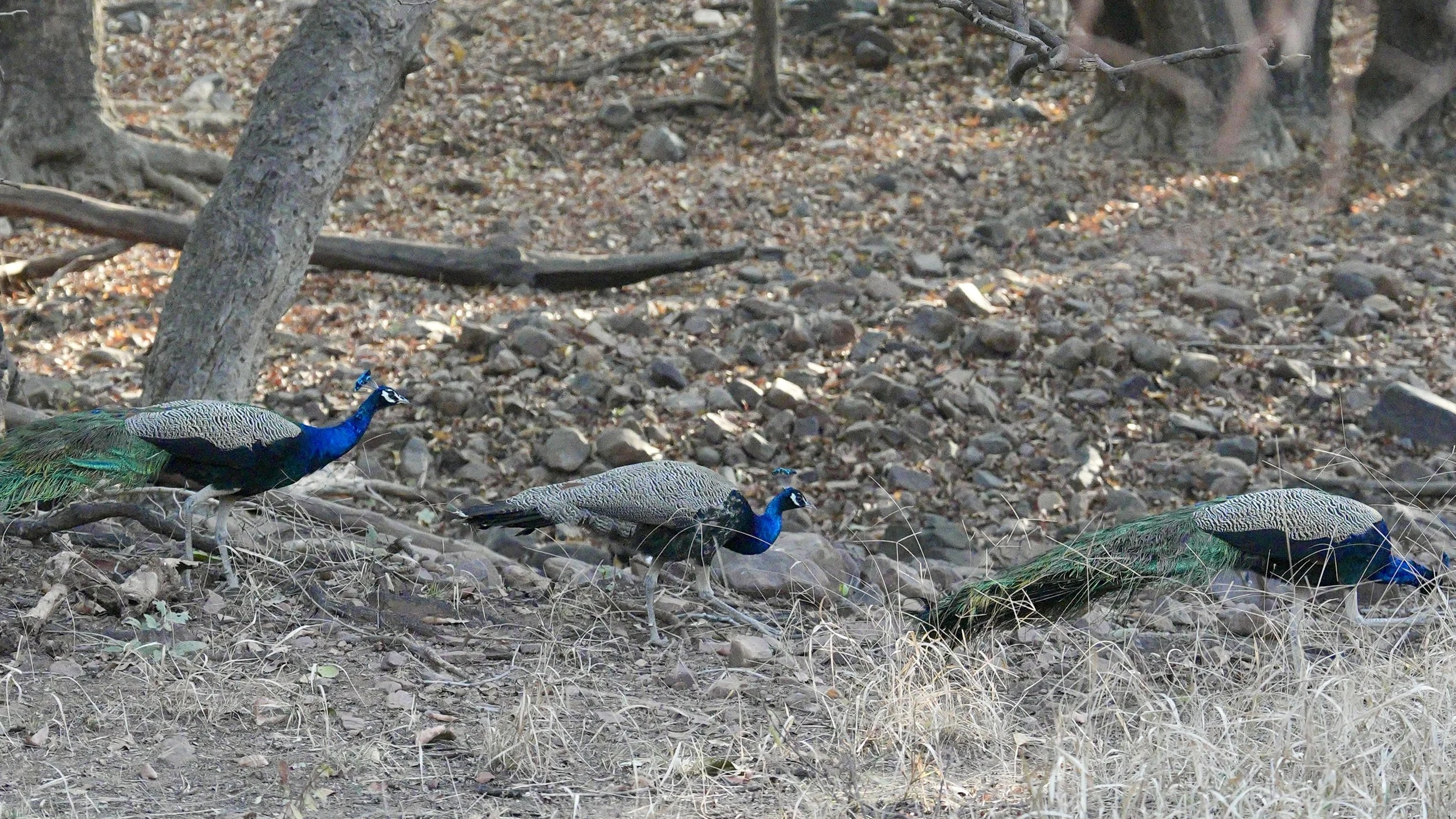
Three Peacocks
Late Afternoon
After the first safari we returned to the hotel to reset. Showers, breakfast, a brief swim for some by the pool, others drifting into an afternoon nap. It felt almost ordinary, that curious contrast between tracking wild tigers at dawn and then doing the same gentle things any holidaymaker might do.
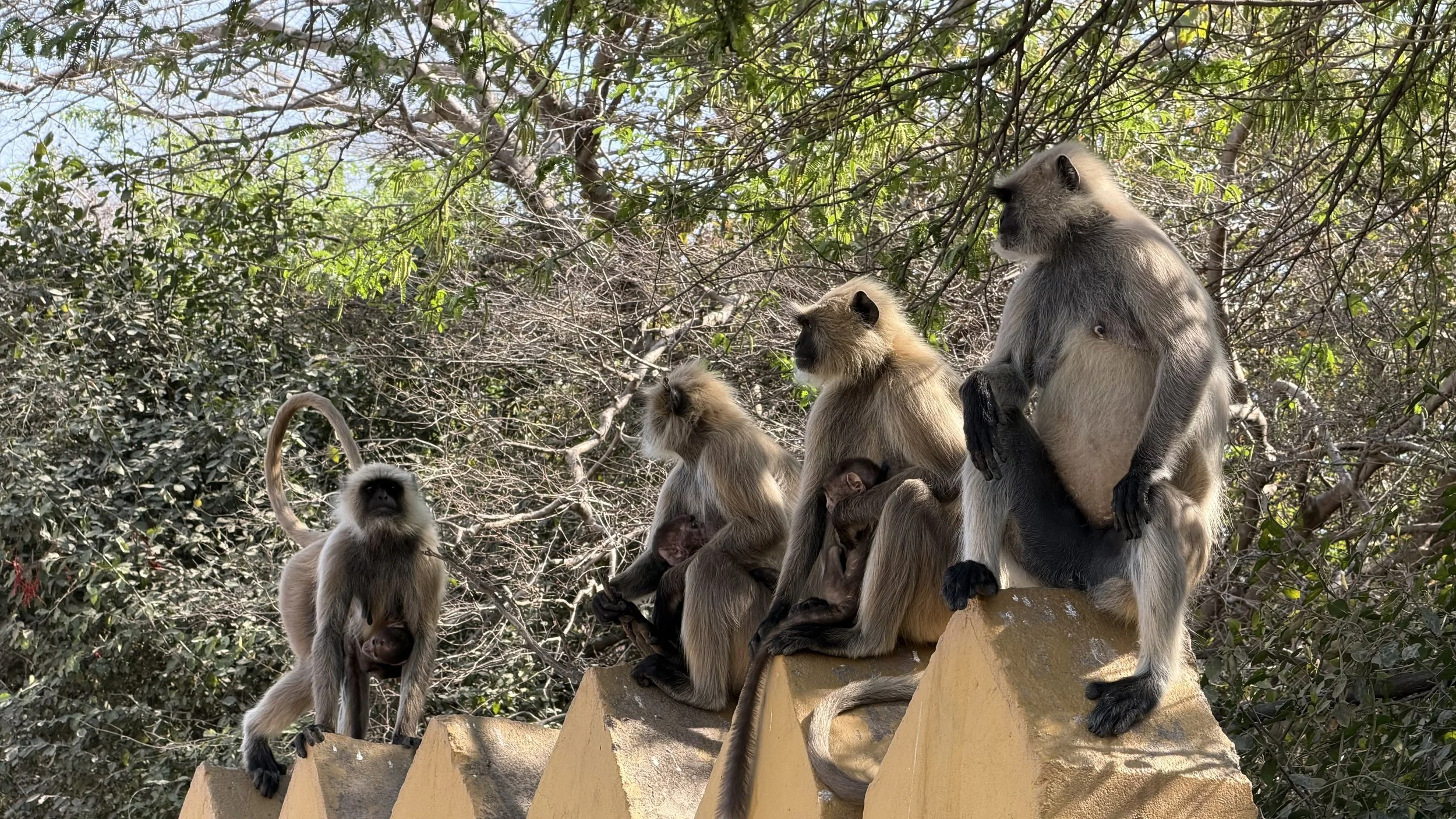
Langur Monkeys
By late afternoon we were back in the canters for our second expedition. At the canter staging point a troop of grey langur monkeys had taken over the yellow boundary wall. Four adults sat in a loose line beneath the trees, long tails draped down the angled concrete, black hands resting calmly on their knees. Two carried infants pressed into their fur, barely visible except for small faces and tiny hands. A larger male sat upright and apart, watchful. Another younger monkey crouched low, peering over the edge at the vehicles below. Langurs often use walls and buildings as vantage points, and this busy gathering area seemed as much their territory as ours. Before we had even entered the park, the wildlife was already in control.
This time the route took us to the far side of the lake, one of five or six designated zones in the park. Expectations were tempered. The morning had been strong. It’s hard to assume lightning will strike twice.
The landscape was familiar now: dry grasses turned gold in the lowering sun, fallen teak trunks bleached pale, the waterline of the lake holding a soft haze. Deer that had caused excitement at first light were now almost routine. It’s remarkable how quickly the extraordinary recalibrates itself.
The track was rougher this time. The canter jolted over ruts and stones, prompting the usual grumbles about backs and knees. There were shouts from another vehicle nearby, someone claiming a sighting far off through long lenses, but from our position there was little to see. We pressed on. Then came a long stretch of quiet. No birds lifting. No alarm calls. Just lots of dust, heat and the growl of the engine.
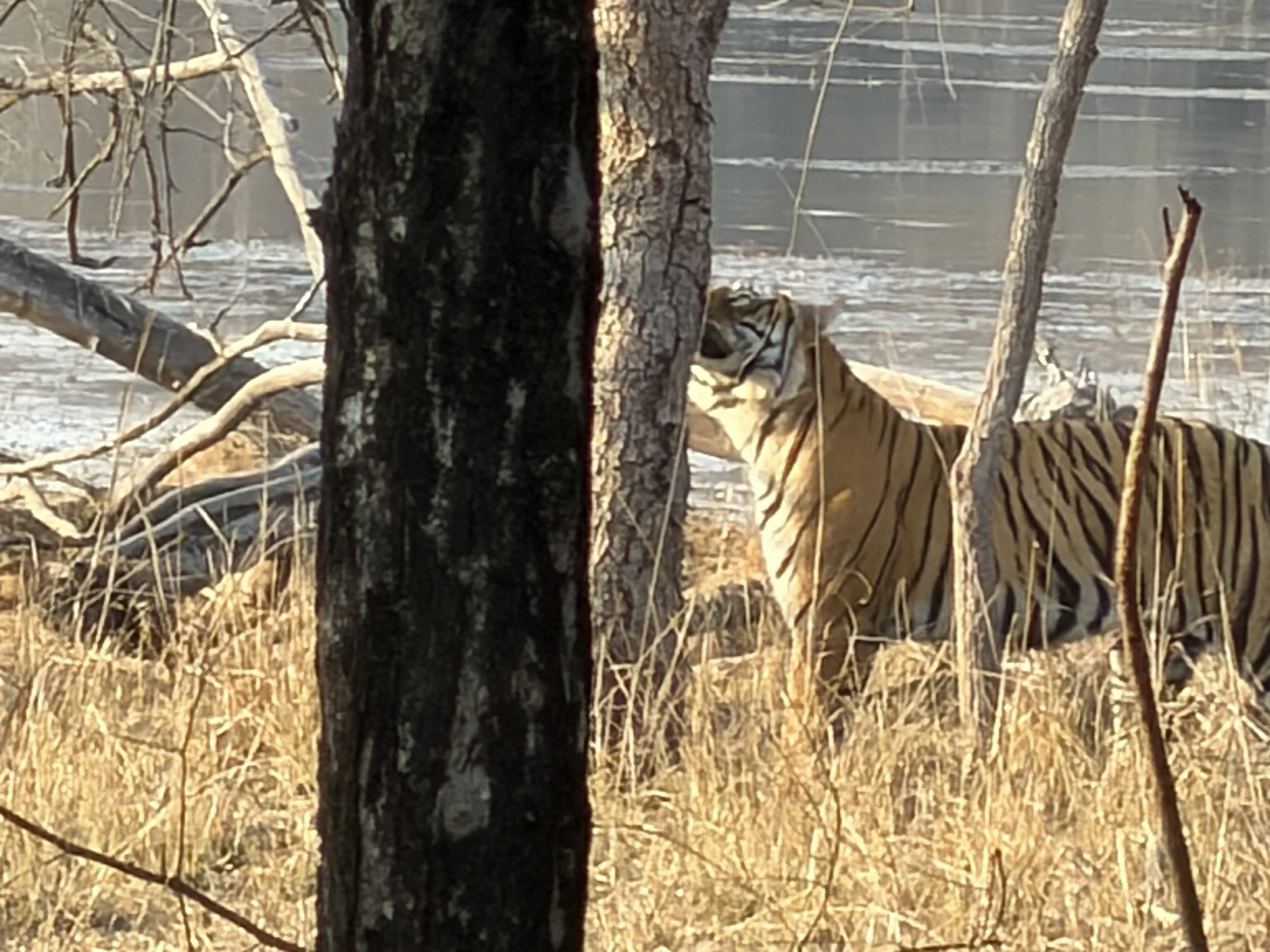
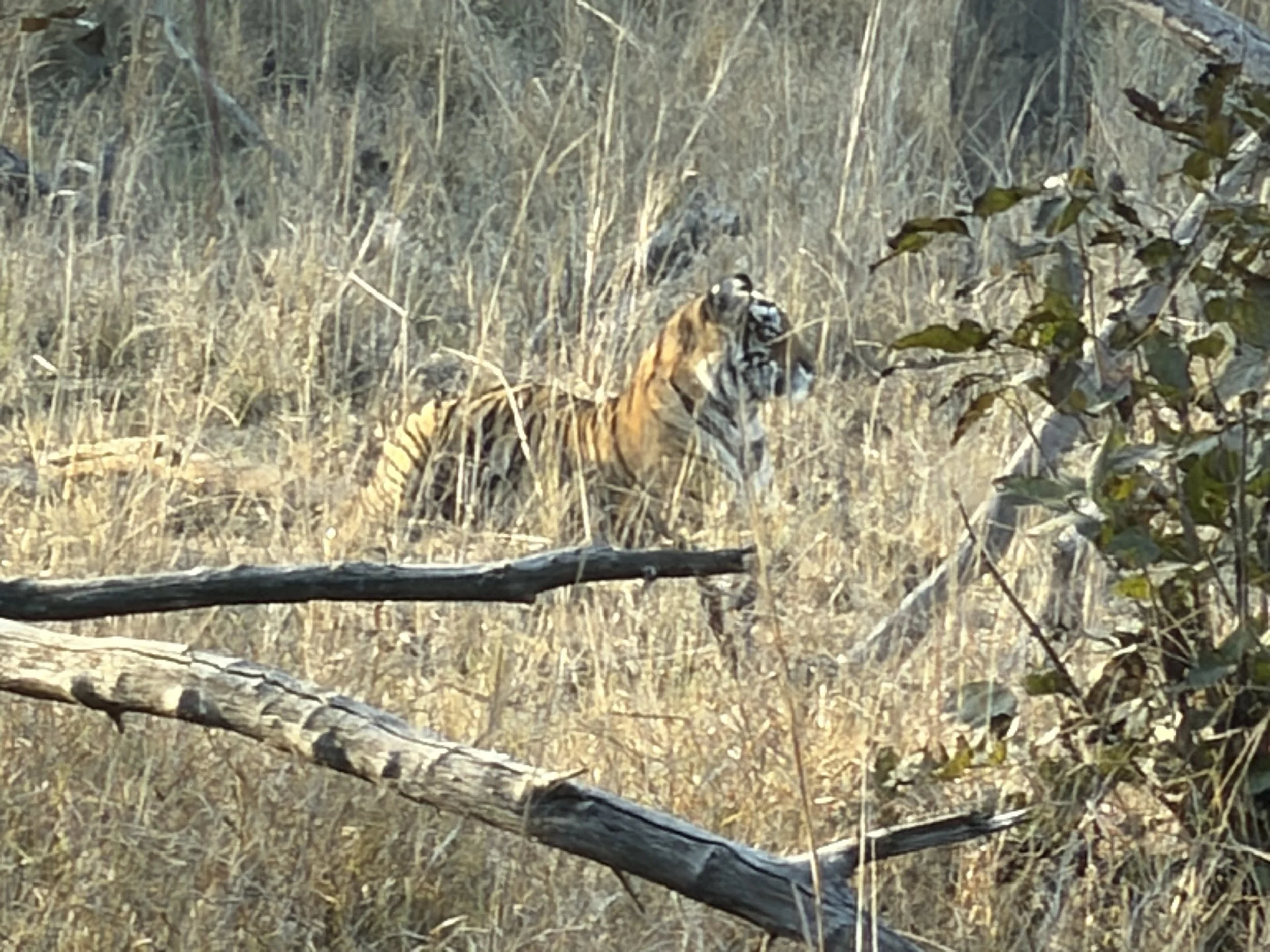
We doubled back, retracing our path and returned to the earlier clearing and this time, through branches and dry stems, a shape resolved itself. At first just a head. Stripes broken by twigs. A stillness that only makes sense once you realise what you are looking at.
Through binoculars the tiger became clearer. Then it moved.
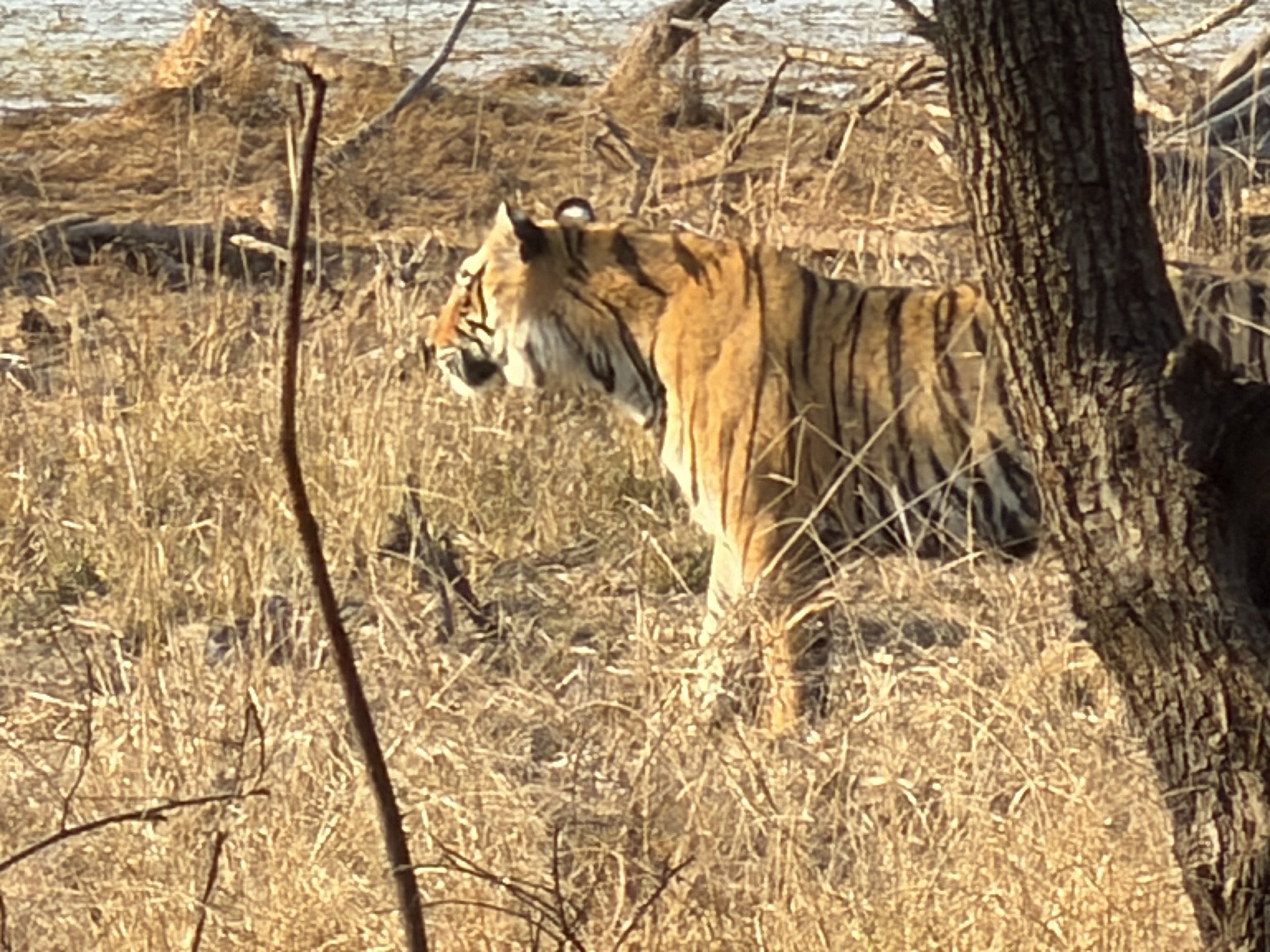
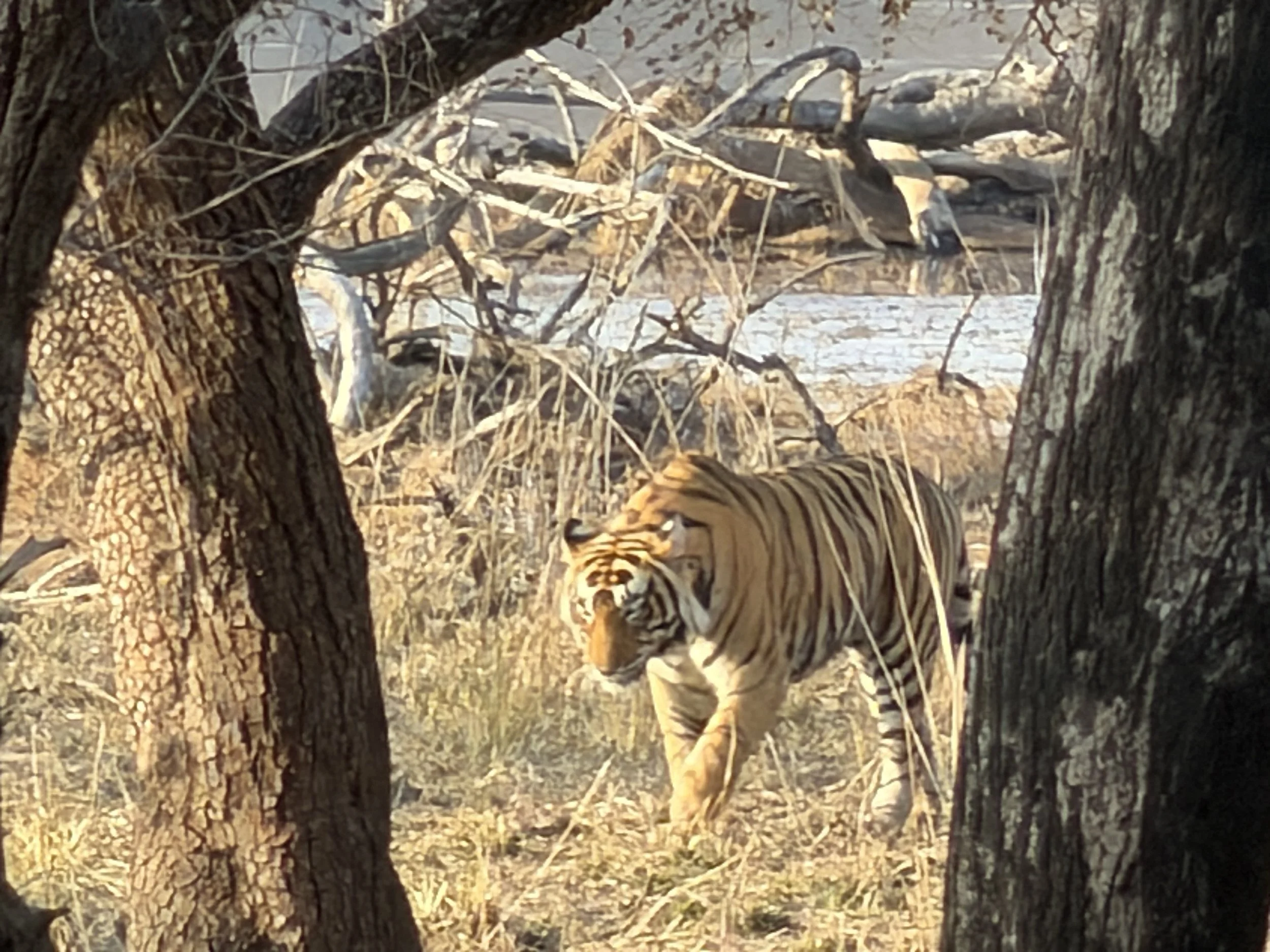
What had been static suddenly became power in motion. It rose and began to stride forward with quiet purpose, surprisingly fast for something so large. We shifted position to keep pace. In the open grass the full body came into view, shoulder muscles rolling, tail curving, light catching the orange coat against the pale scrub.
It paused and sat deeper into the grass, alert but unhurried. Then another tiger appeared, following the same line of travel. For a moment they were both visible — one settled, the other approaching — a brief intersection of territories or familiarity. There was no drama, just presence. After a while they seemed content, and we left them to their own business.
Later, near the park exit, came the final sighting.
Under a small open-sided structure, on the cool stone floor between upright pillars, lay another tiger. Asleep. Completely still. Its body stretched in shade while the late sun lit the ground beyond. We watched for some time. It did not stir.
The proximity to the gate felt almost too convenient. Some in the group wondered aloud whether this could really be chance. The guides were calm, almost matter-of-fact, as though this were simply known behaviour. No urgency. No whispered excitement.
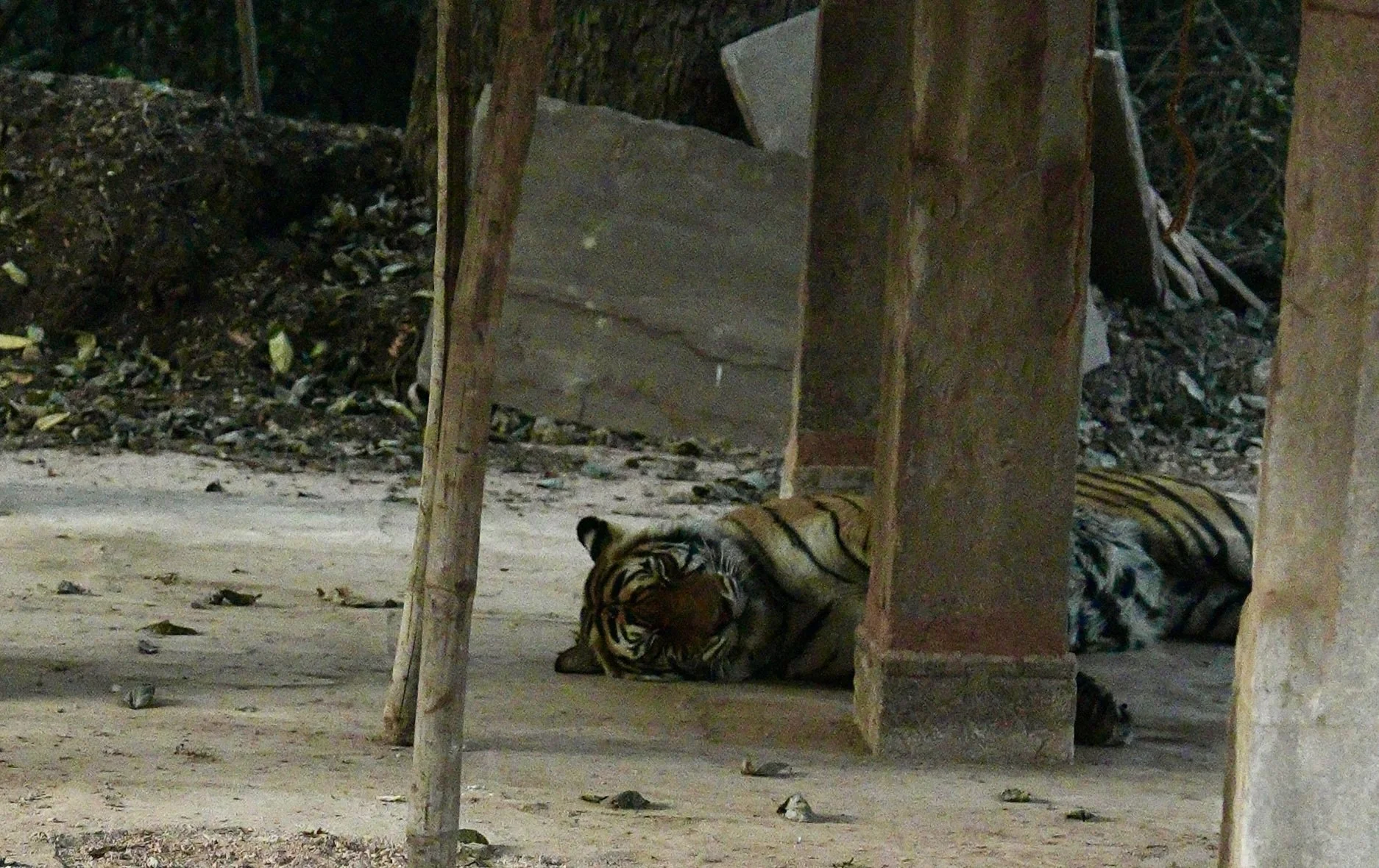
One final tiger
Perhaps it was just that, a tiger choosing stone and shadow in the heat of the day, a regular spot. The park is full of old buildings and pavilions; cool floors make practical sense.
The afternoon had carried us through anticipation, frustration, movement, power and finally stillness. Two tigers striding through grass in warm light; one asleep in deep shade near the edge of the park.