Ashore in Ålesund
First Sight of Ålesund
Yea!! Today we were finally going to be getting off the ship and doing some sightseeing. My wife said it best when she said it felt like we were locked up inside a five-star resort and not allowed out.
We were up early again (6am) and went out on deck to watch us arrive at Ålesund, which was supposed to be our second port. Not surprisingly there were not many people up at that time, although there were a few already out with cameras at the ready.
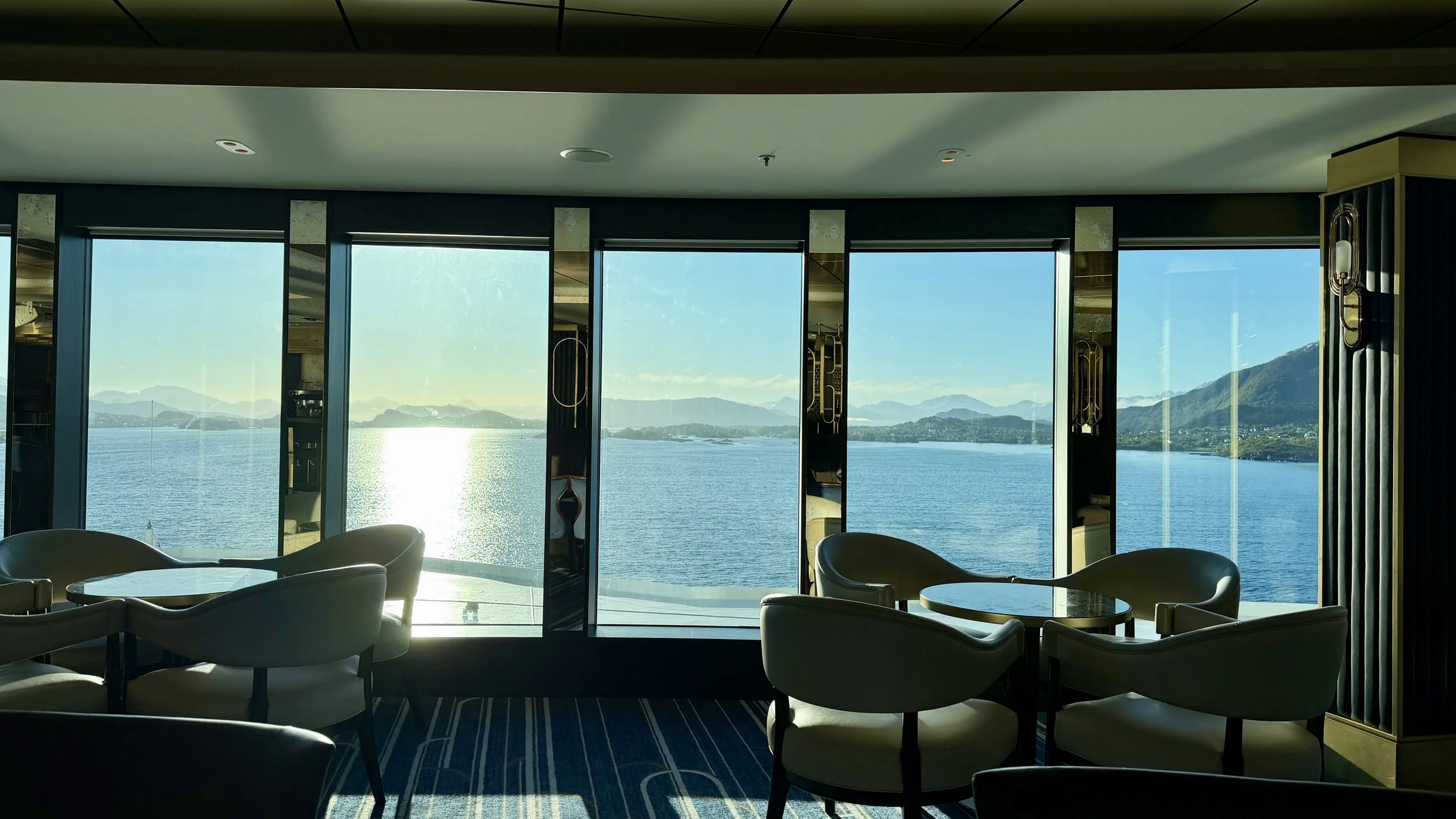
It was cold outside so we decided to spend some time in the Crow’s Nest, which was literally empty. Quite a contrast to yesterday lunchtime when you could barely find two seats together. As I say... it was early.
We sat for a while with coffee, taking a few photographs through the windows. But I was restless. There comes a point where looking through glass no longer feels enough. My long-suffering wife eventually agreed and we headed back outside to watch the final arrival into port.
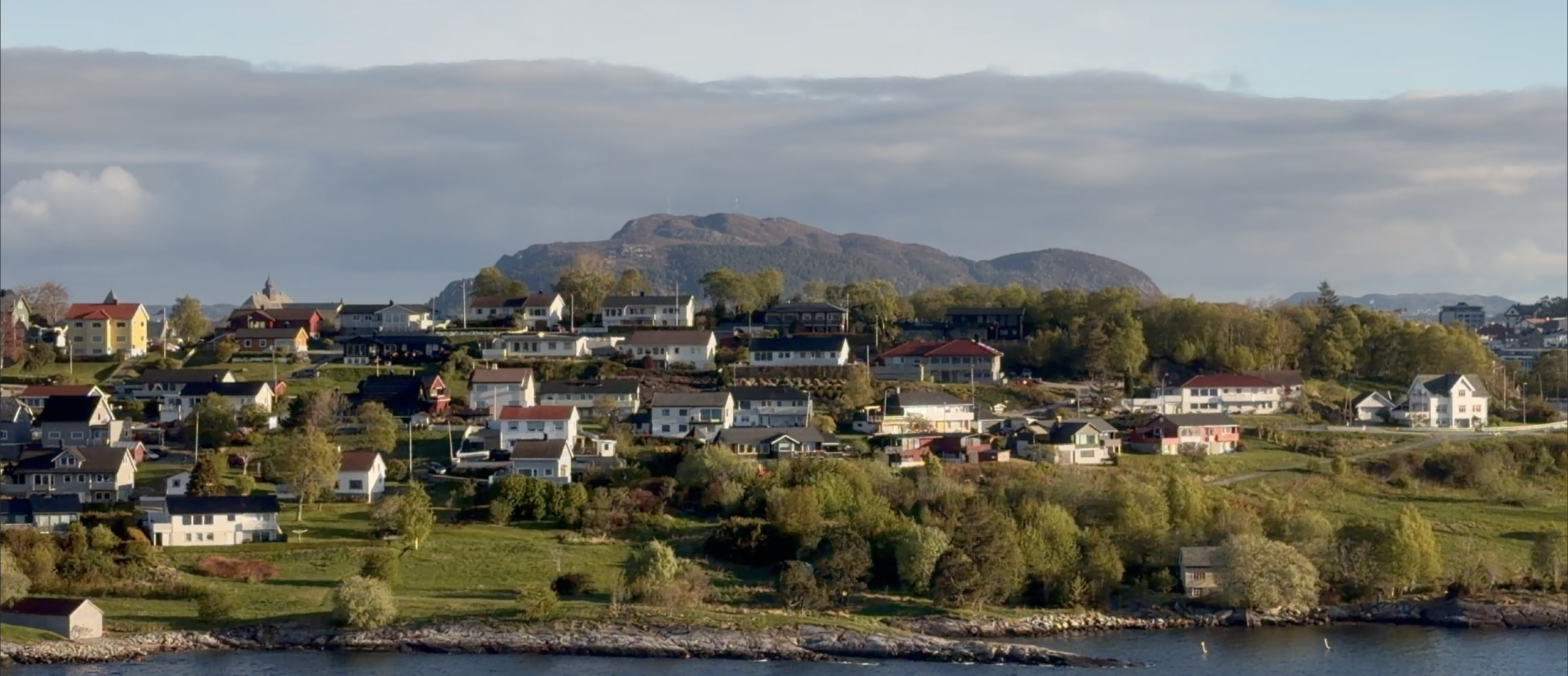
It was another beautiful morning and the views were, once again, amazing. As the ship approached Ålesund the scenery gradually changed. After days of wide fjords and steep mountains rising directly from the water, we were now threading our way between small islands, rocky outcrops and clusters of houses sitting almost at the water’s edge. Little flashes of colour began appearing too — red boathouses, white homes and neat waterfront buildings scattered across the shoreline.
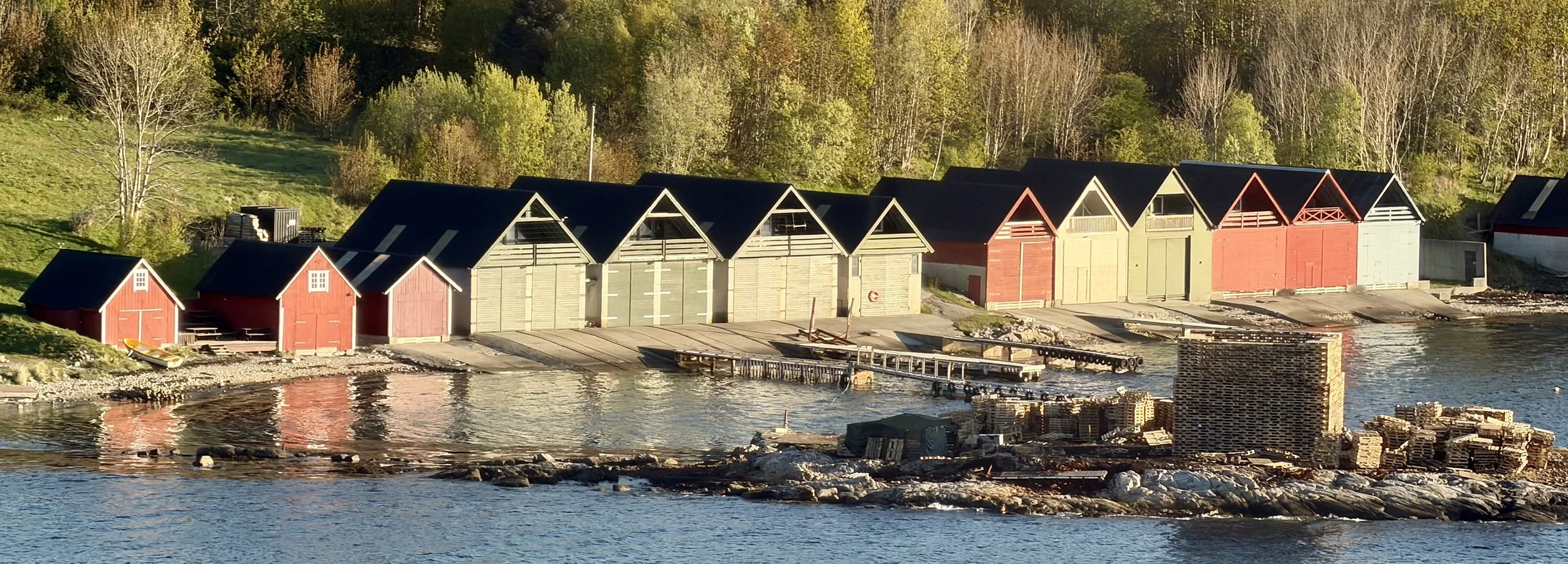
The sea was almost completely still and in places the reflections looked clearer than the land itself.
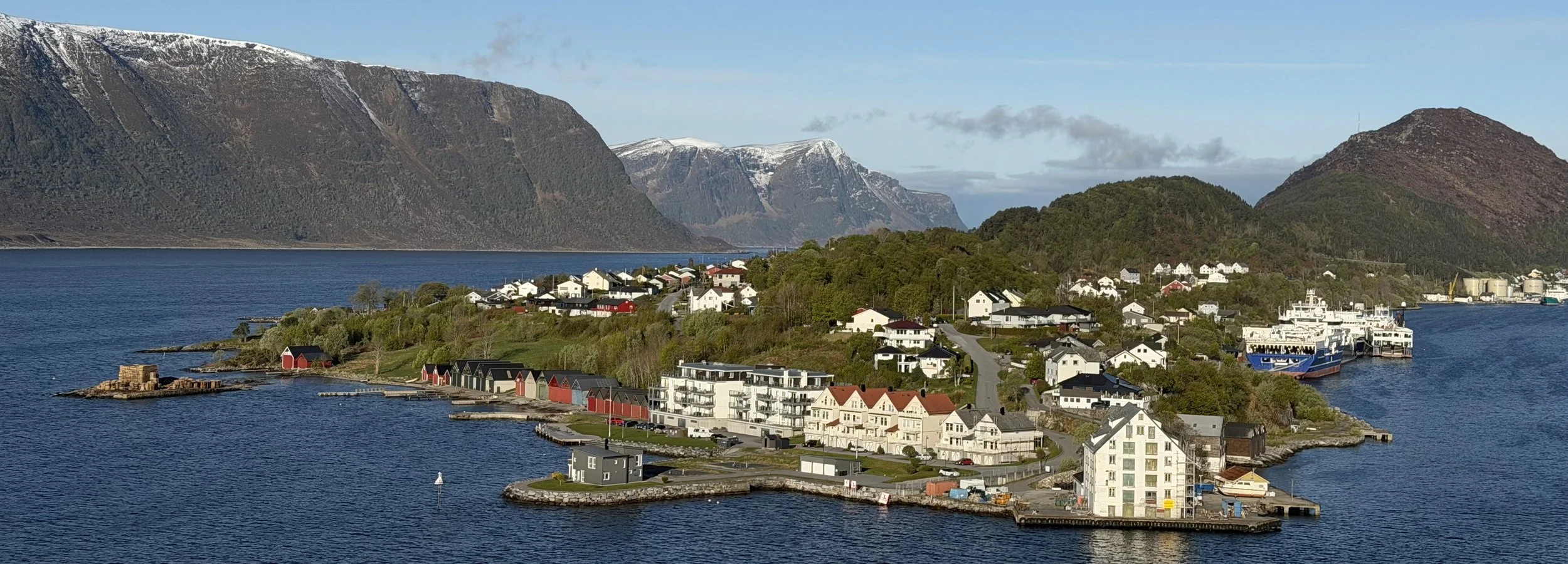
As we rounded the final approach, Ålesund slowly revealed itself spread across several islands, with distant mountains behind still carrying traces of snow.
It felt different somehow. Up until now much of Norway had been scenery to admire as it drifted past balconies and open decks. This felt like a place. Roads, houses, churches and buildings suddenly came into view and with them the excitement that in a couple of hours we would actually be walking around somewhere rather than simply watching from a distance.
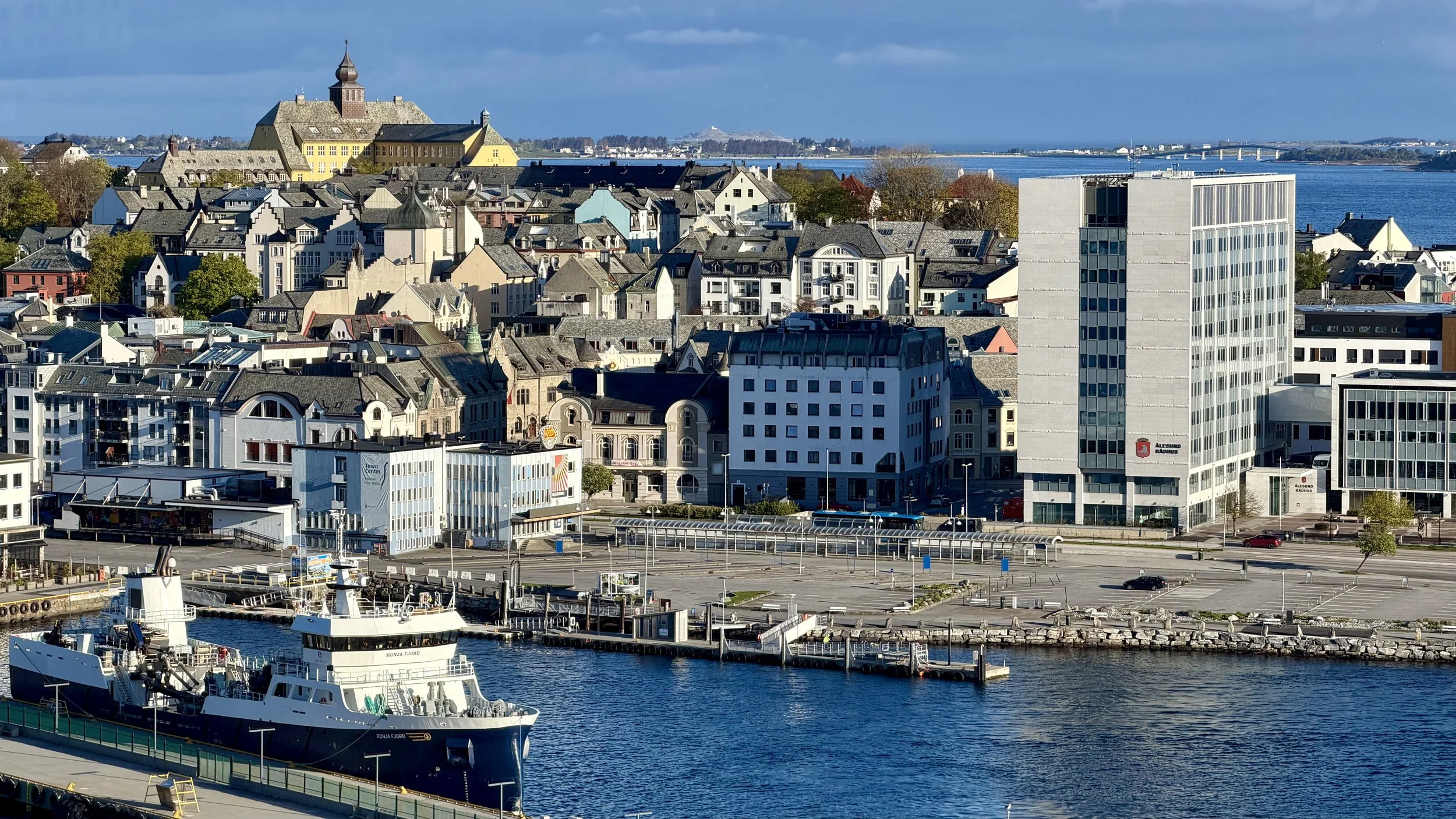
As we got closer, the town itself became clearer. Towers, decorative facades and rows of pastel-coloured buildings lined the waterfront. Much of Ålesund was rebuilt after a devastating fire in 1904 and much of the town was reconstructed in Art Nouveau style, giving it a very distinctive appearance. Even from the ship it looked elegant.
We then had a leisurely breakfast in the main dining room. A much more civilised affair than the usual buffet rugby scrum. No hunting for seats, no weaving through people carrying overloaded plates, just a relaxed breakfast with time to spare, which suited us perfectly as our tour was not due to start until 11am.
The only slight concern hanging over the morning was entirely of my own making.
Back in January, when booking our excursion through Viator, I had somehow managed to book 14 January instead of 14 May. Viator had refused to alter the booking, but the local operator had kindly made a note and assured me that he would honour it.
But would he remember?
Feeling slightly anxious, we disembarked around 10am just in case he had arrived early.
Sure enough, he was standing there waiting and immediately recognised our booking.
In fact, he explained that he had cancelled his normal tours because he was not feeling well and was struggling with his voice. But he had insisted on taking us himself because he had made a promise.
A good start to the day already.
And perhaps the biggest excitement of all... after what felt like days of being locked inside our floating five-star resort, we were finally ashore.
A Private Tour
The minibus for the trip could apparently carry sixteen people in VIP seating, so with only the two of us onboard it quickly began to feel less like an excursion and more like a private tour.
Rolf, our guide, soon got into his stride, pointing out landmarks as we passed and giving us background on the area. Despite not feeling his best, he seemed determined we would still get the full experience. Understandably, with his voice struggling a little, he occasionally relied on information videos as we sped through tunnel after tunnel towards our first and furthest stop: Alnes.
Like much of Norway, the journey itself felt part of the attraction. Bridges linked islands across open stretches of sea while tunnels somehow disappeared straight through mountains before suddenly re-emerging into bright daylight and wide coastal views.
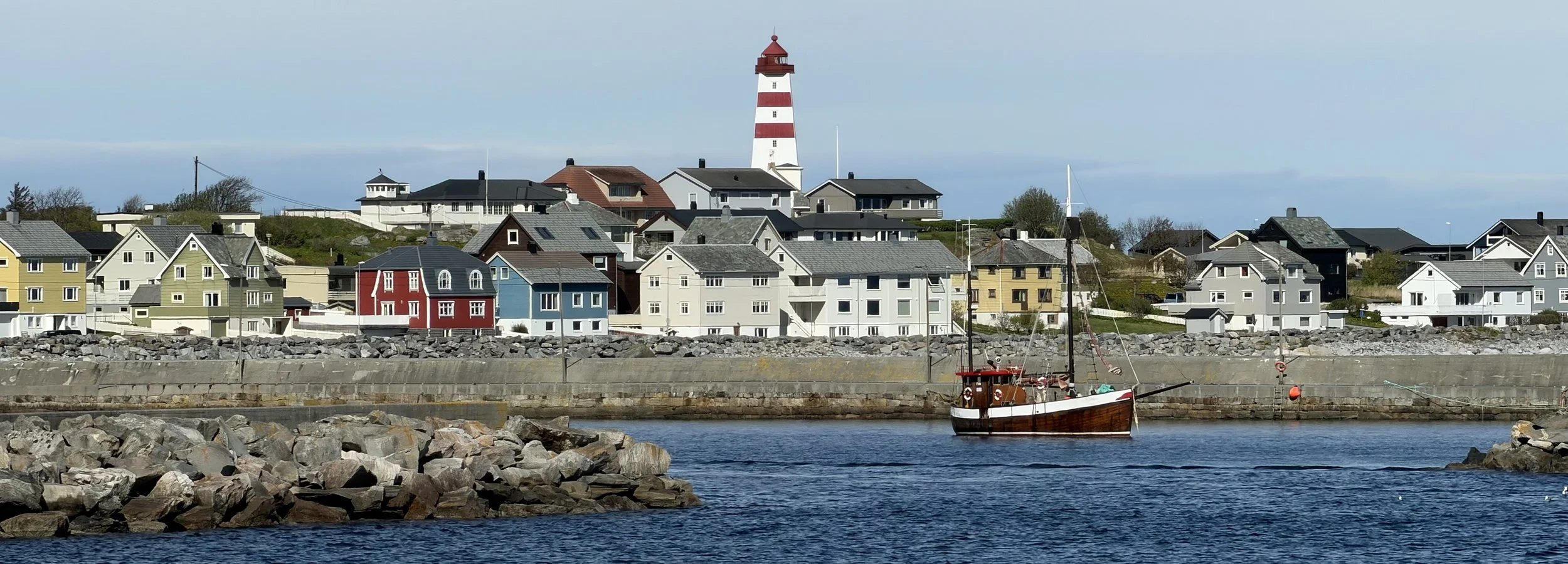
Our first stop was a viewpoint overlooking the small village of Alnes and its lighthouse. The view immediately made us slow down. Colourful houses sat clustered beside the harbour while the distinctive red and white striped lighthouse stood above everything else, looking almost oversized against the small village below. A traditional wooden fishing boat moved quietly across the water and the whole place had one of those slightly unreal qualities that made it feel more like a carefully built model village than somewhere people actually lived.
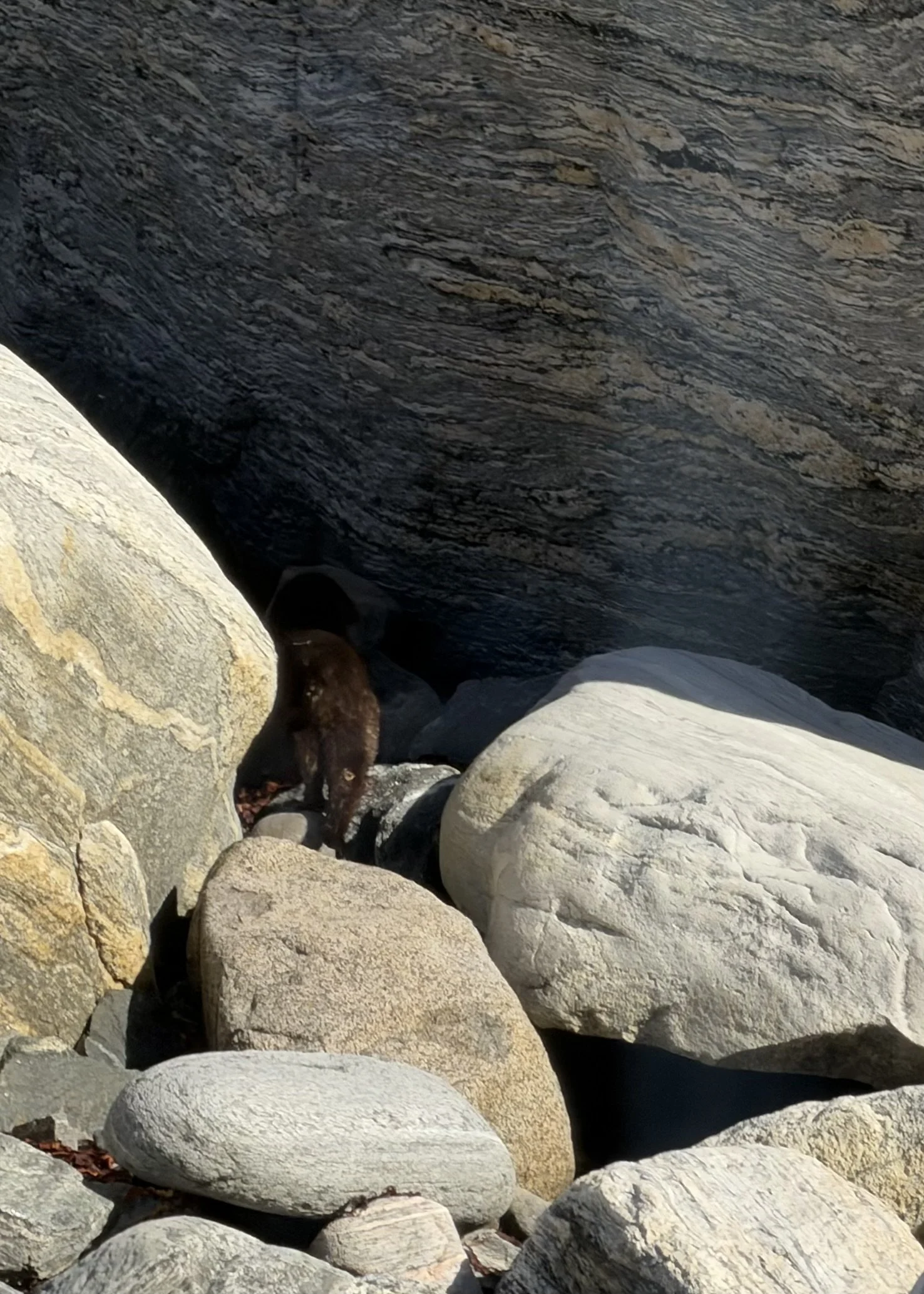
One of those classic wildlife photography moments: there it is... there it was.
Just as we were preparing to leave, movement among the shoreline rocks caught my eye.
A sea otter suddenly raced across the boulders.
I was surprised by its size. Somehow I had imagined something smaller. By the time I reacted and pointed the camera in roughly the right direction, all I managed was a photograph of its retreating rear end disappearing between enormous striped rocks before it vanished completely.
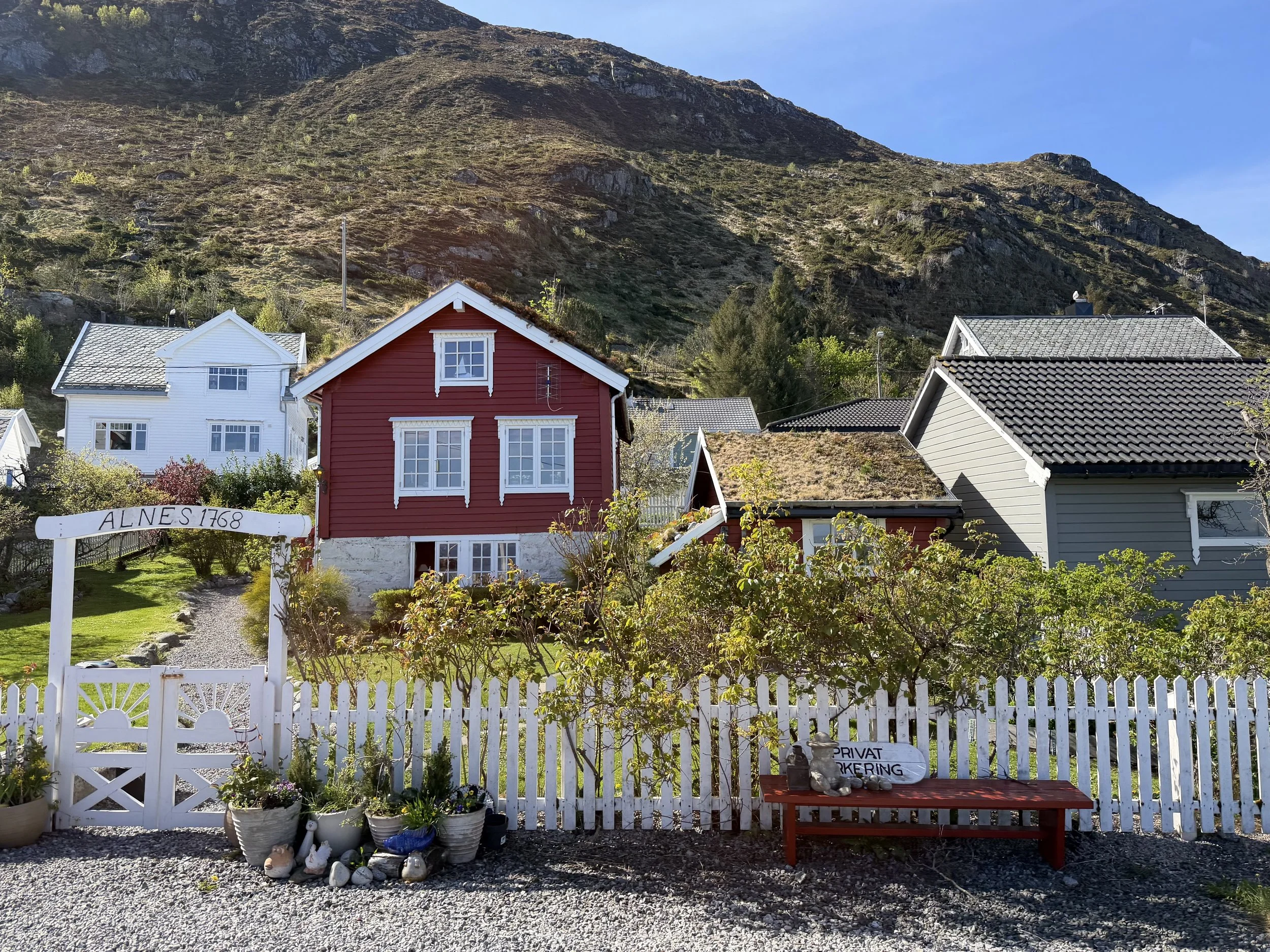
As we drove into the village itself we passed immaculate gardens, white picket fences and brightly painted houses sitting beneath steep hillsides. One red wooden house stood behind a simple gate marked "Alnes 1768", looking as though it had been arranged purely for visitors with cameras. Even the ordinary homes somehow felt photogenic.
The location itself felt wonderful. Remote without feeling isolated and dramatic without trying too hard. It immediately struck me as somewhere I would happily return to and spend a few days rather than simply pass through.
The Lighthouse and the Shoreline
At the lighthouse we ignored the café and headed straight for photographs.
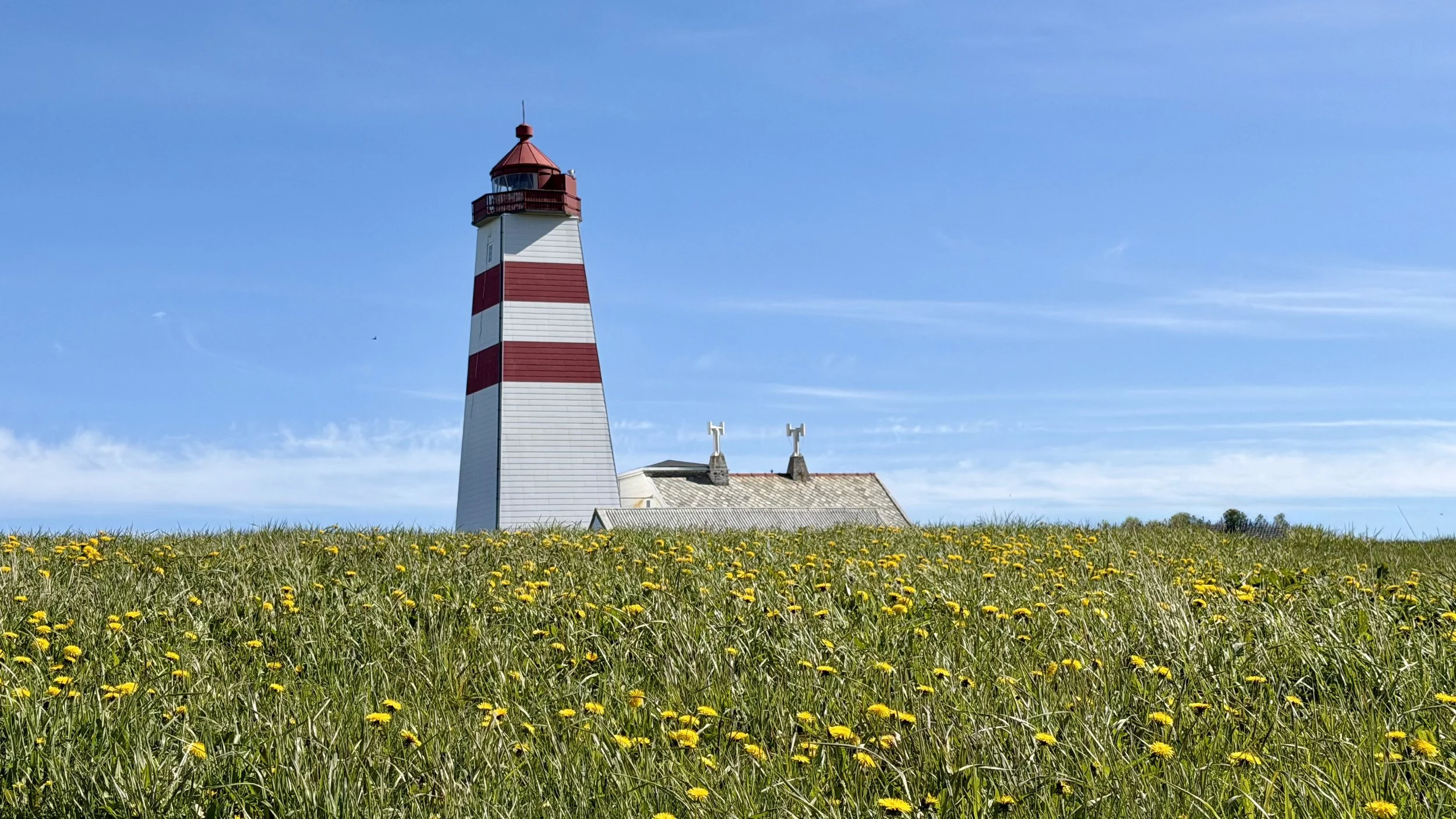
I found a low angle with yellow dandelions spread across the foreground and the lighthouse rising above them against an impossibly blue sky. Walking closer, the lighthouse itself somehow felt even taller than it had from a distance, its bold red and white stripes standing out against the sea beyond.
I was very glad I took the photographs when I did.
Around three minibus loads of German tourists arrived shortly afterwards and suddenly the peaceful scene became rather busier. Not disastrously so, but enough to remind me that timing can sometimes be everything in photography.
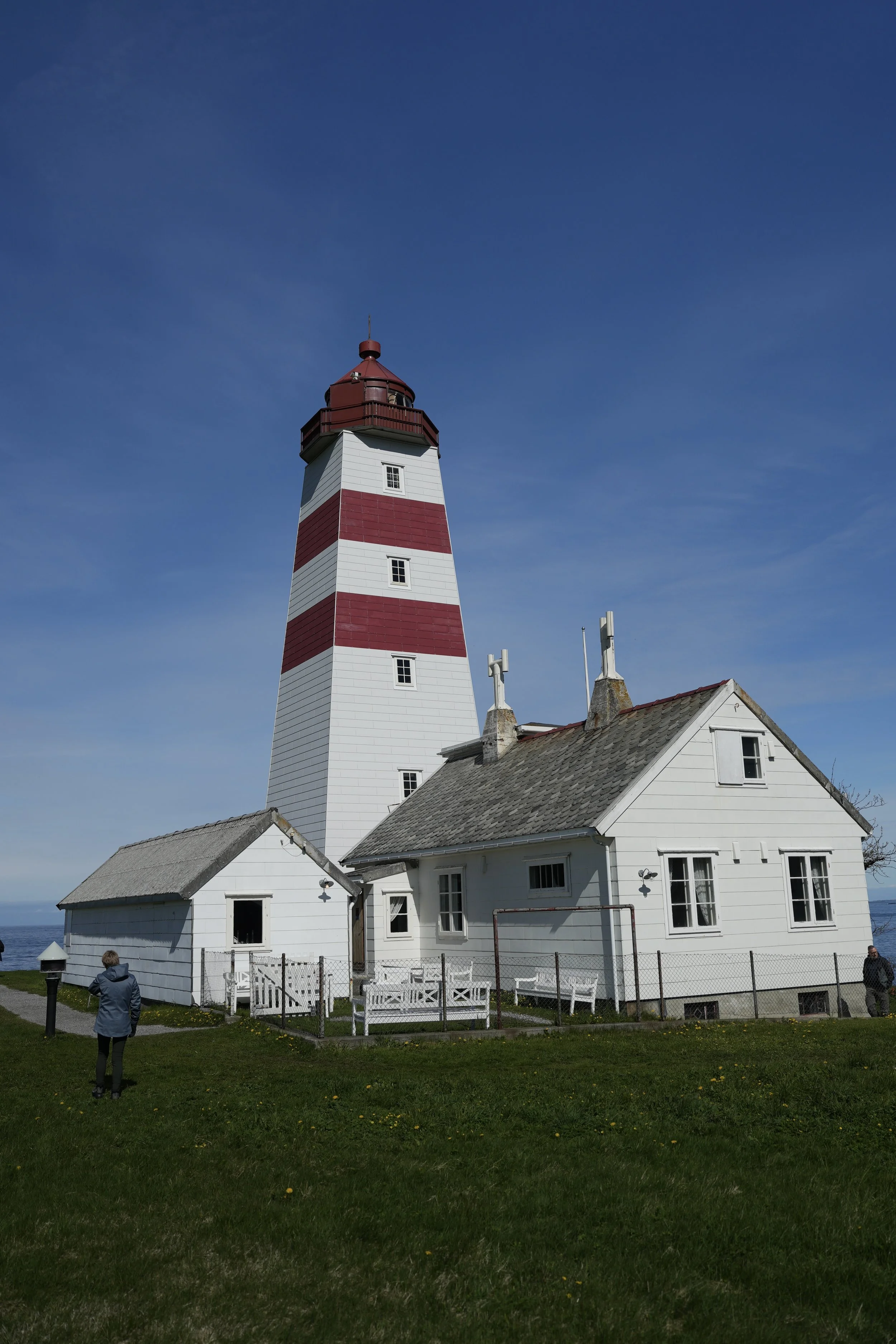
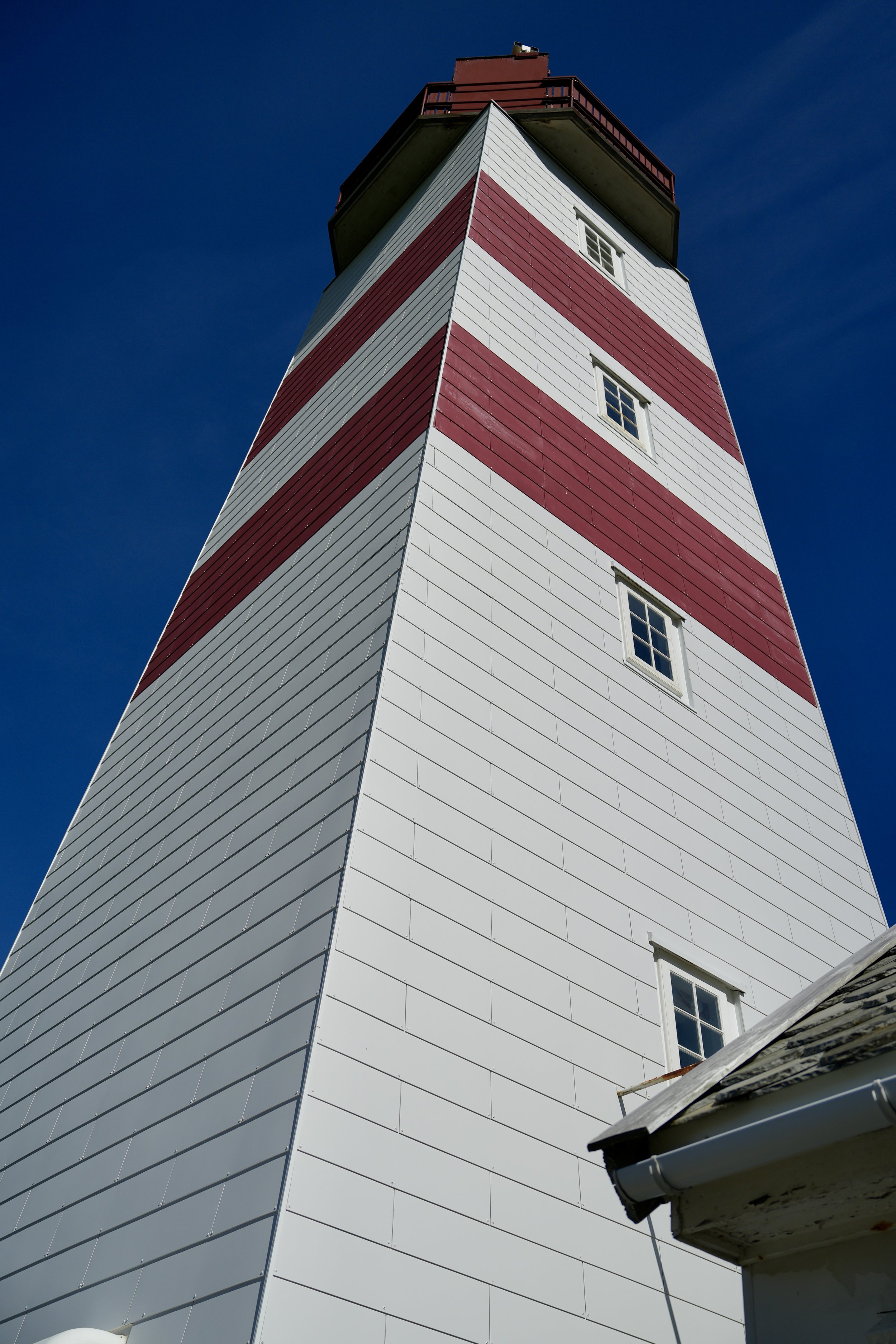
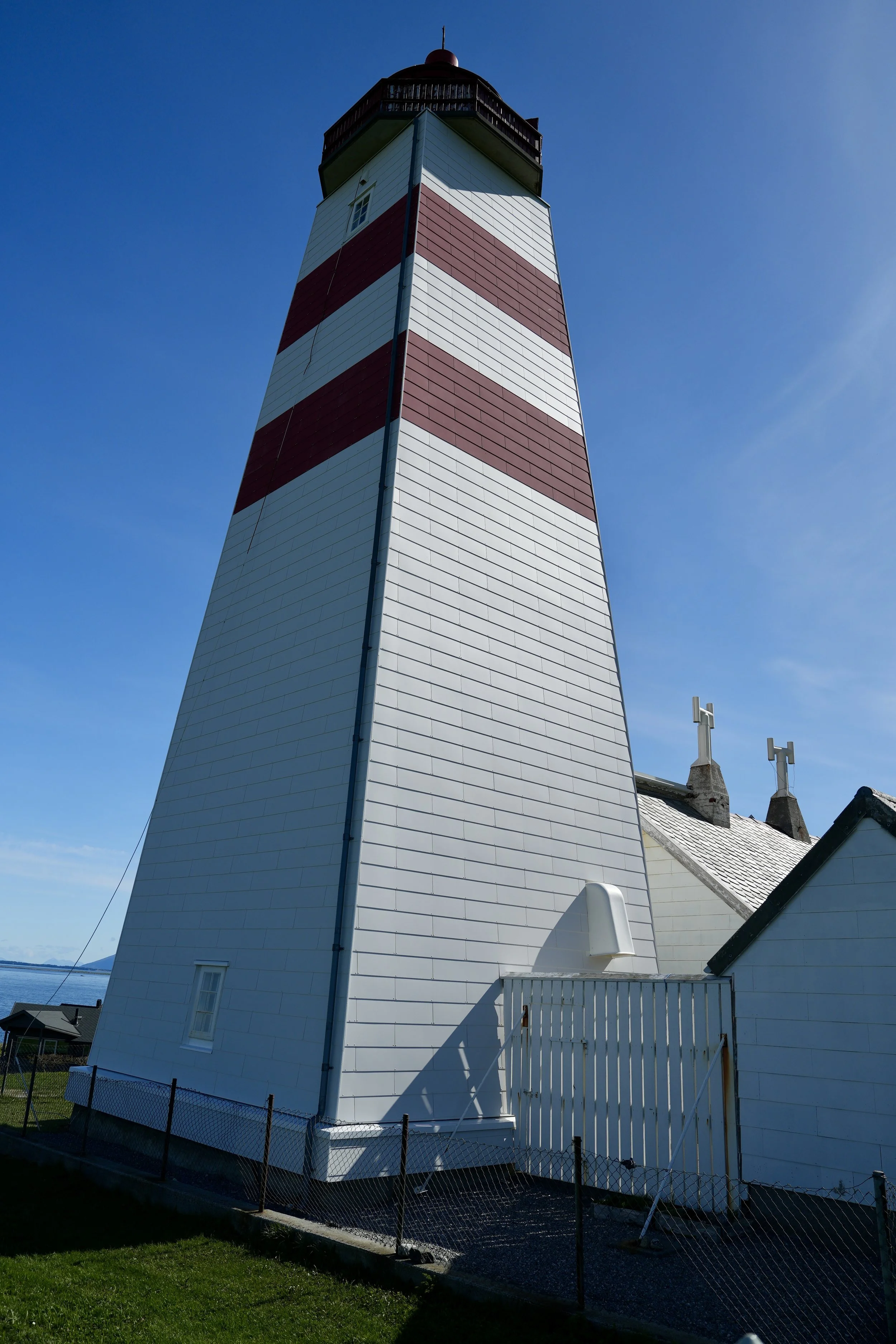
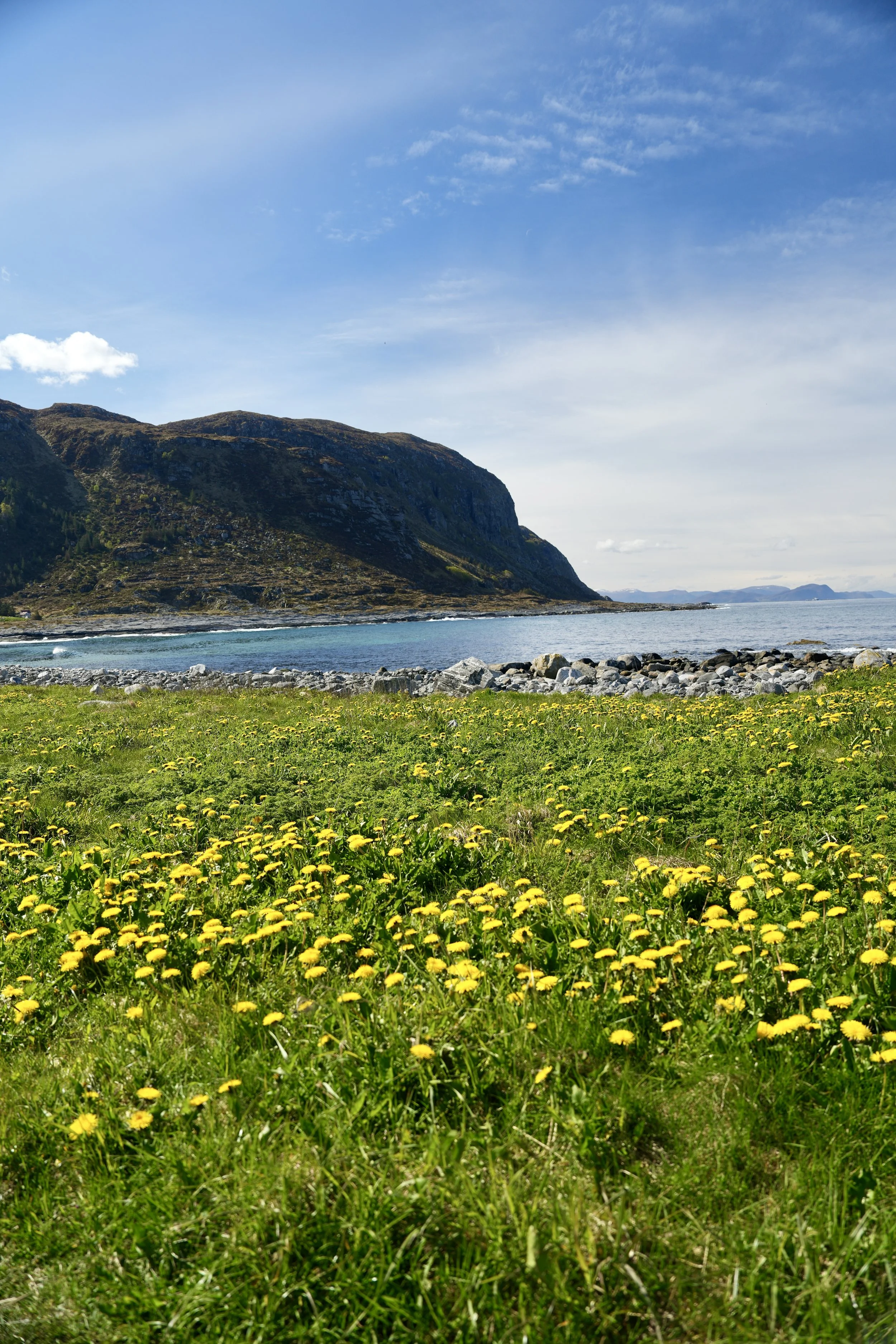
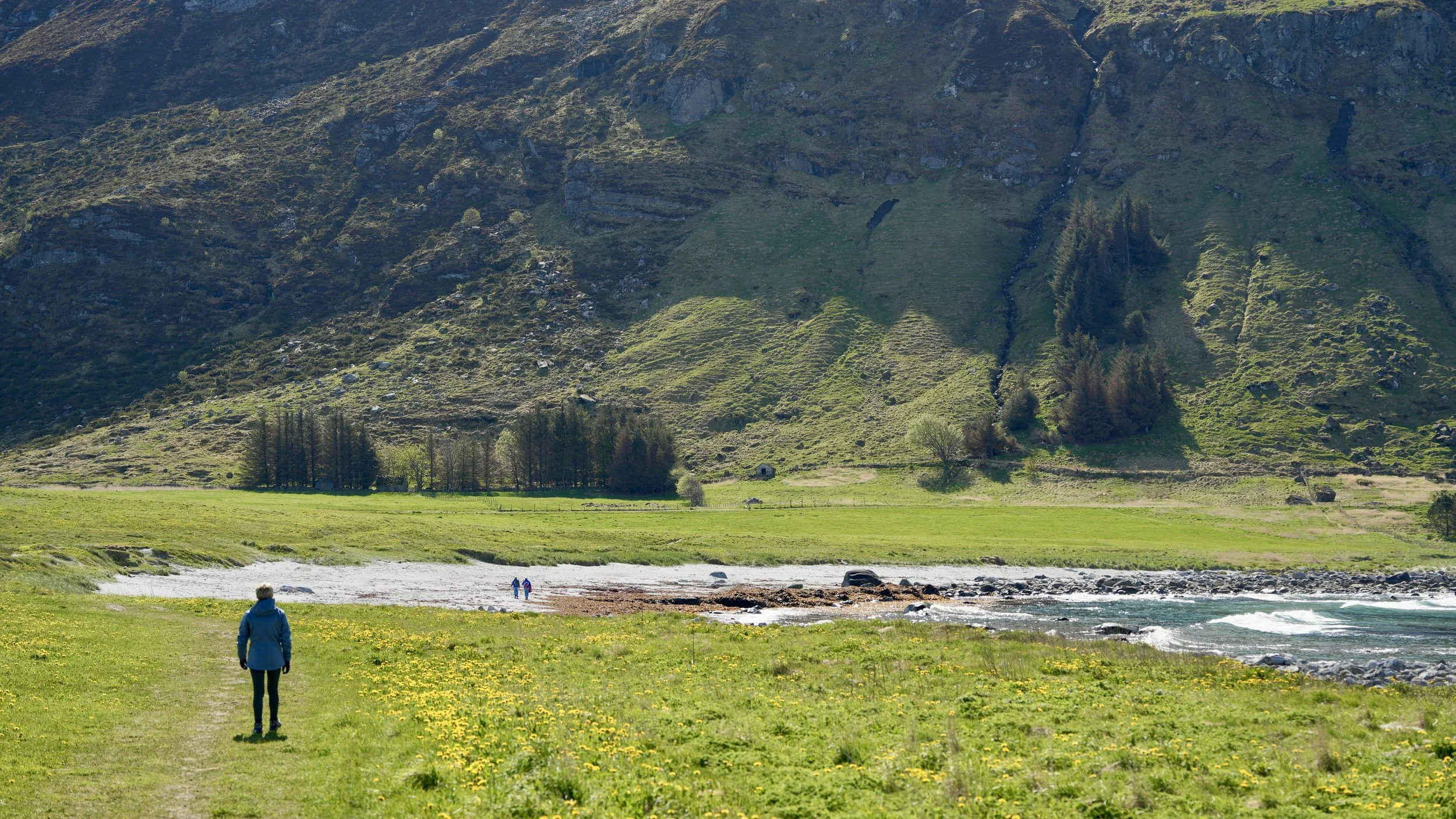
We spent some time exploring around the lighthouse before deciding that, rather than stopping for coffee, we would use our spare time to walk down to the beach.
Again, it was wonderful.
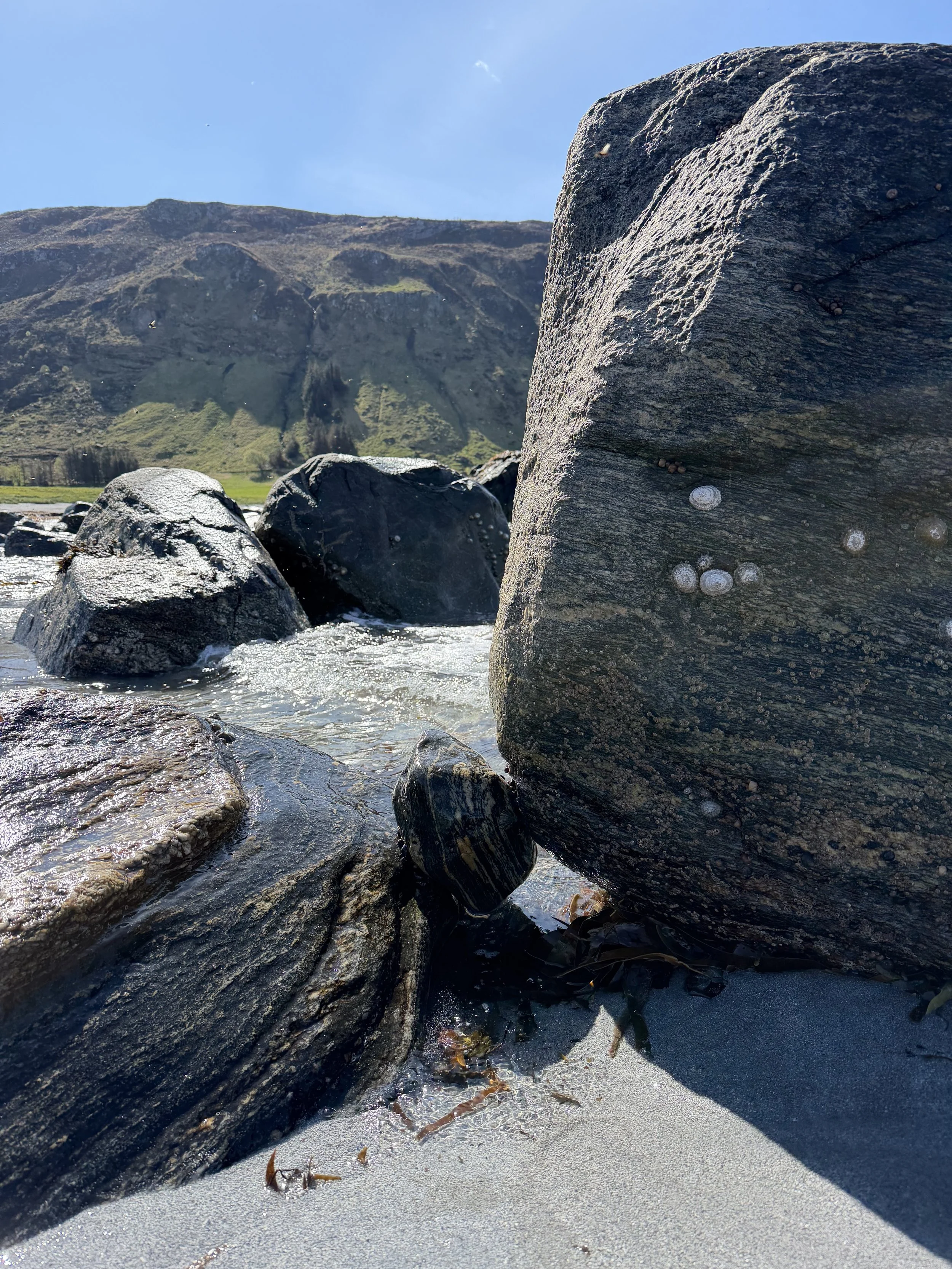
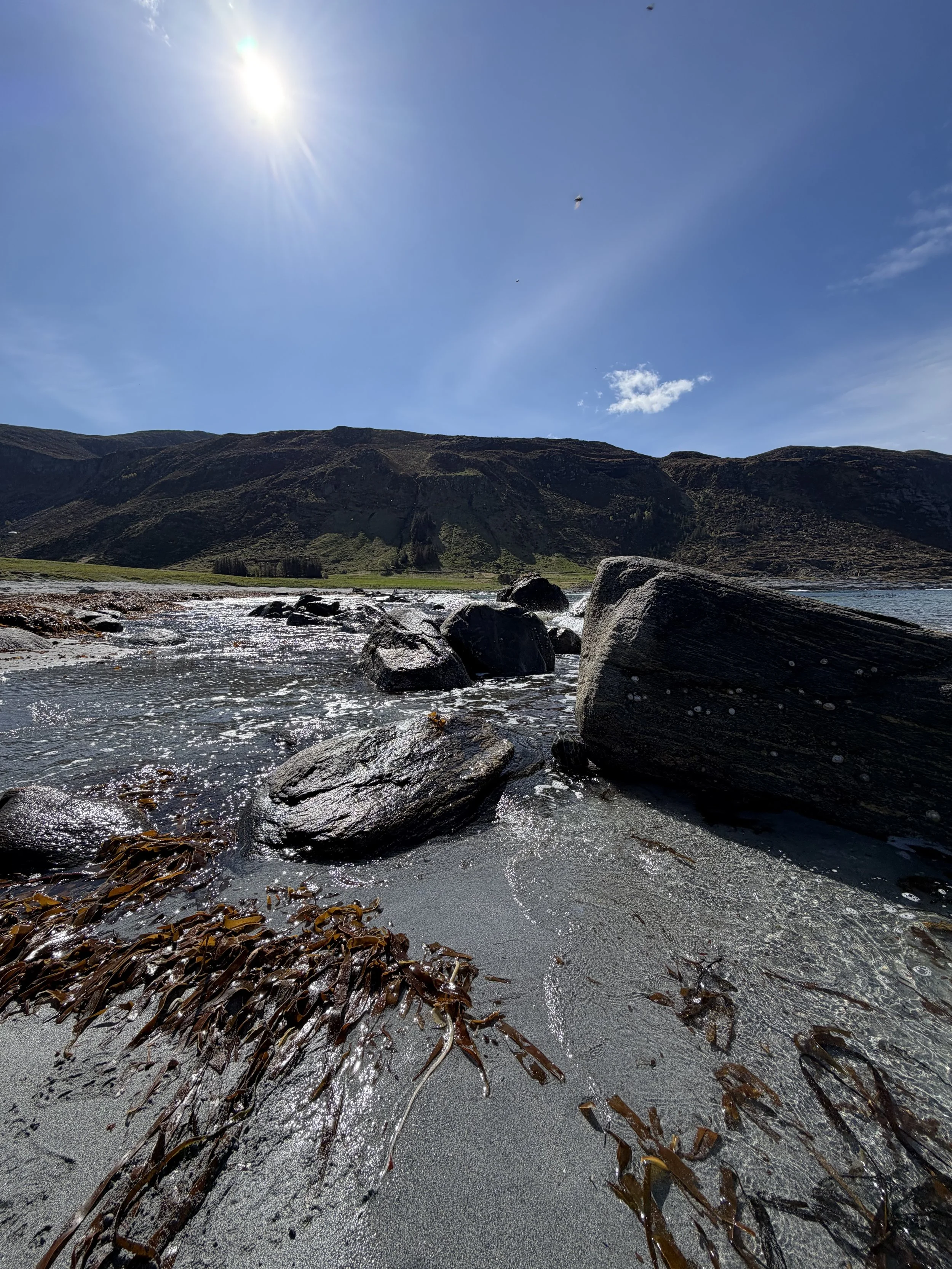
This was not a sandy beach in the traditional sense. The shoreline was made up of smooth stones and huge boulders, with dark cliffs rising behind and open sea stretching away ahead. The waves rolled gently across the rocks and the whole place felt wide, quiet and surprisingly empty. The air carried that cold salty edge that somehow always makes places feel further north.
I found myself becoming more interested in the details than the bigger views. Some of the rocks were extraordinary up close, covered with swirling layers and patterns formed over unimaginable timescales. Water washed around them while sunlight reflected off their surfaces and tiny textures appeared everywhere.
I spent rather longer than I probably should crouched down beside rocks and seaweed looking for photographs.
We almost certainly spent too long wandering.
Despite being the only two passengers on the tour, we somehow still ended up hurrying back towards the bus convinced we were holding everyone up.
Quite why we felt the need to rush remains a mystery.
Old habits perhaps.
Nine Hundred Years
We then headed back towards Ålesund and the lovely island of Giske. Along the way Rolf continued pointing out landmarks and giving us snippets of history. One thing that quickly became obvious was that these islands have far more going on than first appears. Beneath the quiet villages and coastal scenery there seemed to be layers of stories stretching back centuries.
As we drove around, Rolf explained that Giske had Viking connections and had once been home to one of Norway’s most influential noble families. In later years the islands became associated with modern achievements too, including one of Europe’s premier recording studios, Ocean Sound. Like much of Norway, it seemed a place where old and new sat comfortably together.
Giske itself felt more urban, than some of the wilder scenery we had seen. Small communities spread across the island with colourful houses, tidy gardens and little roads leading towards the sea. Everywhere seemed immaculate without feeling staged.
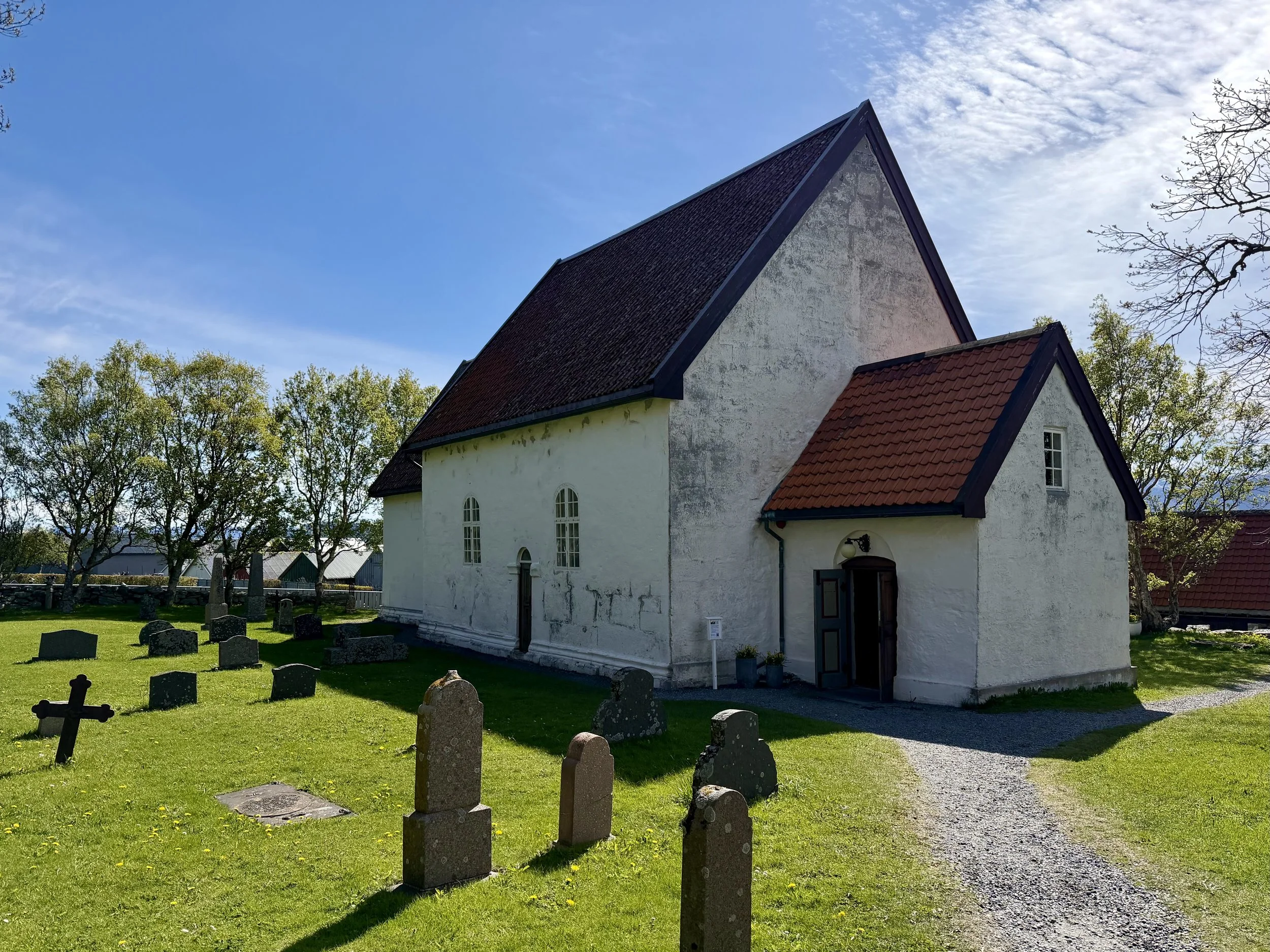
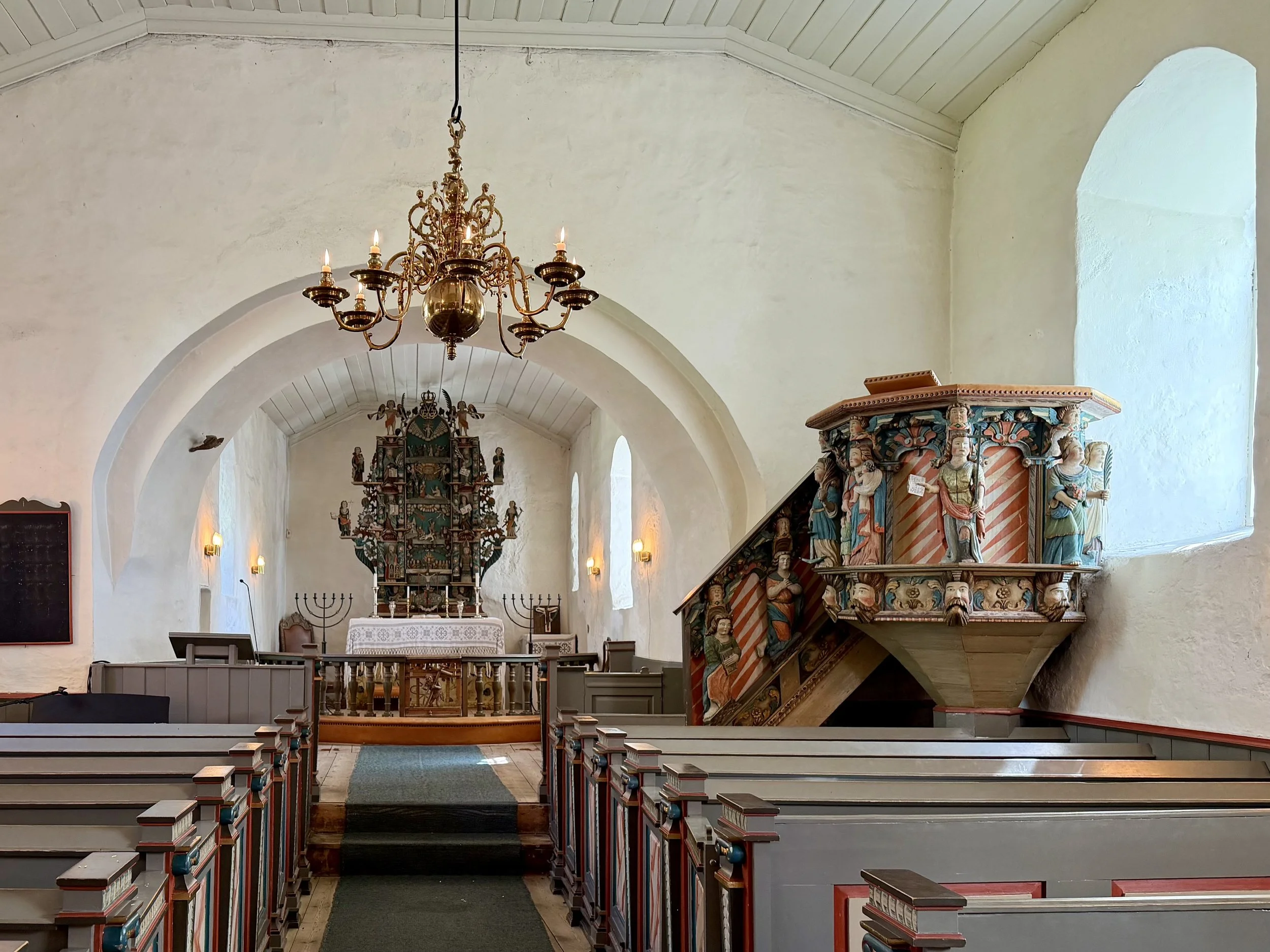
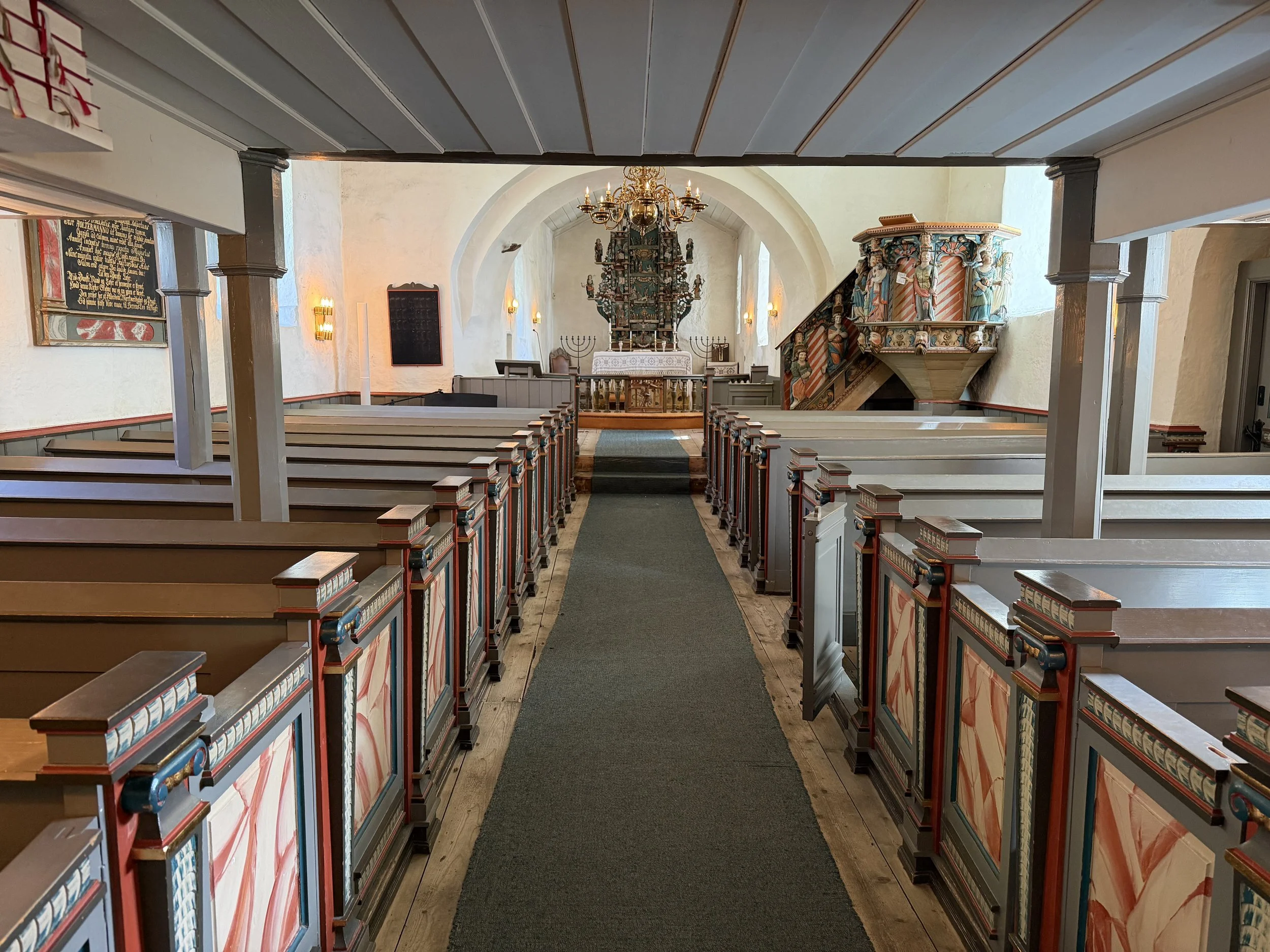
We stopped at Giske Church which, fortunately for us, happened to be open. Apparently that is not always the case.
From outside it looked almost deceptively simple. A small white stone church with a steep dark roof sat quietly among gravestones and neatly cut grass. Nothing shouted for attention. If anything, it looked more modest than we had expected.
But then we noticed the sign outside and discovered the church dated from around 1130.
Suddenly “old church” took on a slightly different meaning.
Built almost nine hundred years ago, Giske Church has stood here since the medieval period and was closely connected to the powerful Giske family. Standing outside, surrounded by gravestones leaning slightly with age, it felt like one of those places where history had quietly accumulated over centuries rather than announcing itself.
Inside, whitewashed stone walls and deep window openings gave away the age of the building immediately. Sunlight streamed through the narrow windows and patches of warm light fell across wooden floors and pews painted in soft greys and reds.
The interior felt wonderfully calm.
At the far end stood an elaborate altar beneath a brass chandelier, while an ornate pulpit climbed the wall to one side, decorated with carved figures and faded colours. One small stained-glass window particularly caught my eye. Set deep into thick stone walls, it showed a crowned medieval figure and seemed almost hidden away. The sunlight falling through it gave the whole thing a warm glow.
After spending time inside we wandered outside again. Nearby, small boats sat quietly in the harbour while mountains rose across the water beyond. Looking down a narrow track between buildings, framed by trees and rooftops, there was another one of those very Norwegian views that seemed almost designed for photographs.
It was peaceful, unhurried and one of those places that probably would never appear on a "top ten sights" list, yet somehow became one of the places I remember most.
Life Before Bridges
Next we were back in Ålesund and on the outskirts of the city we stopped at the Sunnmøre Museum. We began at the church before slowly making our way through the grounds.
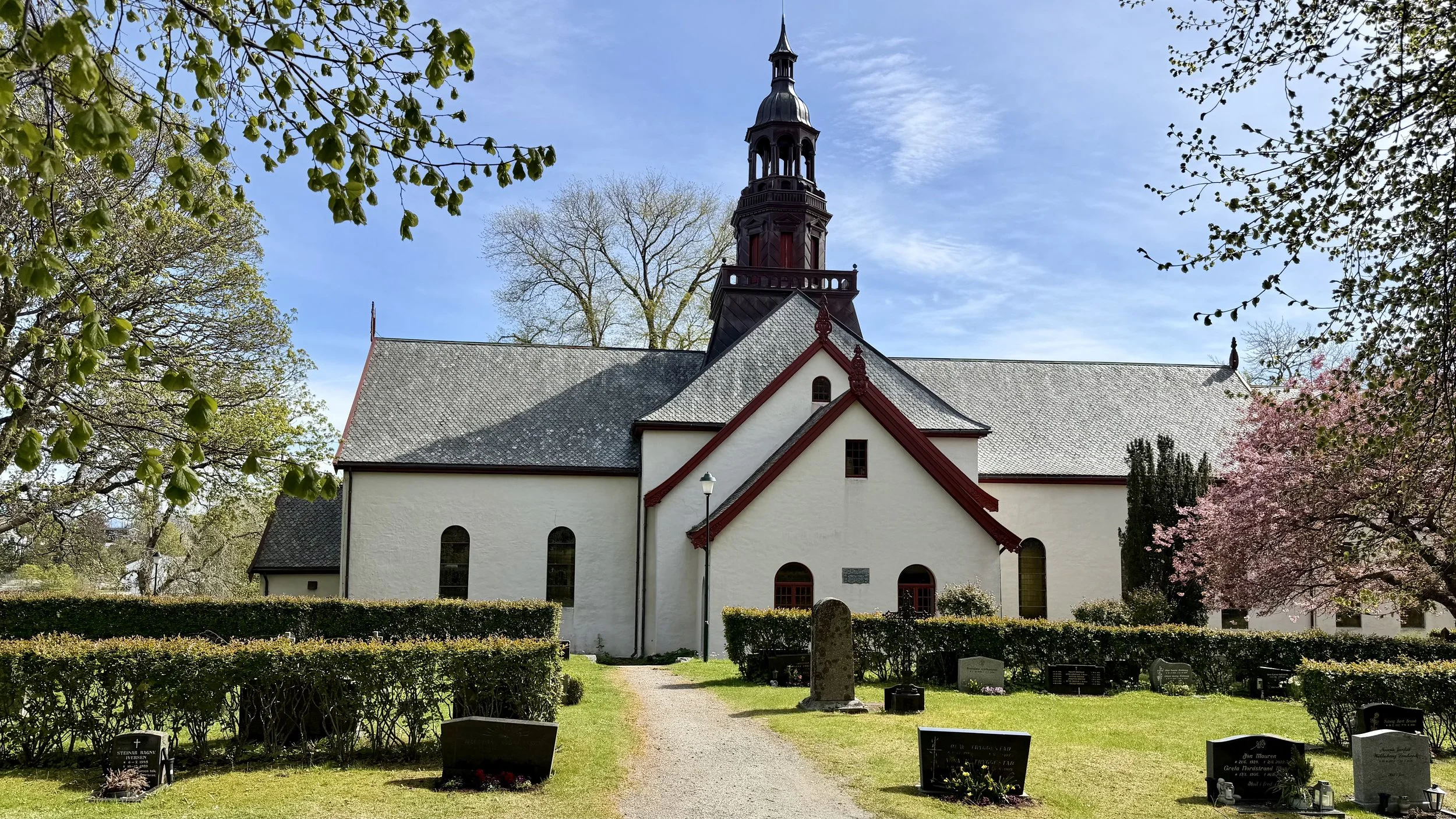
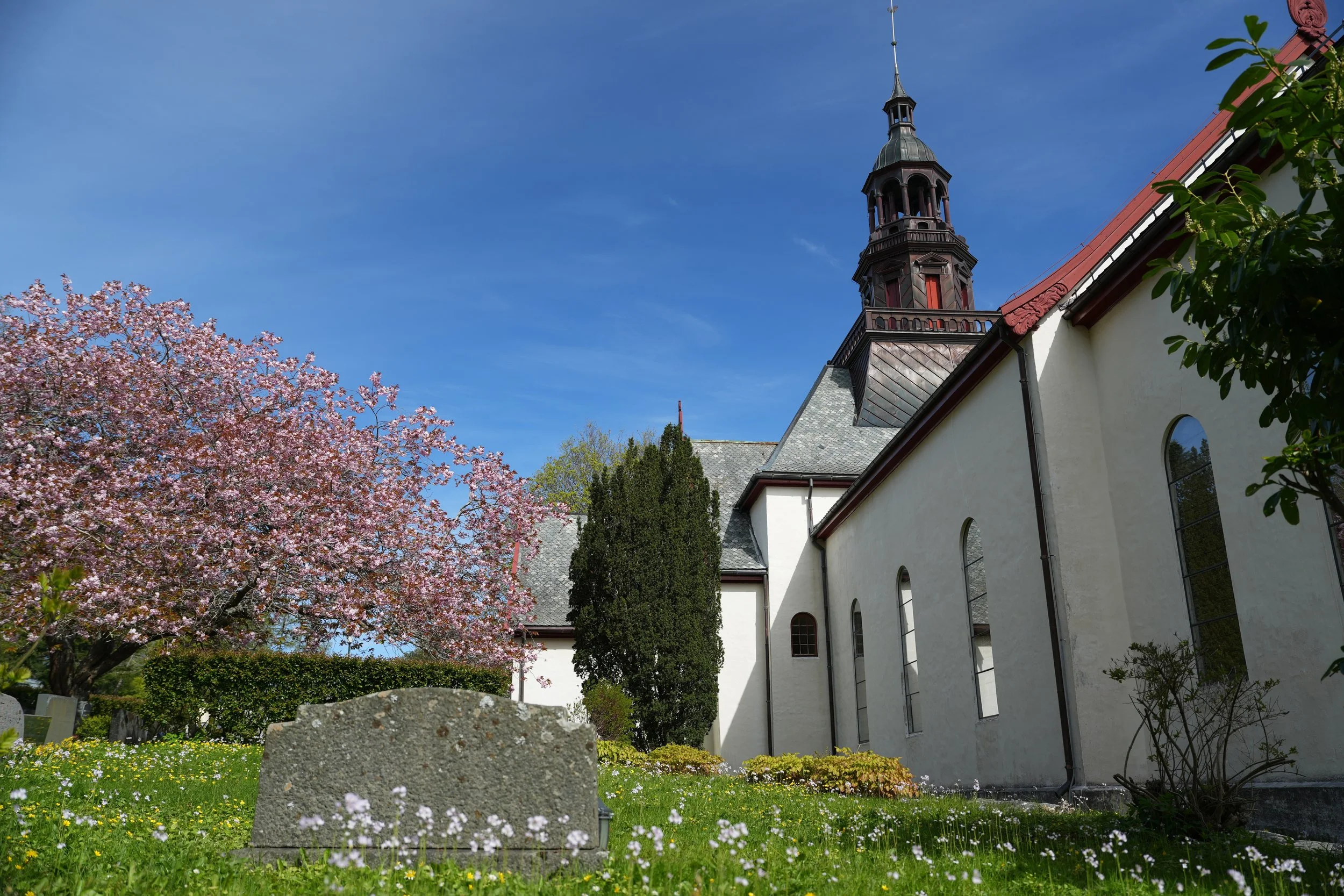
The church immediately caught the eye. White walls, dark timber details and a tall red-brown tower rising above the trees made it feel more dramatic than the small medieval church at Giske. Spring had arrived too. Pink blossom trees framed one side of the churchyard while sunlight lit the gravestones and lawns. It had that feeling Norway seemed to specialise in…. places that felt cared for without feeling overly polished.
From there we moved into the museum itself and the atmosphere changed completely.
Rather than a traditional museum of display cases and information boards, Sunnmøre felt more like walking through a small historic village. Buildings had been gathered from across the region and reconstructed here, creating a picture of life as it once was along this rugged coastline.
Small wooden houses lined narrow tracks and many had traditional turf roofs where grass still grew overhead. Some stood directly on stone supports, raised from damp ground in a practical design that had survived centuries.
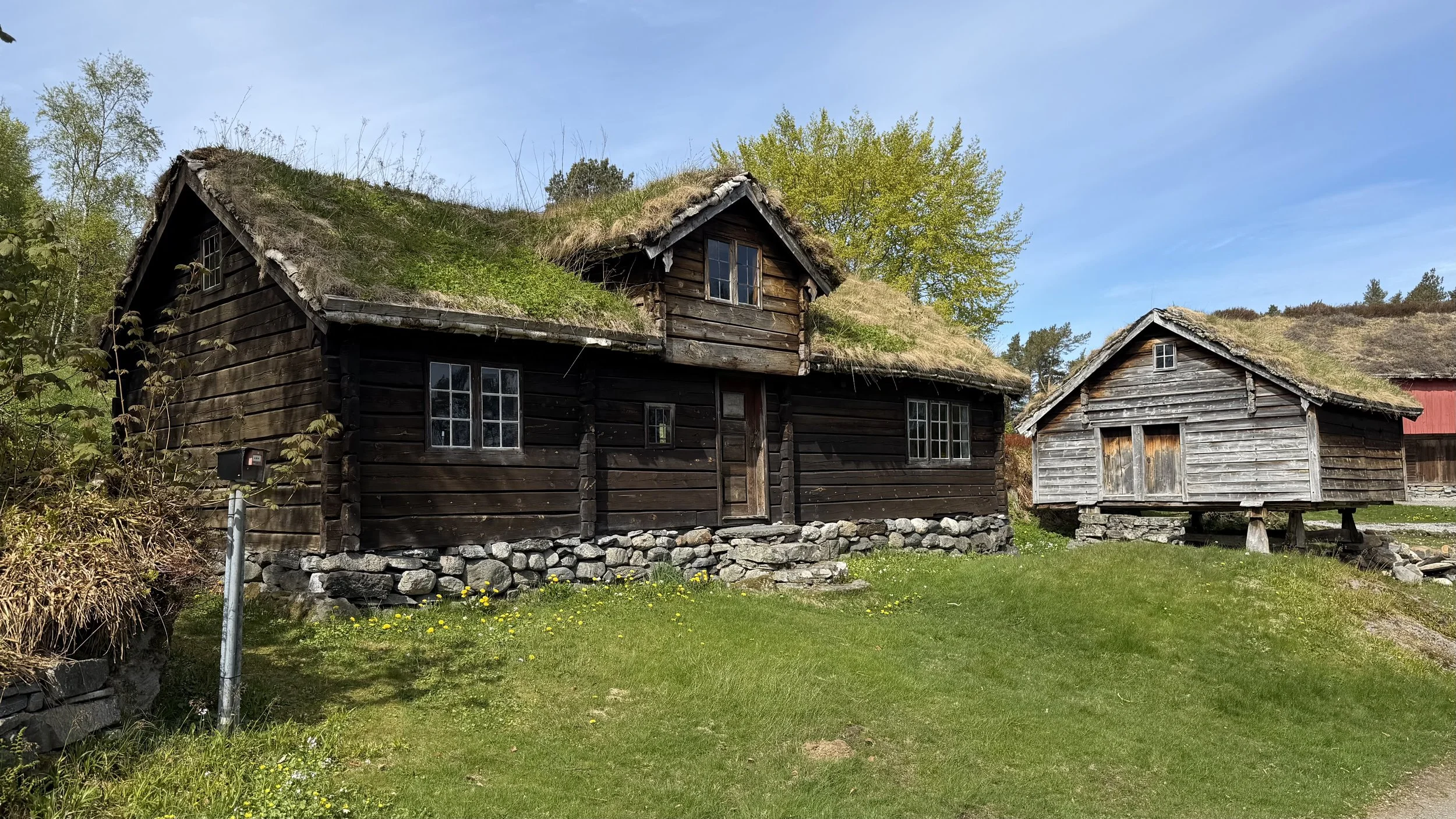
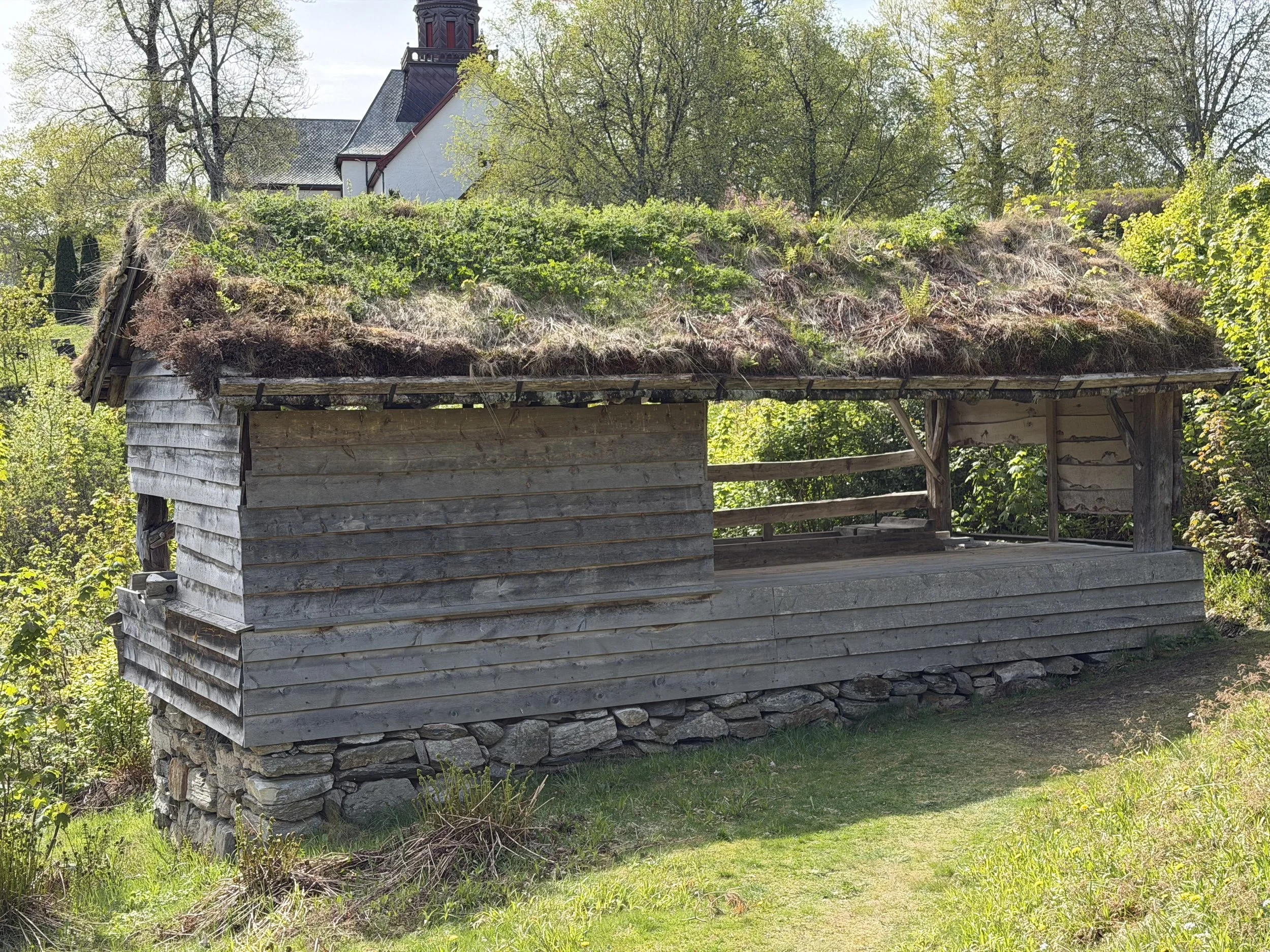
Inside one building we climbed into dark timber rooms where thick beams crossed overhead and daylight entered only through small windows. Long wooden benches and simple tables filled the room. Looking around, life suddenly felt very stripped back. No decoration for decoration's sake, just practicality and survival.
The timber itself seemed to tell a story. Walls blackened with age, worn floorboards and beams smoothed by generations of use. It was difficult not to imagine long winters spent indoors with little more than firelight and company.
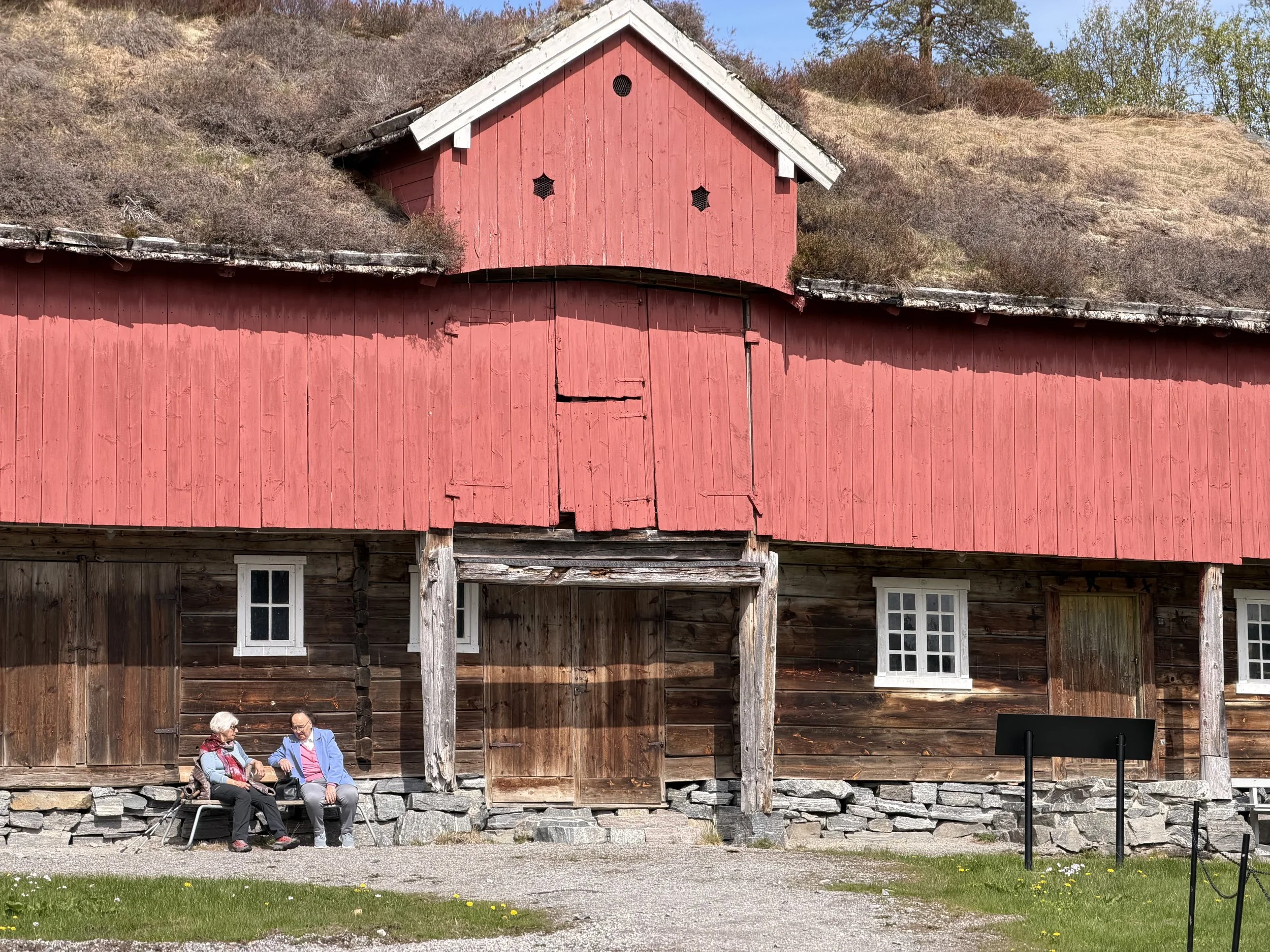
Elsewhere stood larger barns and storage buildings, including one painted deep Norwegian red beneath a grass-covered roof. Some looked as though they had grown out of the landscape itself.
One of the most interesting buildings housed a traditional wooden boat beneath soaring timber beams. Sitting alone in the centre of the hall, it reminded us that life here had always depended on the sea. These islands and communities were connected by boats long before roads and bridges arrived.
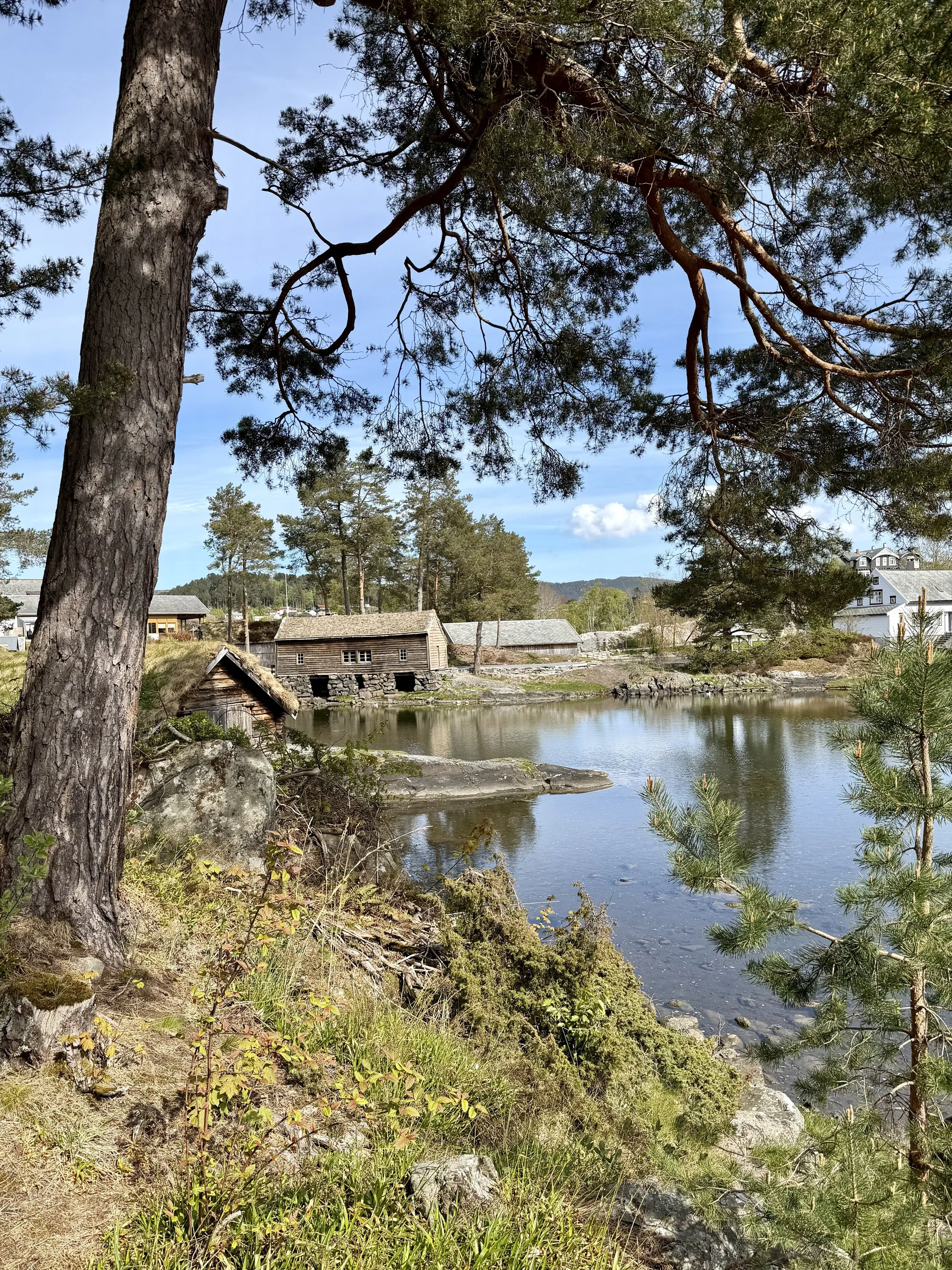
Outside, the museum opened into wider views across ponds and water, framed by pine trees and old buildings reflected in the still surface. Looking across the scene it felt less like a museum and more like a place quietly carrying on with its own life.
The View Everyone Comes For
Next Rolf took us up to Aksla Viewpoint, probably Ålesund’s most famous attraction. Some people climb the 400-plus steps to reach the top, but our minibus had one small advantage over the hop-on hop-off buses — it could take us right to the viewpoint itself.
Unfortunately the café and viewing platform were closed, which initially felt a little disappointing. But as often seems to happen on trips like this, plans shifted slightly and things worked out anyway. We scrambled carefully up over the rocks to find our own higher viewpoints and then spent time moving around the roadside, keeping half an eye out for traffic while trying to take photographs.
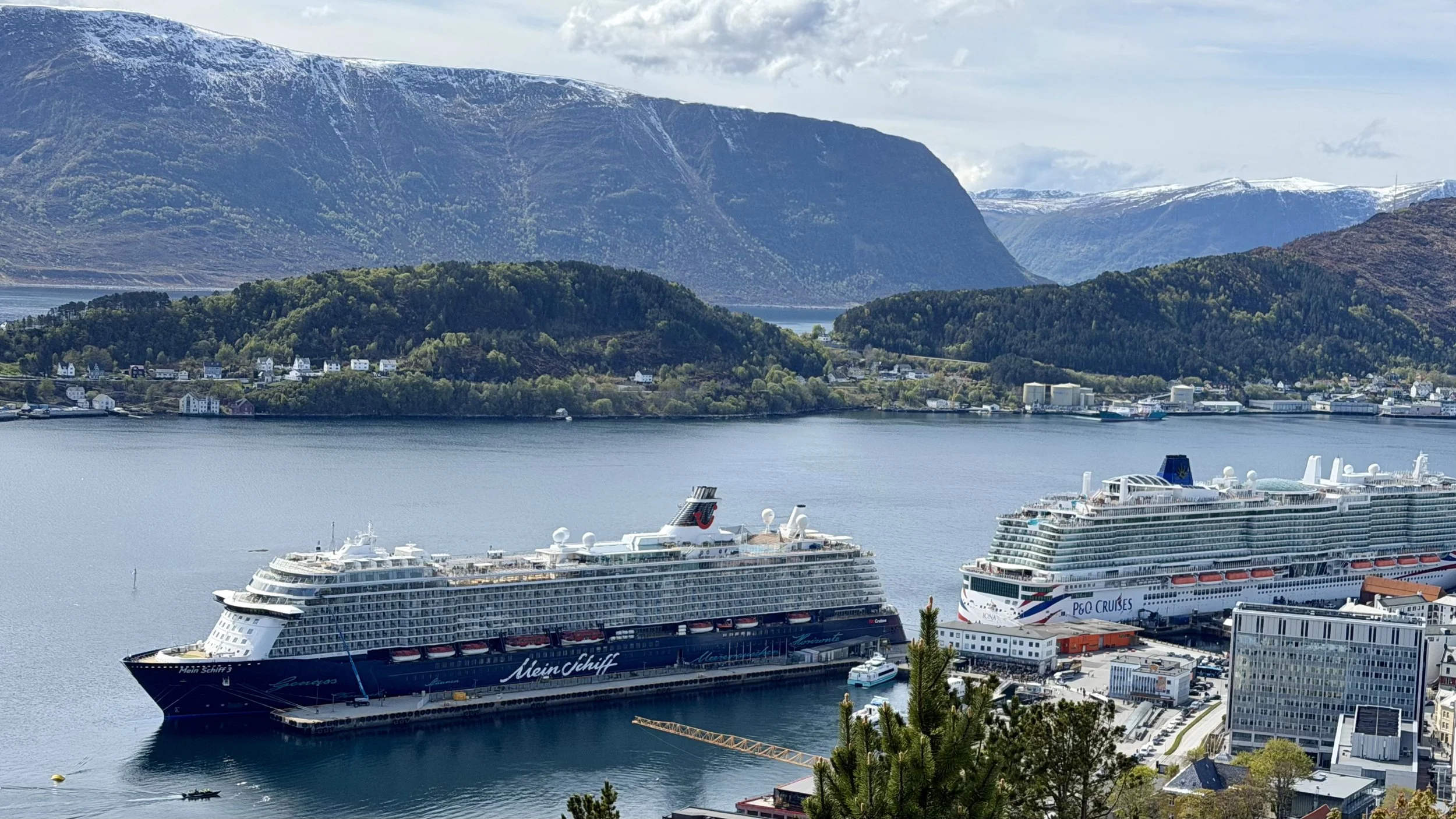
The views made the effort worthwhile. Below us Ålesund stretched out across its narrow islands, with its distinctive Art Nouveau buildings, harbour and waterways packed into the landscape. Two large cruise ships sat in port, suddenly looking far smaller than they had from deck level.
Beyond the town itself the views stretched much further. Snow still lingered on distant mountains while islands seemed scattered almost casually across the sea. Looking toward the horizon there was that familiar Norwegian feeling again — land and water woven together so naturally that it was sometimes difficult to tell where one ended and the other began.
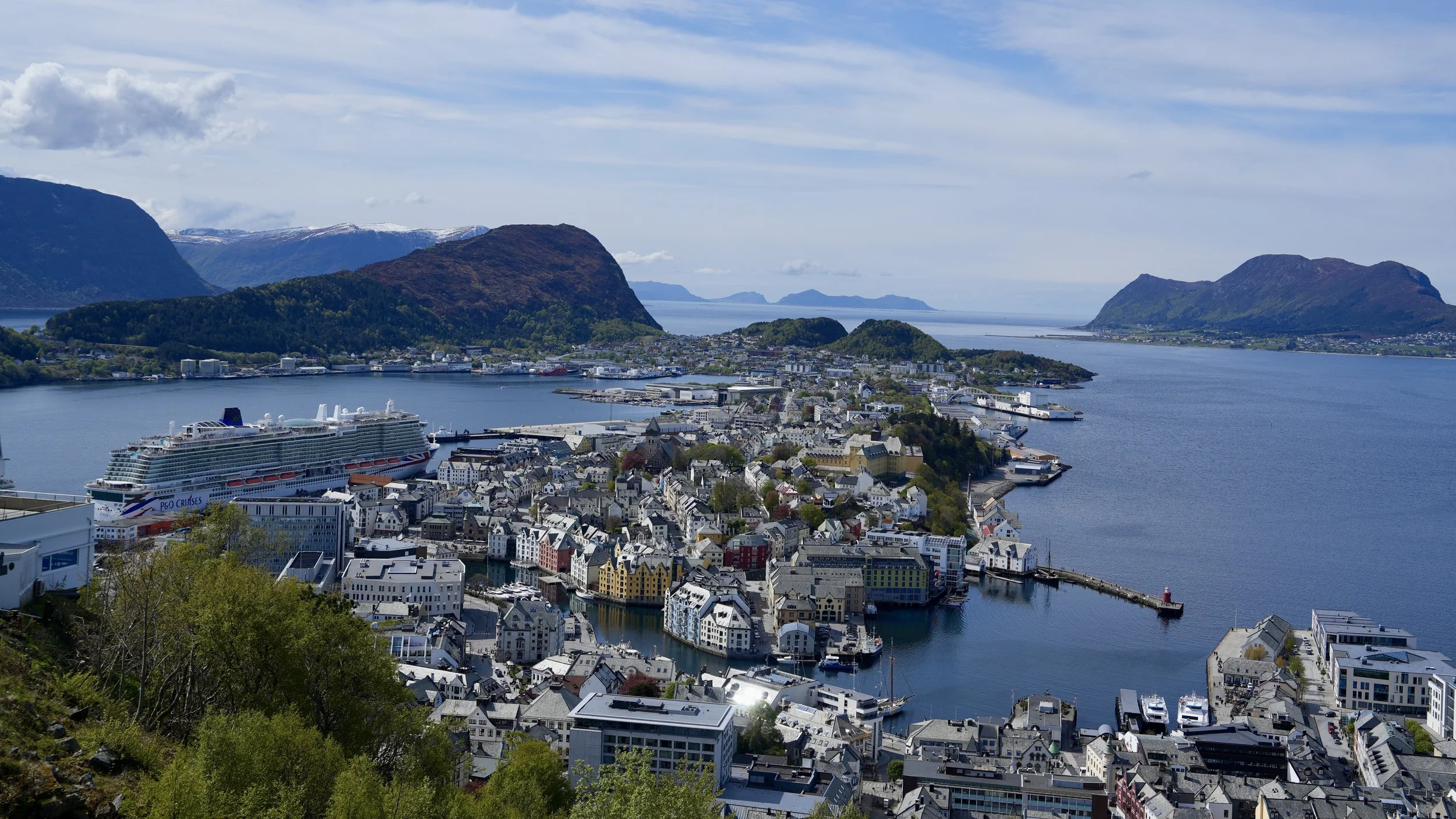
Out in the distance we could also pick out Alnes and Giske, places we had explored earlier in the day. Seeing them from above gave an entirely different perspective. Roads, bridges and islands that had felt separate while travelling between them now suddenly joined together into one wider landscape. It was one of those moments where the geography of a place finally clicks into place.
For somewhere so obviously designed as a viewpoint, it still managed to provide something more than a photograph. It gave us a chance to look back across the places we had already visited and see how they all fitted together. Sometimes that wider view tells you as much about a place as standing within it.
Hiding in plain sight
Next, and last on our tour, our guide promised us a location that almost everyone sees but surprisingly few people actually visit.
As we drove back into Ålesund we passed the familiar waterfront views seen on countless Facebook posts and cruise brochures, before pulling into an area tucked quietly beside the harbour. It turned out to be one of those places hiding in plain sight all along.
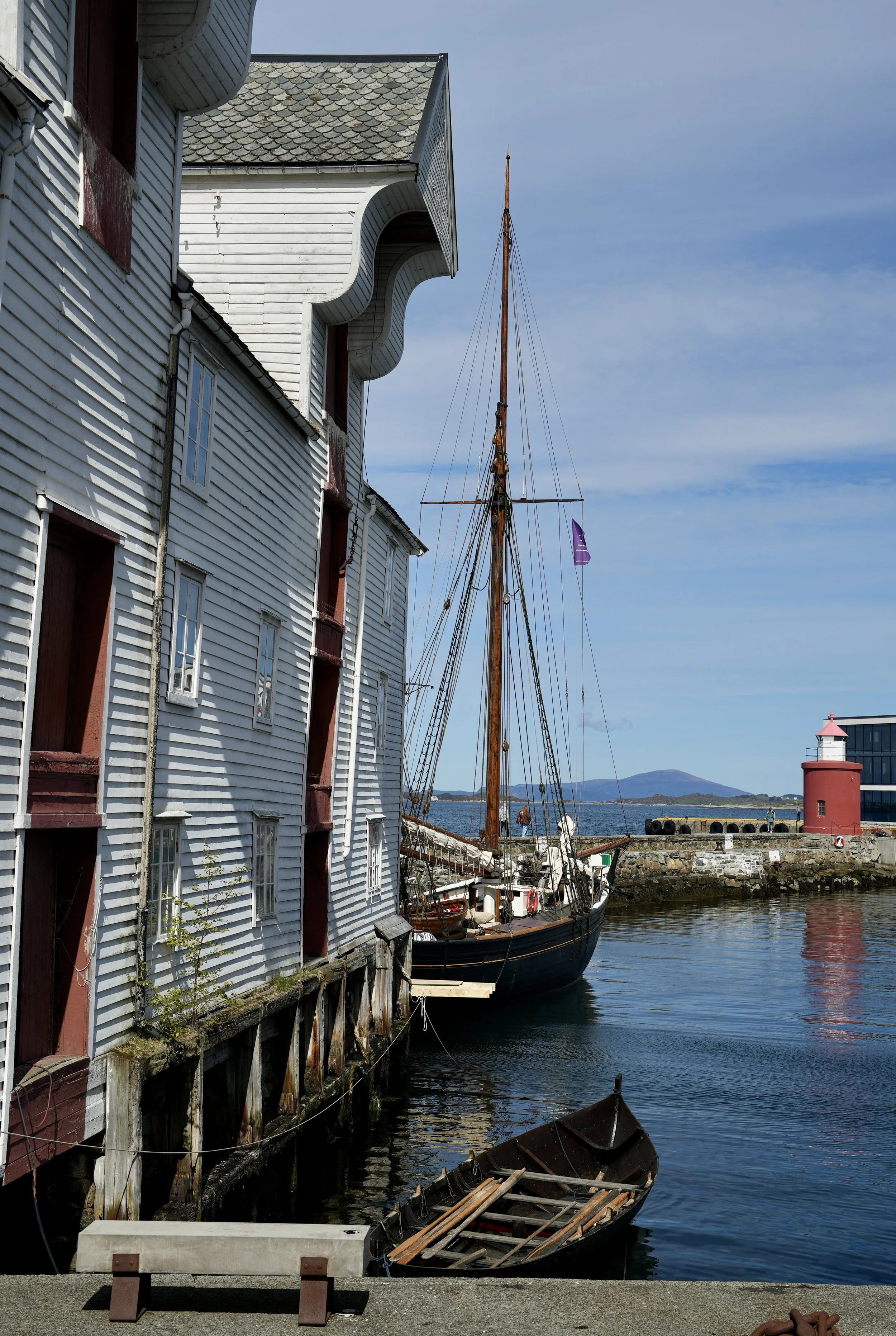
The area around the old warehouses and quays felt completely different from the busier parts of town. White timber buildings stood directly on the water’s edge, their weathered wood and distinctive curved rooflines reflecting Ålesund’s long maritime history. Some of the buildings appeared almost to rise straight out of the harbour itself, balanced on old timber supports darkened by decades of sea and weather.
Moored beside them sat a beautiful traditional sailing vessel, its tall masts and rigging creating a scene that looked almost unchanged from another era. Reflections moved gently across the water while a small red lighthouse stood at the end of the stone pier, adding one of those perfectly Norwegian touches that seemed almost too neat to have been designed.
Walking along the harbour wall there was a calmness to the place. A few people sat quietly looking out over the water while others wandered slowly with cameras in hand. Looking back across the harbour we could see Aksla rising above the town, with the viewpoint we had stood on only a short while earlier now perched high above us. Seeing it from below somehow made the climb over rocks seem slightly more ambitious than it had at the time.
What struck me most was the contrast. Across the water stood modern glass-fronted buildings beside historic warehouses, old boats moored beside newer vessels, and traditional harbour scenes sitting comfortably alongside a modern working town. Ålesund seemed remarkably relaxed about mixing old and new together.
After a day spent looking at Ålesund from beaches, churches, museums and mountain viewpoints, it seemed fitting to finish in a place hidden quietly at the water’s edge, somewhere many people see, but few visit.