Faith, Memory and Service in Amritsar
The Approach
Today was a highlight day on the tour, centred on Sri Harmandir Sahib, better known to many of us as the Golden Temple.
We drove the short distance from our hotel to the large white marble statue of Maharaja Ranjit Singh on Heritage Street near Chowk Phagwara. The monument is striking: the Maharaja cast in dark bronze, mounted on a rearing horse, sword raised, every inch the warrior-king who once ruled the Sikh Empire. Beneath him, tiers of intricately carved marble depict soldiers, courtiers and scenes of battle, the base alive with sculpted detail. Around it, the city carried on at full pace.
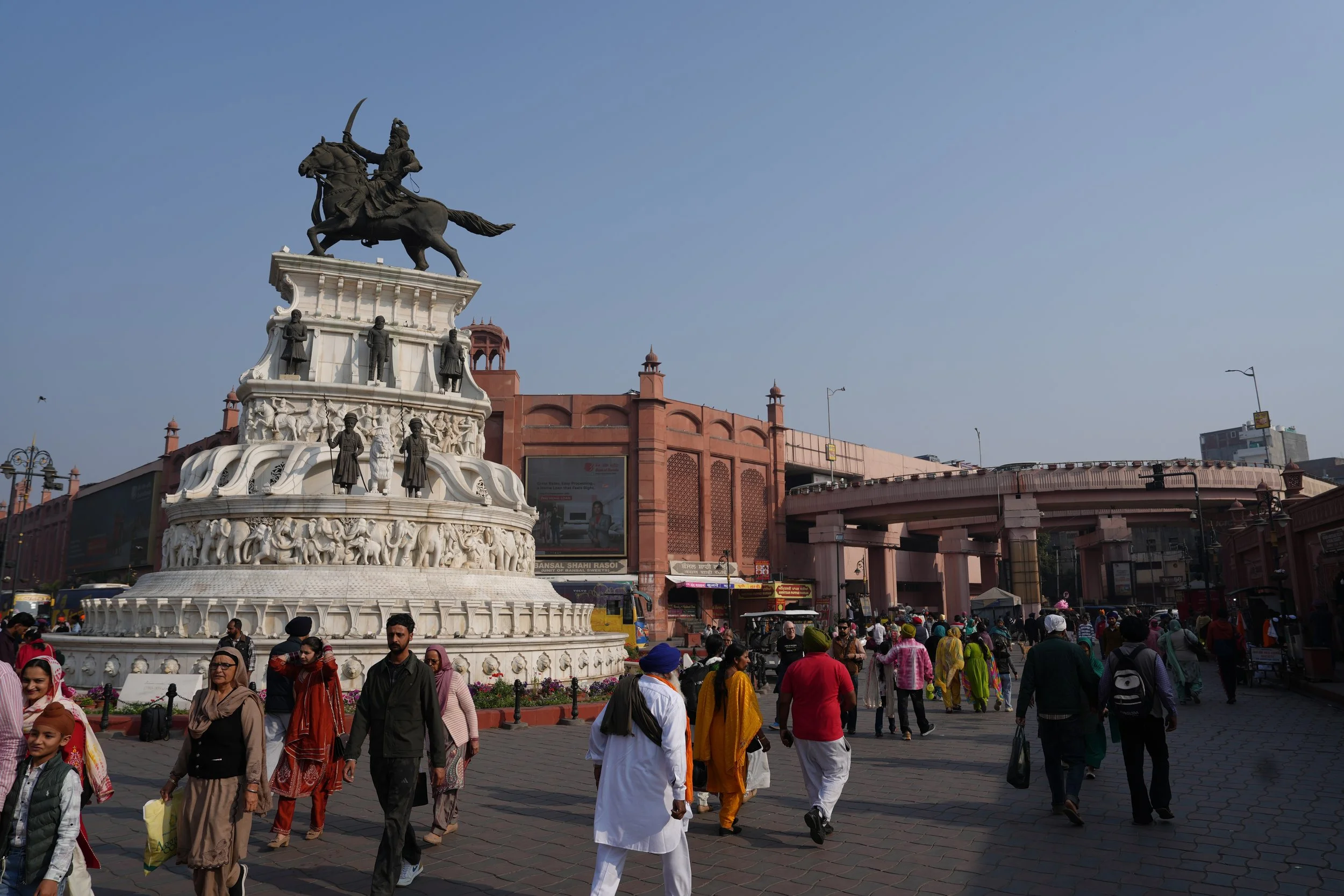
Large statue of Maharaja Ranjit Singh
The square was busy with pilgrims and visitors. Families in bright salwar kameez, men in colourful turbans, children weaving through the crowd, vendors calling out. Red sandstone buildings framed the scene while an elevated flyover carried traffic overhead. It felt like a meeting point between history and modern India.
From there we joined the steady flow along the wide pedestrianised Heritage Street towards the temple complex. Devotional music drifted from loudspeakers, a gentle soundtrack drawing everyone forward. The atmosphere was purposeful but calm. Some chatted; others walked in silence. Many were clearly on pilgrimage rather than sightseeing.
There was a sense of crossing a threshold. Beyond the statue lay not just an architectural landmark, but a place of deep spiritual significance for millions. Even before reaching the temple itself, it felt different — somewhere that mattered.
Jallianwala Bagh
Before visiting the Golden Temple, our guide led us down a narrow lane to Jallianwala Bagh, the memorial garden tucked behind the bustle of the city.
The entrance is modest, almost easy to miss, which somehow makes what happened there feel even more contained. Inside, the space opens into a calm park of lawns, trees and red sandstone structures. In one corner stands the tall, flame-shaped memorial rising from a shallow pool dotted with lily pads, its carved surface resembling folded hands in prayer.
At first glance it could be any city park on a warm morning. A large mango tree heavy with green fruit casts shade near the boundary wall. Families sit chatting; children lean over railings to look at the water. The ordinariness is unsettling once you know the history.
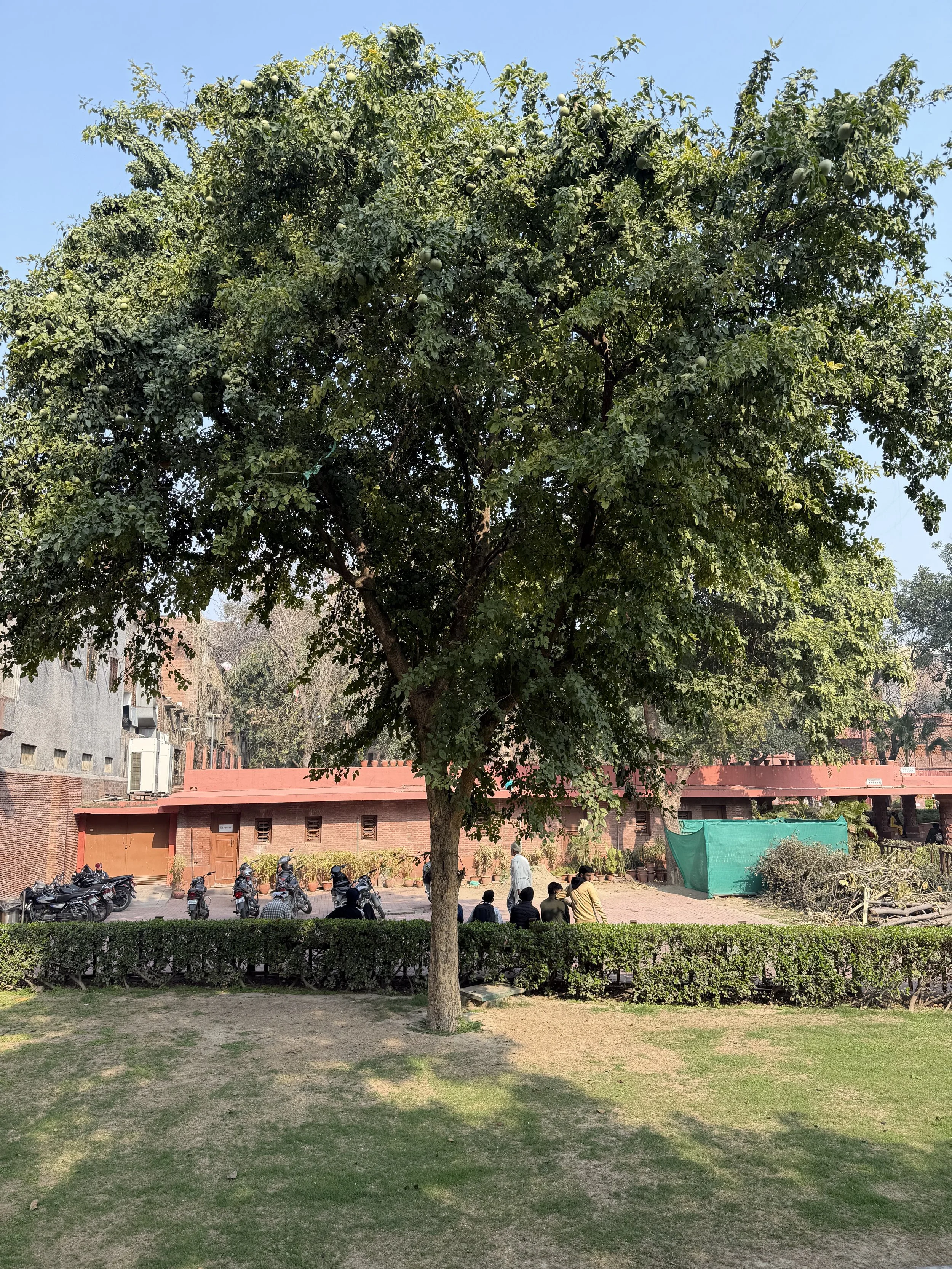
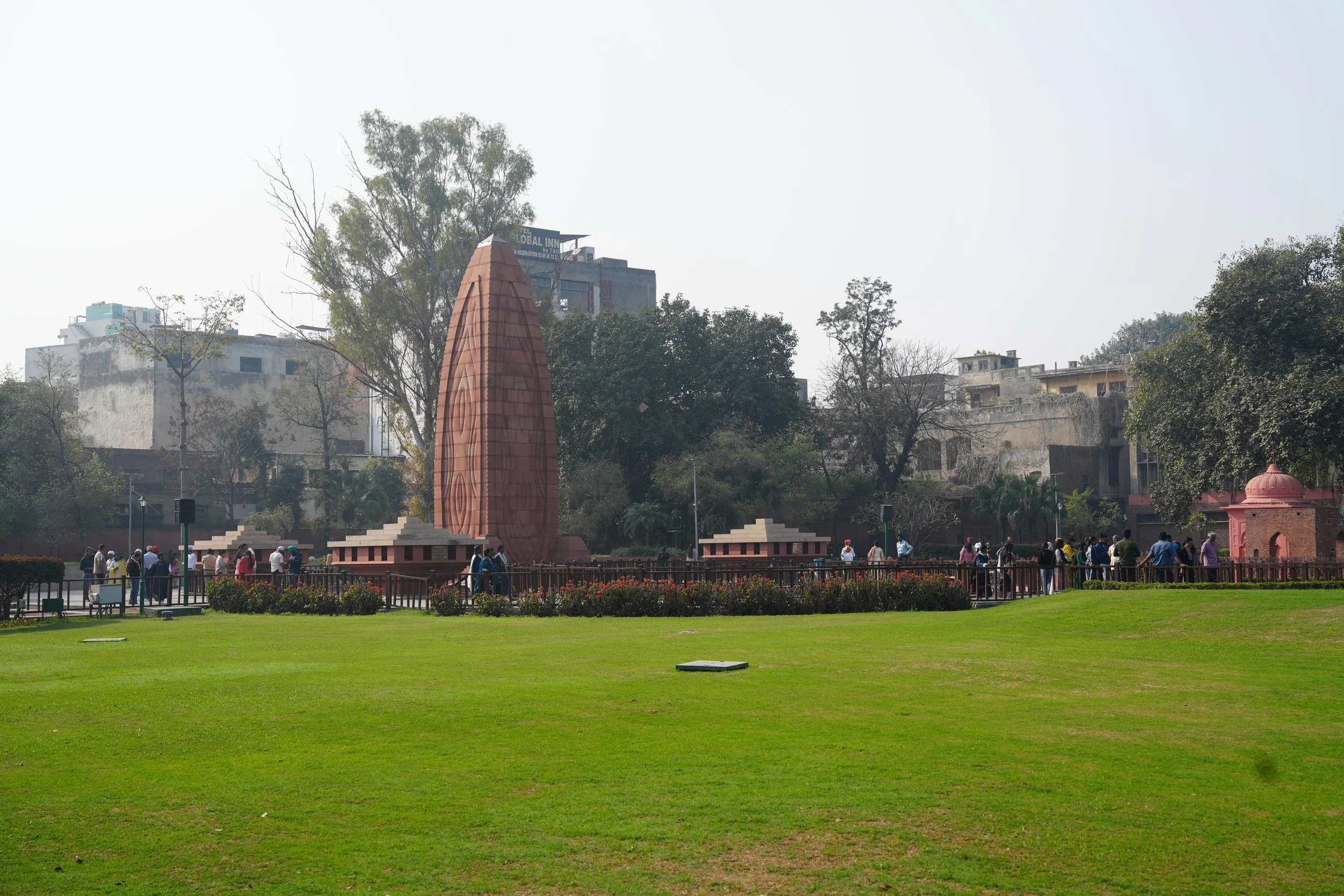
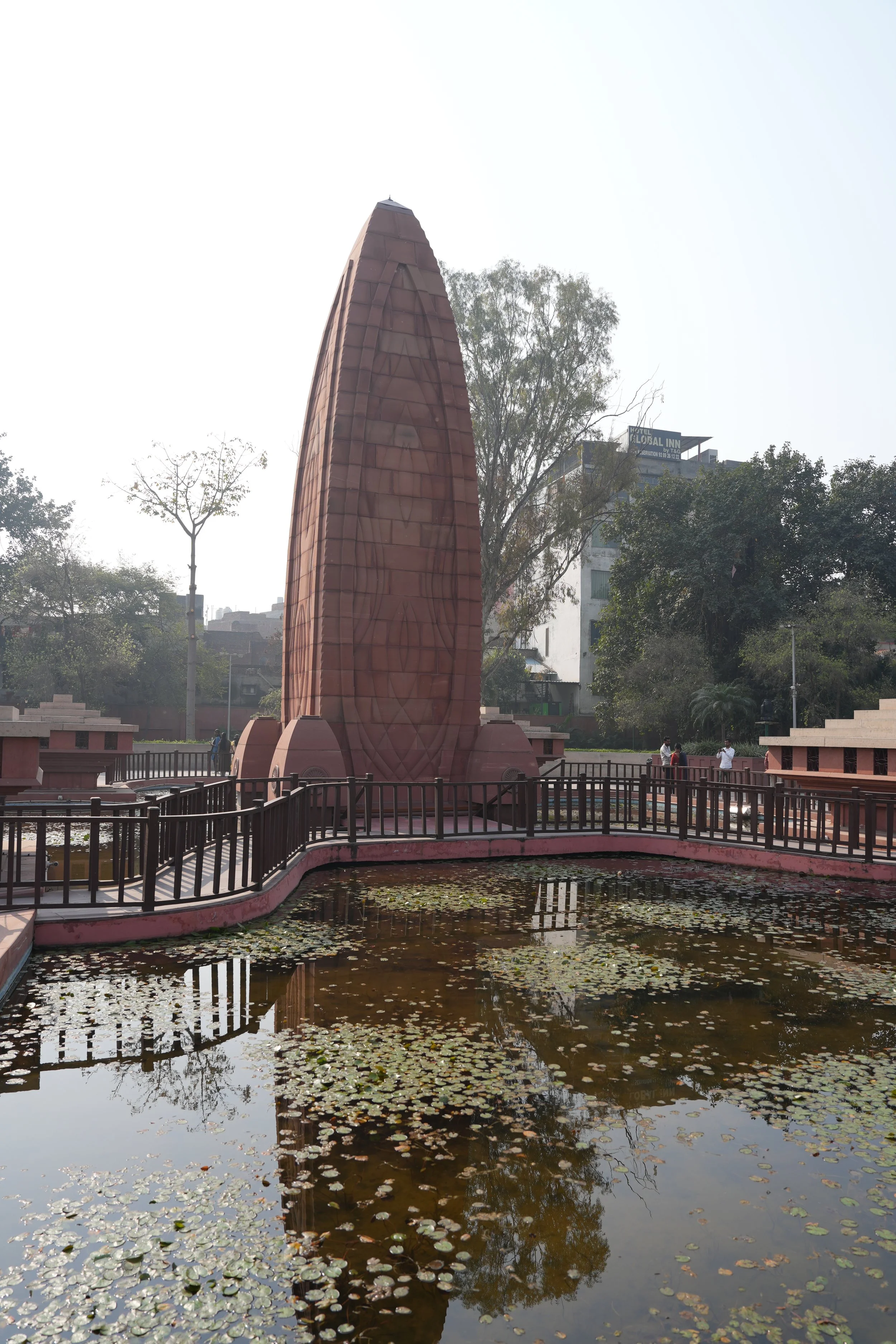
On 13 April 1919, during Baisakhi, thousands gathered here peacefully. Brigadier-General Reginald Dyer entered with troops and, without warning, ordered them to fire. With exits blocked, people were trapped. Official figures recorded hundreds killed; Indian estimates were far higher. The firing continued for around ten minutes. Our guide spoke with visible emotion, describing people jumping into the well to escape bullets, families torn apart, and the shock that reverberated across Punjab.
As a British visitor, the knowledge sits heavily. History read in books feels different when standing on the ground itself.
Like at Auschwitz, it felt uncomfortable at first to raise a camera. Yet around us, local visitors were enjoying the sunshine, taking photographs, chatting. Life continues, even in places marked by tragedy. Perhaps remembrance is not silence alone, but resilience.
Before leaving, we gathered for a briefing on Sikhism: belief in one God, equality of all people, honest living, service to others, and continual learning. Standing in that park, shaped by injustice and resistance, those principles felt especially powerful.
We tied on our orange head coverings and walked back towards the temple complex carrying a growing sense of anticipation.
The Golden Temple
In the square before Sri Harmandir Sahib we removed our shoes and stepped barefoot onto the warm marble. The white façades around us were intricately carved, scalloped arches stacked above one another, jali screens filtering the light. Ahead, a clock tower rose above the complex.
Before entering the parikrama, we walked through a shallow channel of running water. It cooled the dust from our feet and felt symbolic too — a small reset before stepping into somewhere sacred.
Then, almost suddenly, the temple came fully into view.
Across the Amrit Sarovar, the Harmandir Sahib shimmered in gold. White marble at the base, gilded panels above, domes rising tier upon tier. The main dome, shaped like an inverted lotus, glowed against the pale sky. The building seemed to float, its reflection rippling gently in the green-tinged water.
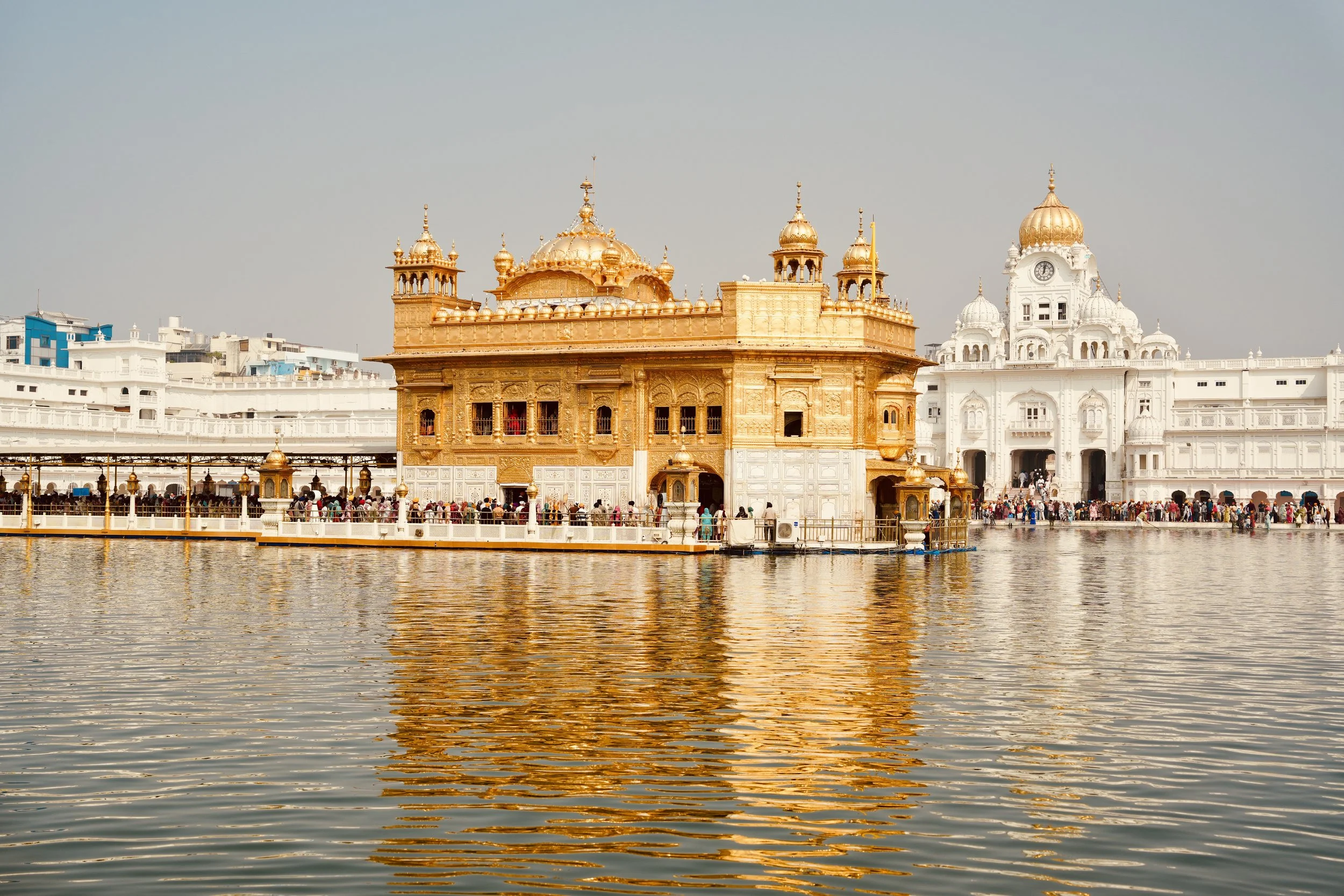
Harmandir Sahib “Golden Temple”
Everyone around us paused. Phones rose instinctively. There was a collective intake of breath before the gentle jostling resumed.
We joined the slow clockwise circuit around the sarovar. Thousands were present, yet it felt remarkably ordered. Volunteers in dark uniforms and bright turbans stood watchfully, guiding the flow. Men in deep blue and saffron turbans, women in vibrant dupattas, elderly couples moving carefully, children darting between adults.
Along the water’s edge some pilgrims knelt to touch the surface; others descended the steps into the sarovar. One man stood waist-deep in prayer, the golden temple reflected behind him. Families helped older relatives bathe, cupping water gently over their heads.
Despite the numbers, there was no sense of chaos. The principles we had just heard about — equality, humility, service — felt visible in the way people moved and made space for one another.
The Langar Kitchens
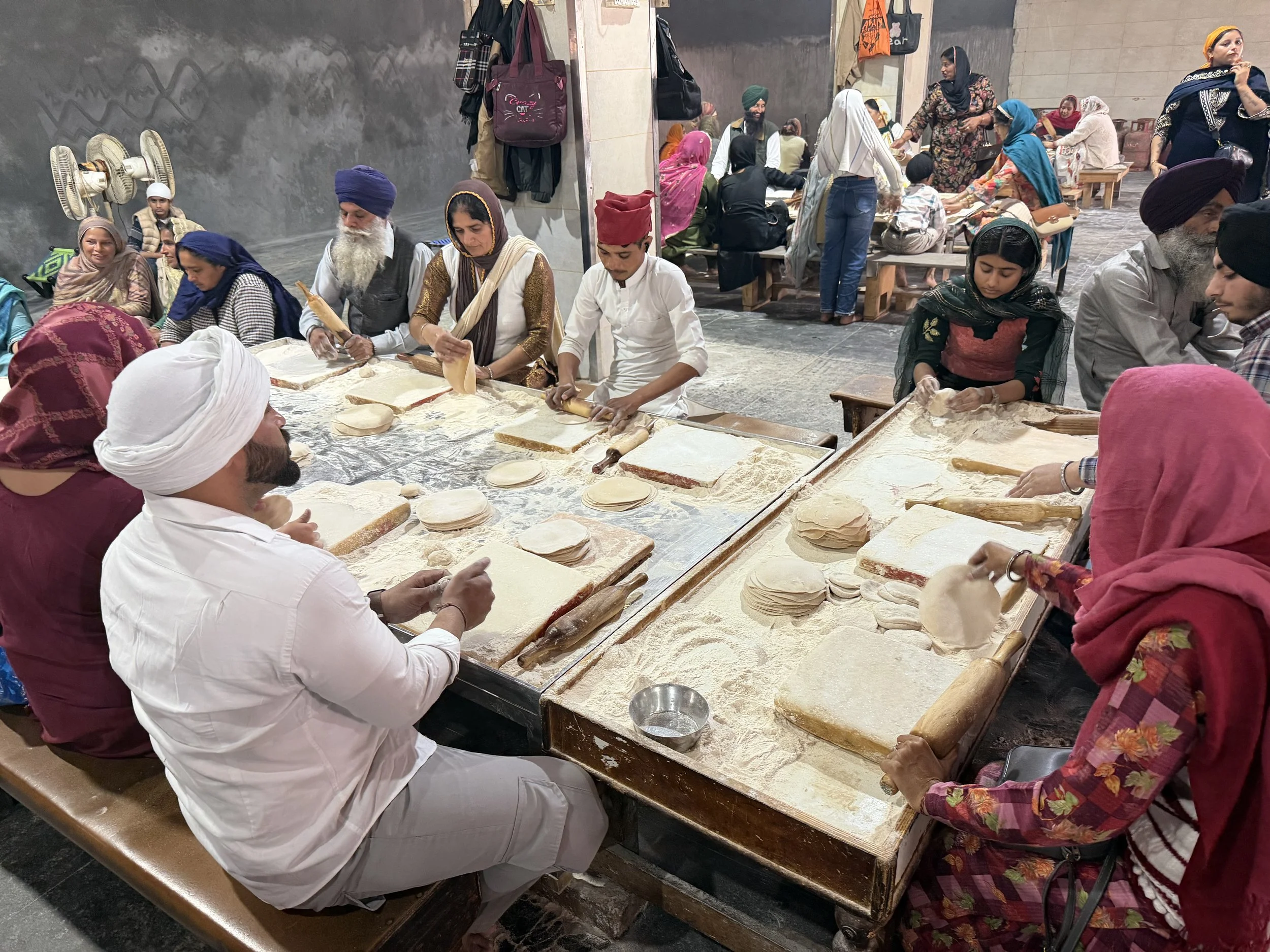
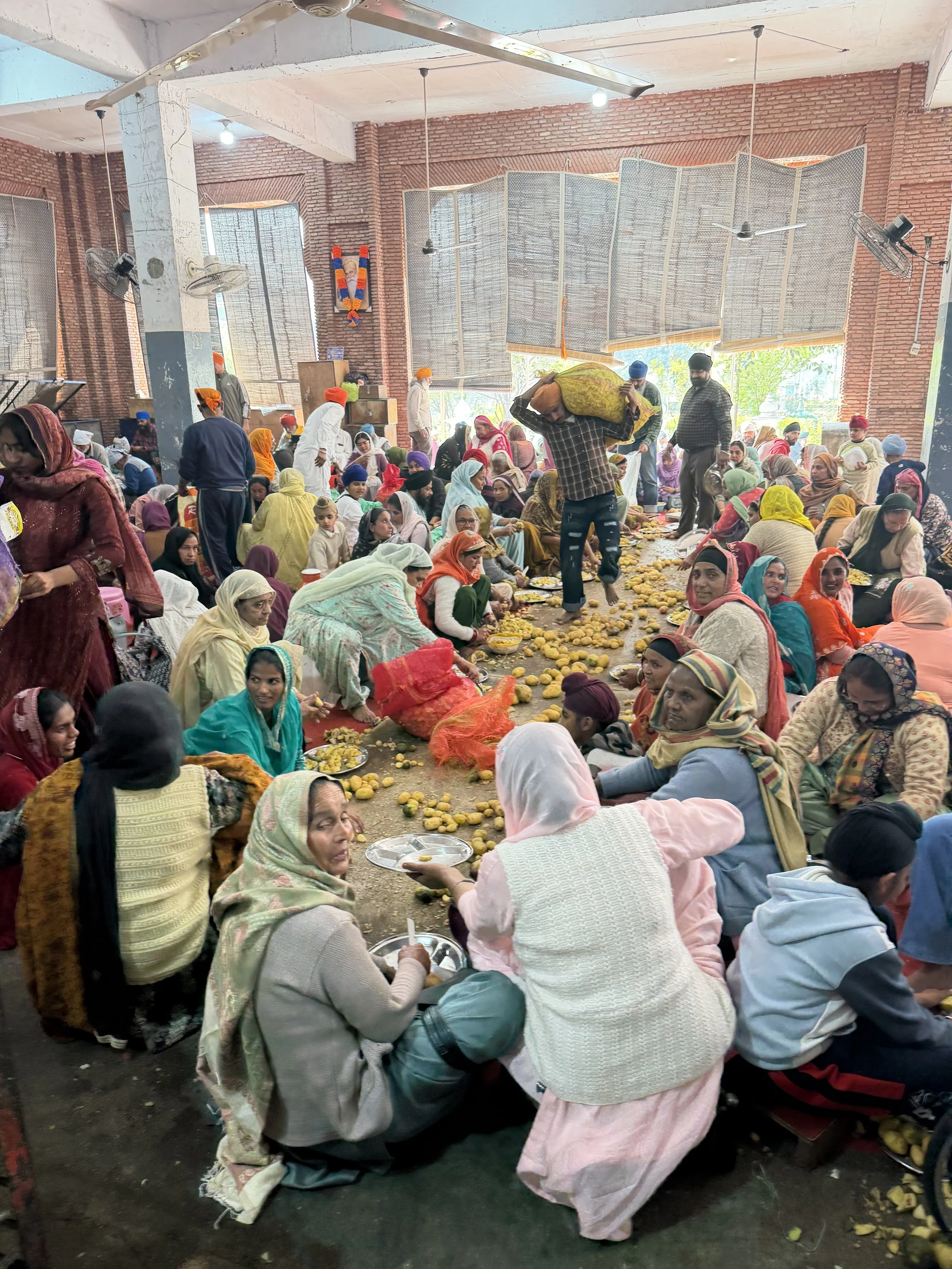
Behind the marble walkways lie the vast kitchens of Sri Harmandir Sahib, home to one of the largest free community kitchens in the world. Through the tradition of langar, tens of thousands are fed each day without charge, regardless of faith or background.
The scale is extraordinary.
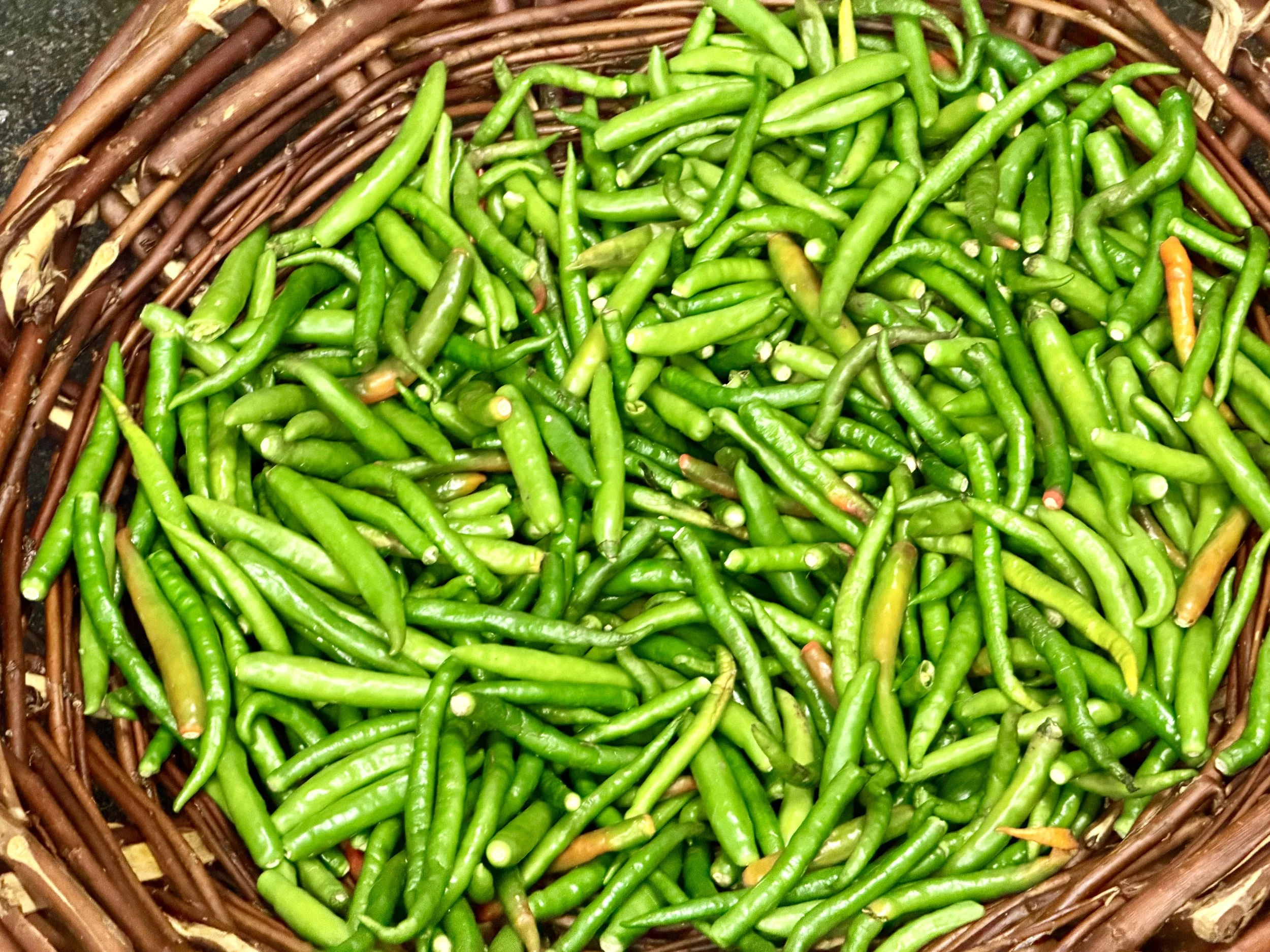
In preparation rooms, groups of volunteers sat cross-legged around flour-dusted tables rolling out chapatis. Neat stacks built steadily. Children helped, proudly flattening imperfect circles of dough. In another corner, women peeled and chopped vegetables, ginger prepared for the daal, sacks of produce stacked against the walls.
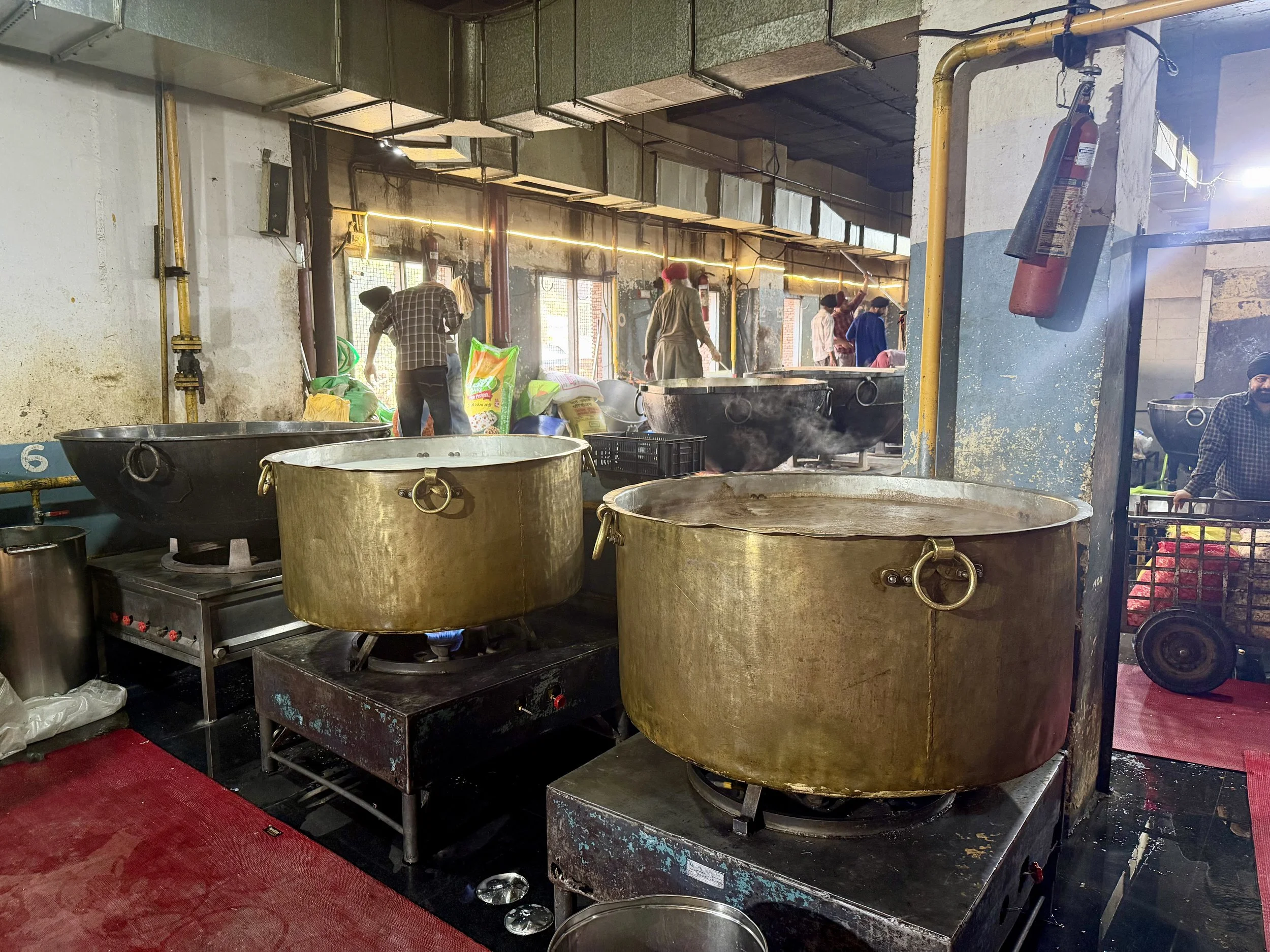
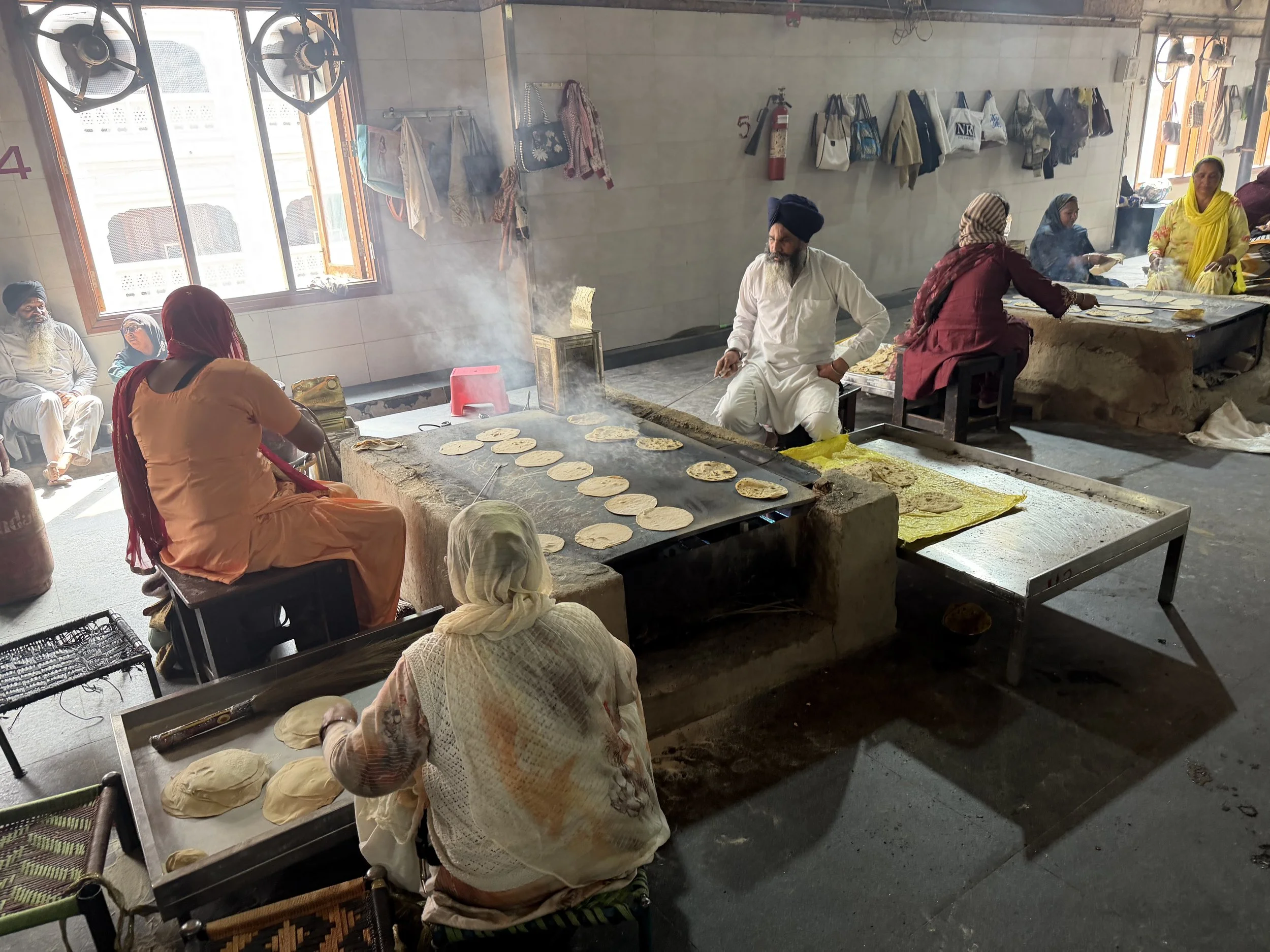
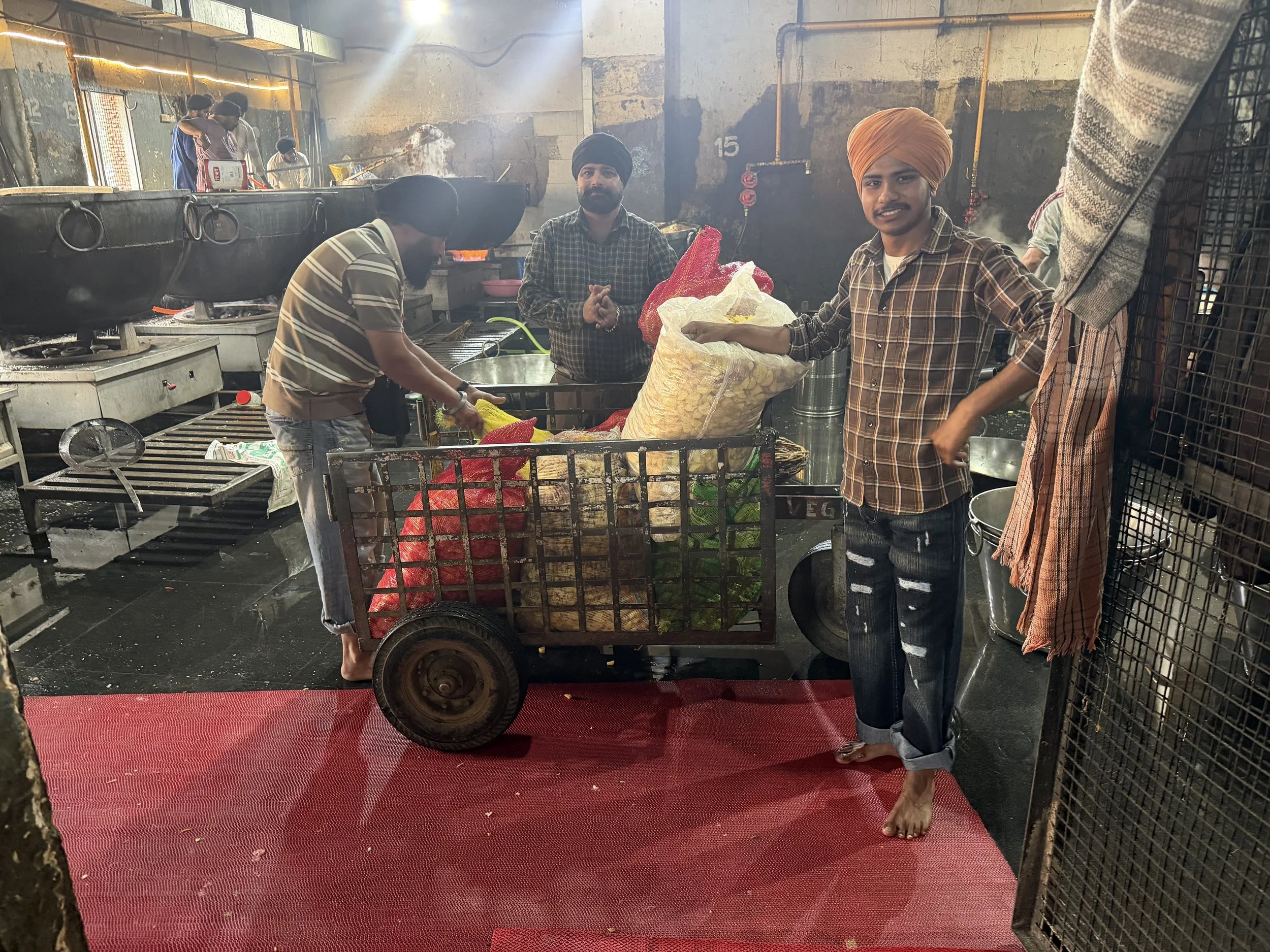
In the cooking area, enormous brass and steel cauldrons simmered on industrial burners. Steam rose in thick clouds from vats of lentils. Roti cooked in long lines across iron griddles. The air was warm, heavy with spice and wood smoke.
In the dining halls, rows of people sat cross-legged on mats with stainless steel trays before them. Volunteers moved briskly along the lines, ladling daal, handing out roti. No distinction between rich and poor, local and tourist. Everyone seated at the same level. Everyone served the same meal.
In the washing area, metal trays clattered in a rhythmic, almost industrial chorus. Water splashed across stone floors. Stacks of plates moved along like a production line. Loud, chaotic, yet purposeful.
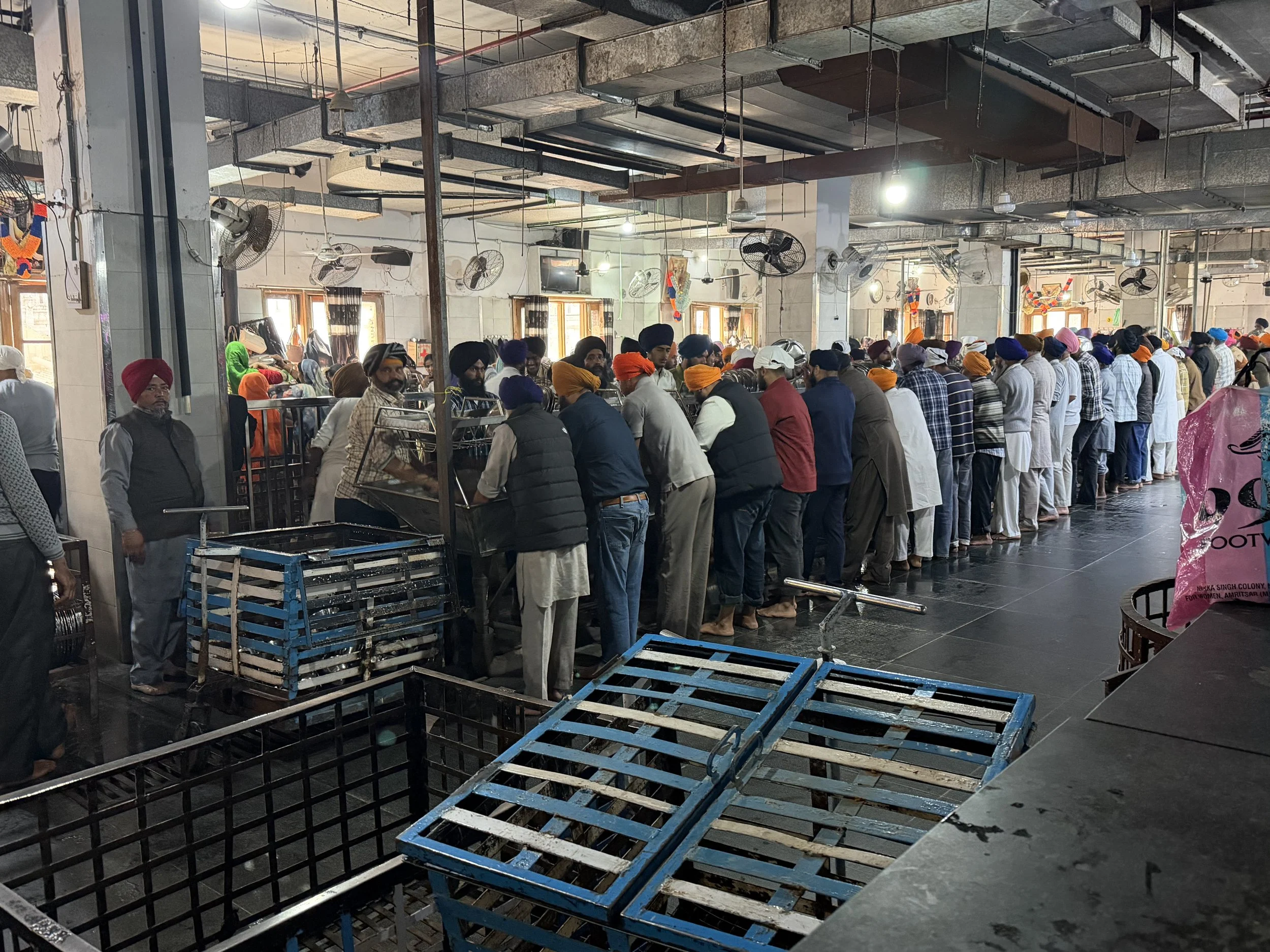
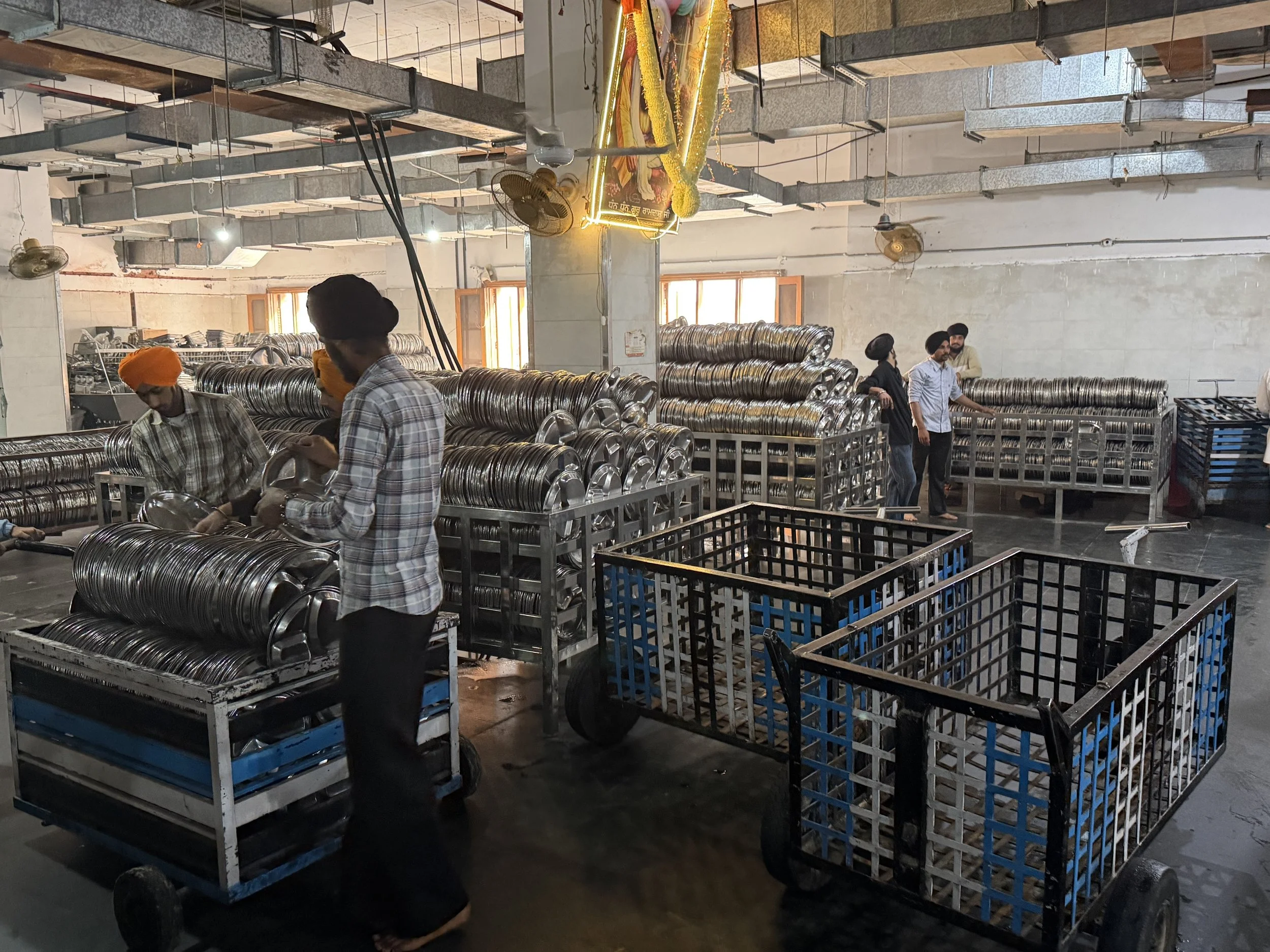
Here, equality was not abstract. It was practical. Flour on hands. Steam rising. Strangers sitting side by side sharing a simple meal.
Part of Someone Else’s Story
After the kitchens we completed the circuit at our own pace.
By midday the marble was warm but not yet scorching. Under temporary canopies, hundreds of pilgrims sat cross-legged on red patterned carpets facing a marble façade. Some bowed their heads; others sat quietly with eyes closed. We did not fully understand the timing, but there was clearly a rhythm to the day.
Then the requests began.
Family groups approached politely, smiling, asking for photographs with us. We had been warned, but it still felt surreal. At just under 6’5”, my height was clearly the attraction. I stood there in my orange headscarf while phones were passed around and children were nudged forward. A few touched our feet in a traditional gesture of respect towards elders.
It was good-natured and warm — but undeniably a culture shock. For a moment, we were no longer observers but part of someone else’s story.
Further along, the long queue to enter the sanctum moved slowly across the causeway. No pushing, no raised voices — just steady progress.
Nearby, a group of Sikh musicians sang devotional hymns into microphones, harmonium and percussion carrying across the courtyard. People sat listening, some swaying gently.
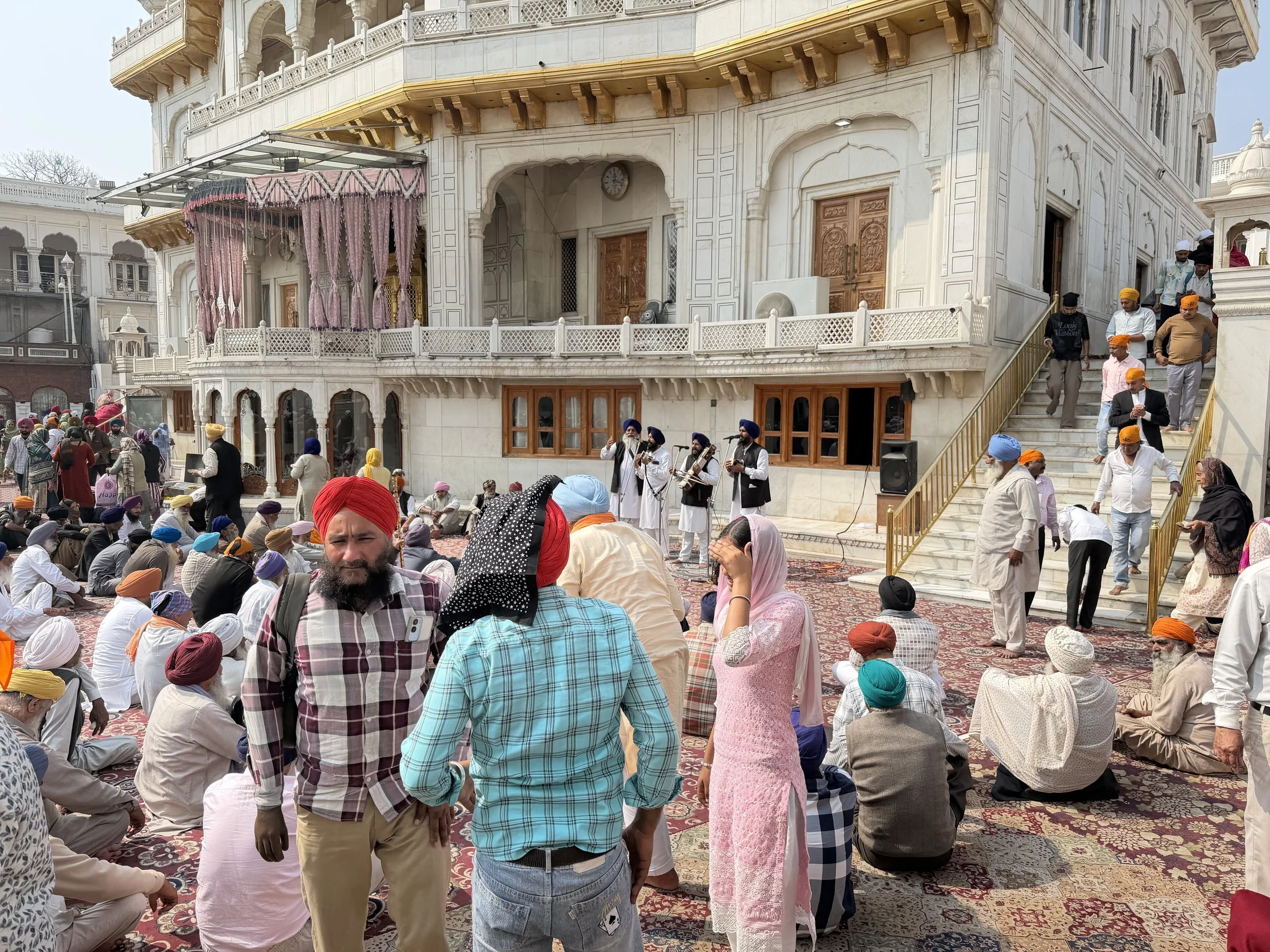
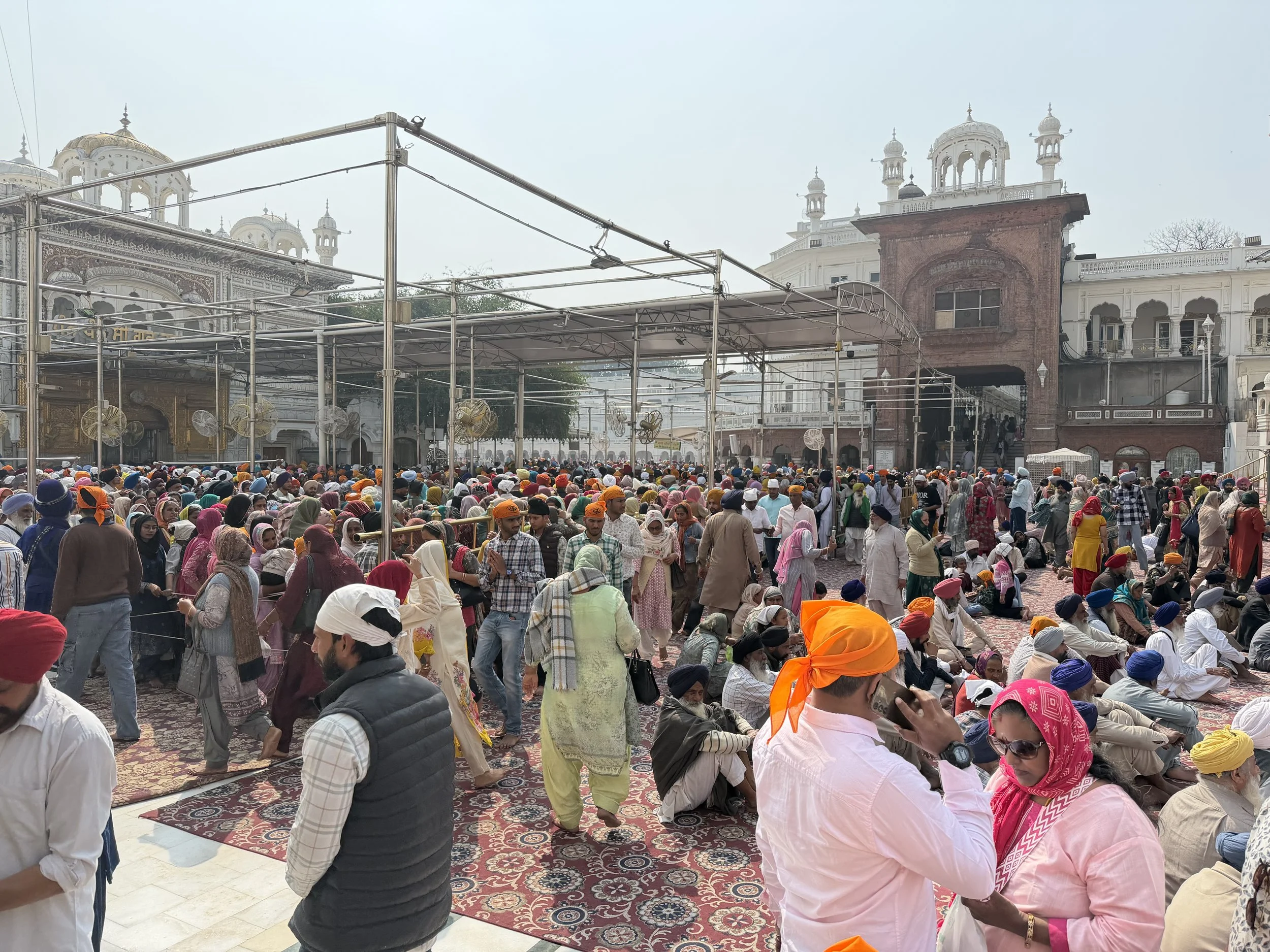
And then, almost without noticing, the circuit was complete.
We stepped once more through the shallow water channel, retrieved our shoes from the vast racks, and tied them on.
Crossing back onto the street felt abrupt. Traffic noise. Vendors. Ordinary conversation.
Inside those white marble walls there had been a different rhythm — one shaped by devotion, generosity and quiet discipline. Stepping back into the city, it was hard not to feel that we had briefly inhabited another pace of life before returning to our own.
In Jallianwala Bagh we had stood in a place marked by imperial violence.
In the Golden Temple we had witnessed discipline, humility and service on an extraordinary scale.